
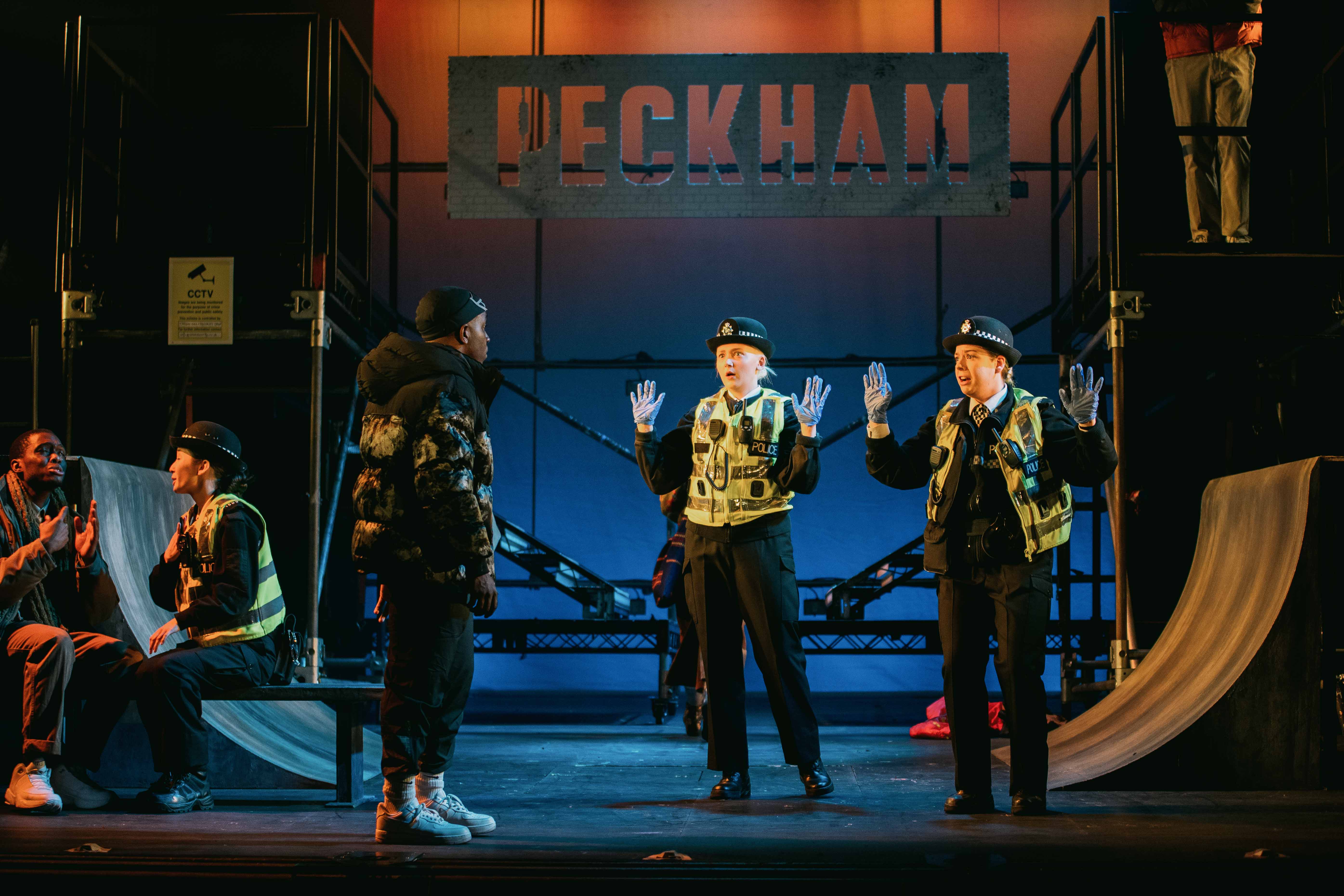
Drama and comedy merge in this staggering portrayal of everyday life and social struggle. Guillermo Nazara shares his thoughts on the National Youth Theatre company’s latest production, to let us know more about a play where true love comes from within.
Don’t believe everything you think. If only I could do the latter… Well, work-in-progress here. But it’s funny how even our deepest convictions can easily stab us in the back. Contradictions are not just something the greatest advocates of moral virtue (aka online haters) are experts on, it’s actually what defines human nature. Sometimes it can be our passion that blinds us; some others, our determination not to look in one particular direction. But it’s precisely on those situations where, sooner or later, there comes a sign (usually shaped as a work of art) to open our eyes.
Gone Too Far does not do justice to its title. It’s not excessive, it’s not overwhelming. It’s just the right balance. Set in nowadays South London’s neighbourhood of Peckham, Bola Agbaje’s play is an ingenious multi-angle observation on our modern society’s zeitgeist. The script follows the story of two brothers: the younger one, a London-born teenager who’s turned his back on his African heritage, with a bitter vision of what life means in the UK for him and his people; the eldest one, recently arrived from Nigeria, a background he holds with great pride, just as much as his passionate hope for what fate will bring him now in Great Britain.

Plays (or any piece of fiction) dealing with social problems usually fall into either of two boxes: the preachy ones (obsessed with brainwashing you with their mantras) and the shallow ones (unable to move even those who cry with Peppa Pig’s demise). The fact that Gone To Far does not align with neither of which is just one more trait of its uniqueness. The play is as convoluted as life itself. It’s plain but complex, it’s messy but organised in its own way. It follows a path – the path of reality.
There’s no good or evil properly defined in this plot – or perhaps they’re not often defined as properly as in this one. Don’t worry, you’ll certainly find a few bad guys to hate (it would be cruel not to give you something to feel angry about), but unlike many other tales, those who act bad have a reason for it. It may be wrong, it may be unjustified, it may be even heinous and deserving of the most severe punishment, but it’s definitely more complex than just a malevolent caricature of somebody playing the villain – for even those who take that shameful pleasure in hurting others are convinced, through some twisted motivation, that they’re doing the right thing.
Directed by Monique Touko, the narrative maintains an engaging and well-established pacing that speeds up with precise and adequate progression. Featuring a simple but practical (and occasionally, imaginative) set design by Madeleine Boyd as well as compelling lighting by Alan King, the production manages to lead and transport us to an universe that, in this case, we’ll probably feel acquainted with, but whose depiction will not come as neither distanced or inaccurate.

As for the cast, the whole National Youth Theatre’s company plays the entire piece immaculately. Displaying some thrilling chemistry among the whole troupe (the fact that they’ve been doing so many shows together must count for something), the brotherhood duo performed by Richard Adetunji as Blazer and Jerome Scott as Yemi is a triumph of stage presence and acting rapport – giving us a bittersweet rendition that encapsulates the harsh but good-hearted essence of their journey.
It’s easy (and understandable) to raise your eyebrows in distrust when you hear about works doing with fashionable social issues – you know you’re not in for a treat, but probably an evening of disgust. Fortunately enough, this is just the opposite. It is, in fact, a soiree of reflection, excitement and enjoyment. It is what, in summary, good writing means. And it is what theatre should be all about.
All pictures credit to Isha Shah.