
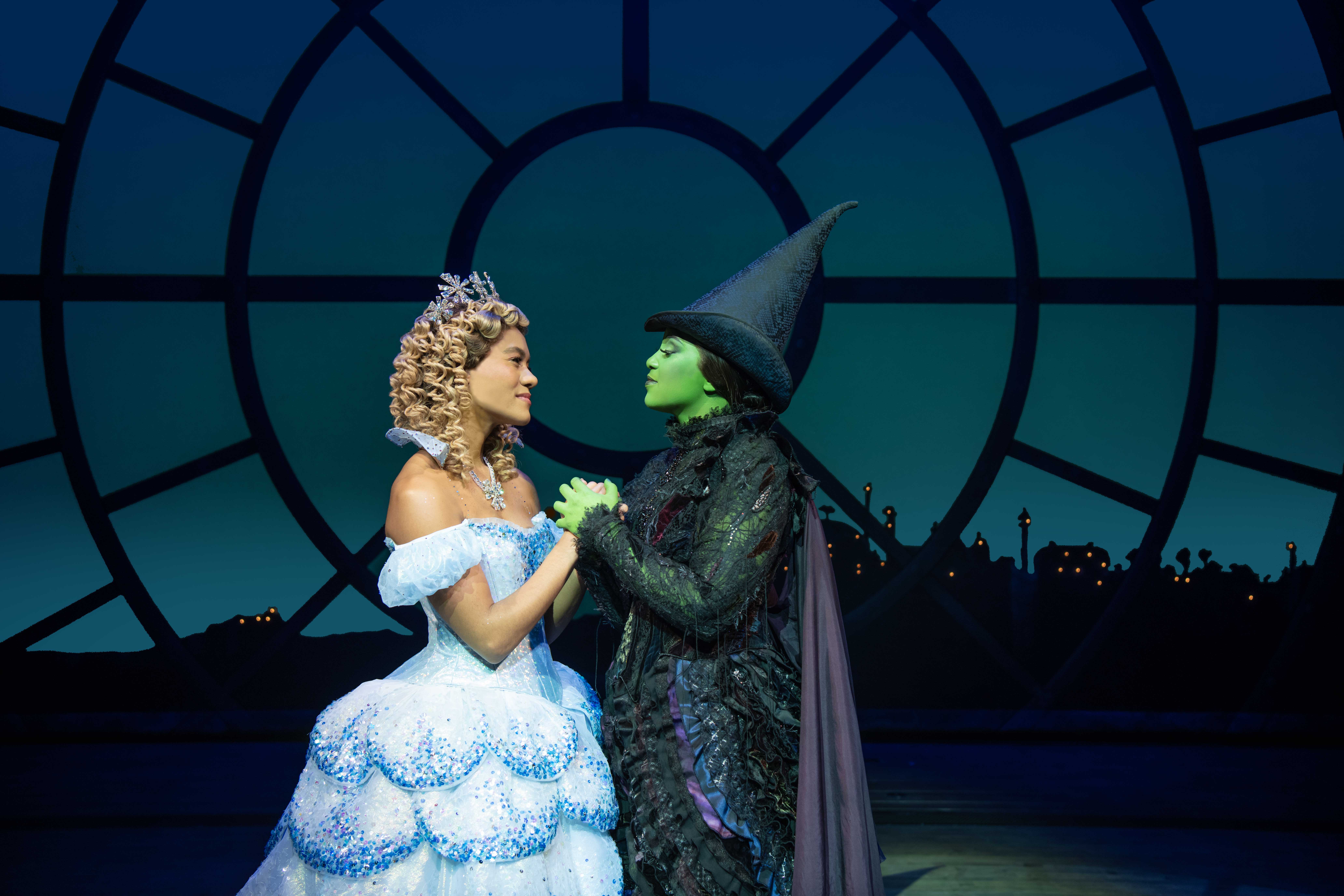
The most swankified musical in town continues to enthrall audiences from all over the world at London’s Apollo Victoria. Guillermo Nazara gives us his thoughts on this long-running production about to celebrate 17 years in the West End, to let us know if the show’s greenifying tone still means go.
For good… It may be called Wicked, but the show’s famous tear-triggering duet summarizes the piece’s journey much better. It’s been on for ages. Literally – I’ve gone from cute child, to obnoxious adolescent to bitter attention-seeking adult and the musical doesn’t seem to be going anywhere. It stays there… reminding me that at 29, gone are the days were I was a young lad…. And I’m saying this because I know you’re reading it… See? I can be a an evil witch too (old hag’s cackle).
The reasons for a production’s enduring success are usually difficult to explain – and almost always, impossible to predict. Theatre history is packed with montages that, despite its quality, didn’t last even for a year (sometimes, to much surprise, returning as record-breaking revivals), while several cheap and incredibly boring creations have been wowing viewers for generations (not the best ones, though…) and generations to come. When Wicked opened on Broadway back in 2003, several critics weren’t polite about it (as if we ever are): some reviews named the piece banal and mediocre, calling the story unoriginal and saying that the score proved that Stephen Schwartz had lost his touch. It was all bollocks.
It’s been over 10 years since I last saw the show live – not that this has stopped from listening to the album, playing the songs on the piano and even watching a couple of bootlegs on YouTube (….sorry….). Impressively, it doesn’t get old. Quite on the contrary. The work is still a dramatically smart allegory of the dangers of mass control and manipulation. When it premiered, traditional media and the ones behind their scenes were the ones you could associate the message to. Nowadays, social networks, cancel culture and even PC are the new scapegoat-seekers (no pun intended) that the musical’s cautionary tale encapsulates: don’t be fooled by people’s facades.

The staging uses steampunk theming to represent the wonderful (though fake) land of Oz. But perhaps designer Eugene Lee was inspired by something more than 19th-century fantasy to create its magical universe, as the piece’s quality accurately mirrors its mechanical proscenium. It works like a clock! With carefully intersected plots and enticing loose ends (all of them very cleverly tied up altogether at some point or another), we’re presented with a much exciting, interesting story that, more than giving us just plain entertainment, manages to both move us and make us think.
It’s pacing is truly staggering. Not a single scene, moment or number seem out of place, let alone rushed or slowing the rhythm down. It only builds up and up at a perfect beat. Stephen Schwartz’s iconic contributions are no doubt a huge contributor to this factor. Its deservedly famous melodies, mixing symphonic film-style underscore with pop-rock anthems (its popularity would not allow to call them tunes anymore), is the epitome of good theatre composing. The reasons to support that idea are a strong as its musical value: flawlessly structured, amazingly memorable (you can’t forget one bit!) and, most importantly, serving both the narration and its development at all times. Its lyrics, credited to the same artist, work in immaculate tandem (well, pun intended here, yes…) with Winnie Holzman’s hilarious and insightful book – all in all resulting in a cohesive intertwined piece where music and dialogue feed from each other in pursuit of one same goal: to tell a good story, and to do so well.
Good news (alright, I’ll stop) have come to the land of Oz this season too, as two new witches have joined its spellbinding family – one, new; the other one, returning after around 15 years! Lucy St. Louis (previously reviewed in our Phantom of the Opera post) stars as G(a)linda, giving a much joyful vocal rendition and a committed endeavour to her pretentious though caring character. On the other hand, Alexia Kadhime excels with her refreshingly natural approach to the role, providing her Elphaba with so much veracity and closeness to the audience, it really feels just like a mere extension of herself.

But those are not the only ones worthy of recognition in this piece – there’s also me, of course. And in addition, the whole company. Because the Apollo Victoria’s been blessed (I wanted to say cursed, but I promised no more puns) with one of the best and most devoted ensembles in the West End. Their performances, all of which constantly paying thorough attention to the text, culminate in exact the opposite of what long-running shows usually fail in: the material doesn’t feel tired or dated, not even excessively safe or choreographed. It’s still a much vibrant and alive piece.
The same goes for the orchestra, masterfully conducted by Ron Crocker, as every excerpt is played with much noticeable care for the phrasing and the score’s rich textures – once again, not making the mistake of betraying the numbers’ original tempo or delivering a plain sound, something I’ve already had to cope with a bit too much with other similar pieces. Two more mentions are earned by Sophie-Louise Dann, for her elegant portrayal of Madame Morrible (and the brilliant new blocking during the March of the Witch Hunters) and Mark Curry as the Wonderful Wizard of Oz, exuding both the charisma and cheerful personality his part is all about.
Throughout its 20 years of existence, Wicked has become a huge phenomenon, both popular and cultural. It’s in its essence, after all – the former not just because of the song (sorry, I couldn’t help it). It’s intelligent, but appealing to the general public; it’s profound, but much of an easy watch; it’s complicated on paper, but its music is so smooth to the ear. In summary, it’s the example of what every creator in their right mind (I’m aware there are not that many) would wish for: something that’s both a commercial and artistic victory. I just couldn’t be happier that the Apollo Victoria keeps looking to the Western sky, as not only is this show about magic, it’s proven to be able to make it.
All pictures credit to Matt Crockett.
Wicked plays at London’s Apollo Victoria Theatre from Tuesday to Sunday. Tickets are available on the following link.
One response to “Review of ‘Wicked’: “Let’s go down to the Ozdust ballroom””
[…] Read our review here! […]