
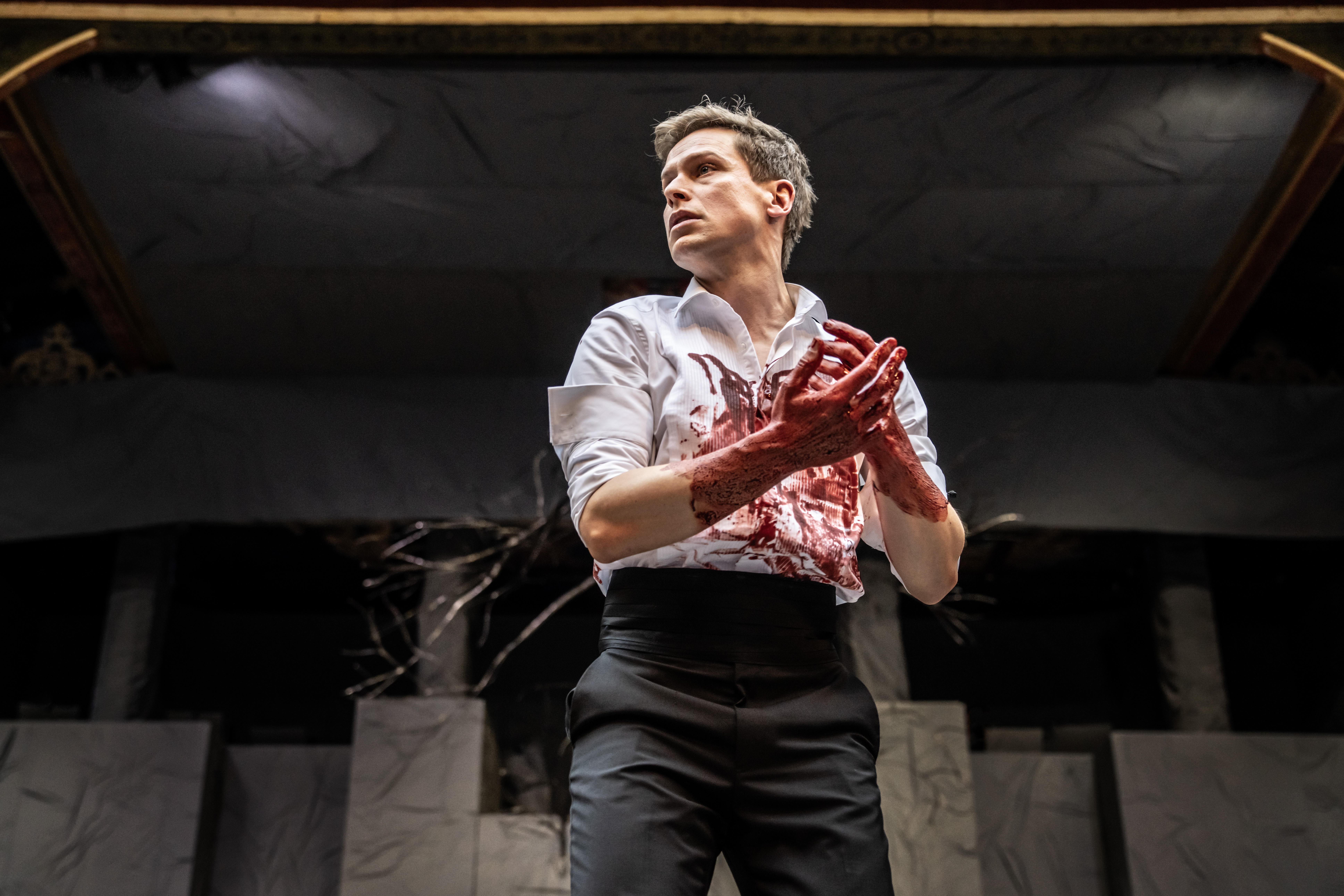
Shakespeare’s most haunting tragedy returns to its birthplace in a new production starring Max Bennett. Guillermo Nazara shares his views on the show, to let us know if the charm of this montage is truly firm and good.
By the pricking of my thumbs, something wicked this way comes. Tonight, at the Apollo Victoria… Come on, that was a good one… No? Well, okay… But in all fairness, both musical and… the play (yes, this is going to be exhausting…) share more in common that one may think of at first. Both feature magical forces to depict the most honest portrayals of the human condition. Both deal with the corruption of our nature when this is tainted by inconsiderate desire and blinding ambition. And both could equally use that term as the truest description of what they are. Because if dark was brilliant, these two would dwell in obscurity.
Writing about this work (I’m sorry, too much risk taken already by typing the title) means to write about disaster. From the ill-intentioned prophecy that the three old witches presage in the opening to the alleged curse-related fatalities that have accompanied several productions throughout the play’s 400-year existence, to talk about The Scottish Play means to talk about the ultimate decline of personal morality – and how it only takes one small step (for anyone) to spiral down into that endless pit of eternal blackness.

Abigal Graham’s conception on the piece brings out the cognitive reading of the story to some degree. Keeping enough respect to the original material, the production enhances the script’s exploration on the subconscious by the use of visual symbolism – combined through props and suggestive blocking. Also relying on an onstage choir and a percussion set for both music and sound effect purposes, the underscore is surely one of the best and most refined traits not only of this version, but as for play’s soundtracks in general. Subtle, evocative and incredibly subjective, the mixture of upfront numbers with incidental parts creates a cohesive, effective underlayer that founds the strength of this montage – exuding great understanding of the content and even greater capability to immerse us into its universe.
The cast, on its side, is certainly the production’s other big forte. Generally regaling us with much devoted and, above all, extremely attuned performances, the highest mentions go to Tamzin Griffin for her sophisticated -somehow, magnetic- rendition as (this time) Queen Duncan. On the other hand, Ferdy Roberts gives one of the most breathtaking portrayals of the whole show, in the double role of Witch and Seyton – bringing both temperament and flavor to his interpretations through absolute (and obvious) dominion over the parts. Finally, Max Bennett shines at some points as the lead character, but his exposition occasionally feels too recited – thus preventing us, at those moments, from fully connecting (either through sorrow or repulsion) with the protagonist’s abrupt rise and irremediable fall.

Fair is foul, and foul is fair. No good deed goes unpunished, then. But none of the Scottish King’s were of that kind by any chance. And so, his despicable actions fairly led to what is, in fact, one of Shakespeare’s most polished, enjoyable works. Despite the harrowing facts that construct both its essence and its narrative, the piece is a sublime blend of entertainment and philosophical reflection – which has been treated with more than sufficient care in what, up to this day, is the best play I’ve seen performed at the Globe. With all of the ingredients brewing properly in its cauldron, there’s nothing more to say but: Oh, hail, Macbeth! Oh, dear…
All pictures credit to Johan Persson.
Macbeth plays at London’s Shakespeare’s Globe until 28 October. Tickets are available on the following link.