
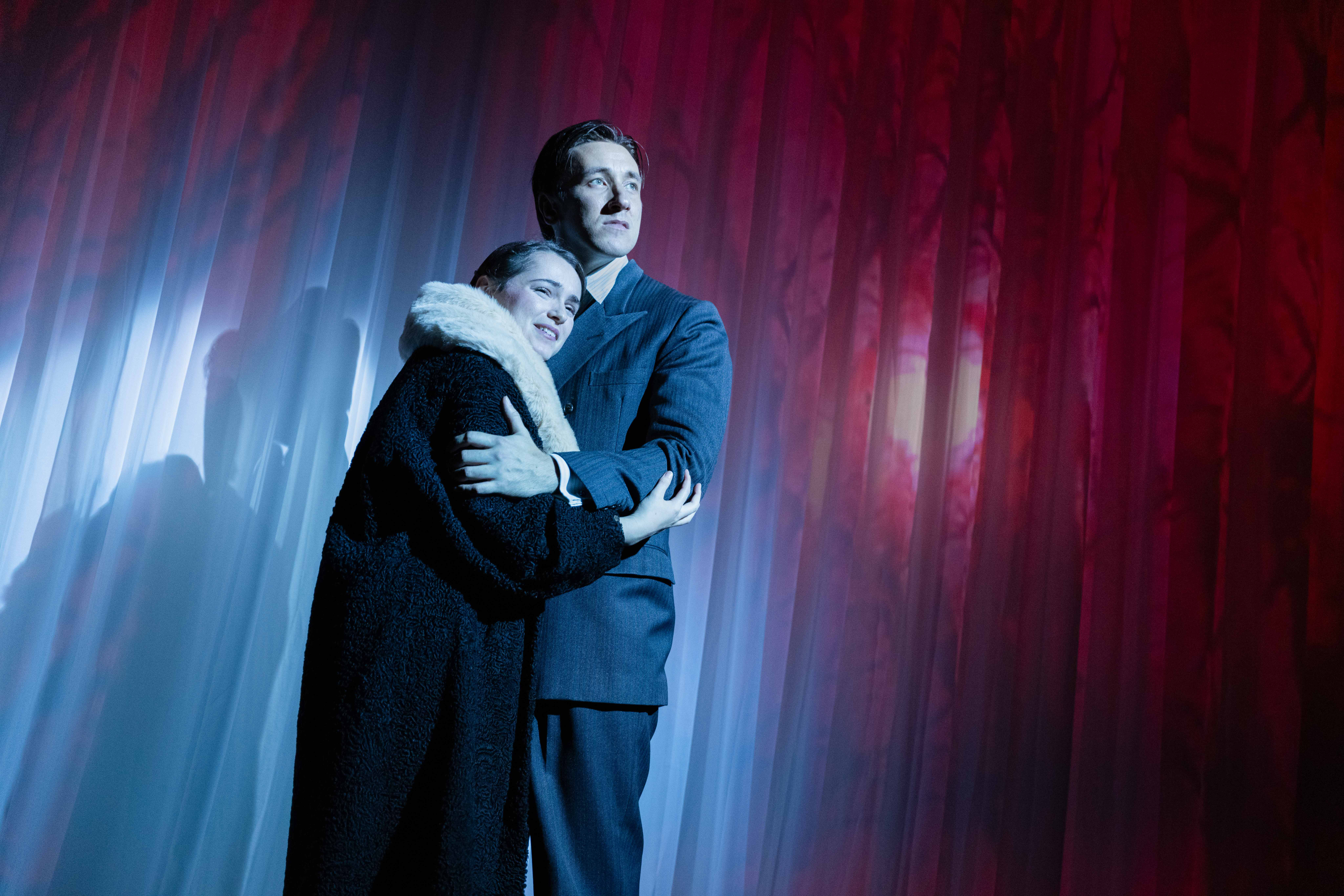
Du Maurier’s best-selling book celebrates a new milestone with the world premiere of its English-version musical adapation. Guillermo Nazara shares his views about this show filled with mystery, lies and unconfessed secrets, to let us know if the production actually got away with murder.
Last night I dreamt I went to Manderley again… Oh, wait… That was a press night, right. So I guess that the fiery thing with the hot guy was a different kind of dream then… Anyway (DM me if you wanna know about that one), the thing is that yesterday Du Maurier’s literary classic (and later Hitchcock’s cinematographic icon) wrote a new chapter in its almost centennial life, through the world premiere of the English-language version of its musical adaptation.
Originally penned by Sylvester Levay (music) and Michael Kunze (book and lyrics), the West End production has welcomed another veteran into its creative team – with Christopher Hampton (whom in just a few days will be able to walk down the street to another show of his) joining Kunze for the translation. Strong authors with an even stronger content in their hands, the chances of being astonished are not only plausible but highly expected – especially if it’s anticipated by the success of its German counterpart.
But can a musical mirror the Gothic allure of its film-noir predecessor? Kunze may have the response for that. After all, his dancing vampires (a much bleaker approach on Polanski’s camp comedy) are solid proof of his darker side. Yet, it seems as if the situation has been completely reversed in this case, replacing the eeriness of its initial form for a much smoother take – in spite of its murderous essence.

There are no changes in the plot, however. The show remains, in fact, quite faithful to the novel. Then, how can it feel so different? The answer is more or less simple: it’s the score. Is it bad? Not at all. It’s actually beautiful, intricate and filled with more than a few hummable motifs. It’s also sharply orchestrated and, at some moments, it gets extremely moving. But all of those traits, though favourable on their own, seem to work as a double-edged sword when brought into the show – it’s just too pretty.
Despite its tuneful style, it never manages to evoke the story’s true vibe – let alone, its time period. Of course, hundreds of previous (and highly influential) musicals could dispute the idea that you need historical accuracy when it comes to songwriting. It’s true that you don’t. But you do need to transport your audience into the universe that’s being presented before them. Sadly, though the melodies are lush and mellow, they do not bring out the flavour the narrative is looking for. On the other hand, the book doesn’t help to their reception either, as many times the cues seem too abrupt, not fully setting the tone for a number to start naturally. In addition, the lyrics fail to do much justice to the recount, often appearing to be more concerned with rhyming instead of aiming for more subtlety and depth.
Directed by Alejandro Bonatto, the production also poses a few major problems regarding its staging, those coming from Nicky Shaw’s not-too-well executed set design. Even though dynamic at some points and able to create a few interesting atmospheres, the general impression is that it doesn’t set the right mood – nor does it allow for the versatility its fast-paced narration requires. The fact that she has opted for a figurative take may be the main issue, as this prevents the visuals from adopting a more imaginative tenor – something that’s crucial when quick changes are necessary, but even more when the plot deals with matters dwelling in the psychological realm.

There are some good points, nonetheless – which actually happen to be excellent. Both orchestra and company play to utter perfection, the latter exuding outstanding vocals combined with several captivating performances. Kara Lane boasts an incredibly powerful voice as the enigmatic Kara Lane, while Lauren Jones gives a delicate yet vigorous rendition in the lead role of I. Yet, the biggest praise is earned by Richard Carson in the also main part of Maxim de Winter, not only through a more his more than accomplished singing ability, but also through his magnetic portrayal of a rather complex, layered character.
“Always make the audience suffer as much as possible”, said the man that set the rules for any good mystery that was to pop out the silver screen. Clearly, this hasn’t been the situation with this one, as there hasn’t been misery for the viewers and there are quite a few excerpts that are fairly enjoyable. But perhaps that lack of edginess is what’s halted it from having what once the Master of Suspense, in spite of its gloominess, gave the story to make it look brilliant. A more daring approach and some general editing will be decisive to let the piece work as a whole. At the end of the day, it’s all reduced to one single solution, the same one that the film genius had even for a sore throat: cutting!
All pictures credit to Mark Senior.
Rebecca plays at London’s Charing Cross Theatre until 18 November. Tickets are available on the following link.