
New writing meets old money in this priceless comedy dealing with the material drama of the upper class. Guillermo Nazara shares his views on the show, to let us know if the piece has been granted with the Midas touch.
When I grow up, when I grow up… (that’s as much as I can take from that song). But truly, who hasn’t dreamed, when they were a child, of all the things we wished to have as adults? A big house with a swimming pool, a nice convertible to drive around town as fast as you can, and lots of spare cash to do absolutely what you want. Then you hit your 30s and realize your generation is screwed and the only answer is… well, I kind of said it already… Well, either that or you can let mommy pay for it. Or perhaps daddy can give you sugar too, though… Anyway. Some of us have been able to make it, nonetheless – at least, in fiction, albeit the situation may change sooner than expected (if it ever was).
Welcome to Mates In Chelsea, a new comedy revolving around the financial drama of those who brush their teeth with champagne and scrub their skin with caviar (seriously, if that’s what they actually do, sign me in!). Written by Rory Mullarkey, the play deals with a young viscount facing the hardest endeavour of his life: his mother cannot support him anymore! And what’s even more frightening, she’s decided to sell the summer castle to a Russian oligarch! What is he going to do? Work?! Haaaaaaaaaaaaaaaaaaaa! Better to spend his energies in preparing an elaborate (figure of speech) scheme to avoid losing the opulent lifestyle he’s been brought up with. But as everything with satire, for things to work and make us laugh, they all must go terribly wrong…

A social comment on the power of materialism and the lengths some are willing to take for it, the piece is a hysterical observation on the two-sided force of money: it’s the only mean to live; but to get it, we may need to kill ourselves inside. Offering a critical, yet always humorous, view on the superficiality of those whose only interest in people dwells in their disposable income (and a tiny bit on the commies wishing to meet someone who knew Lenin – I guess it’s not just economics that they don’t understand…), the script doesn’t go any deeper than its superfluous (yet not shallow) farcical tone. But by doing that, it regales us with an exciting and extremely amusing journey where fun gets the lion’s share and preachment has filed for bankruptcy.
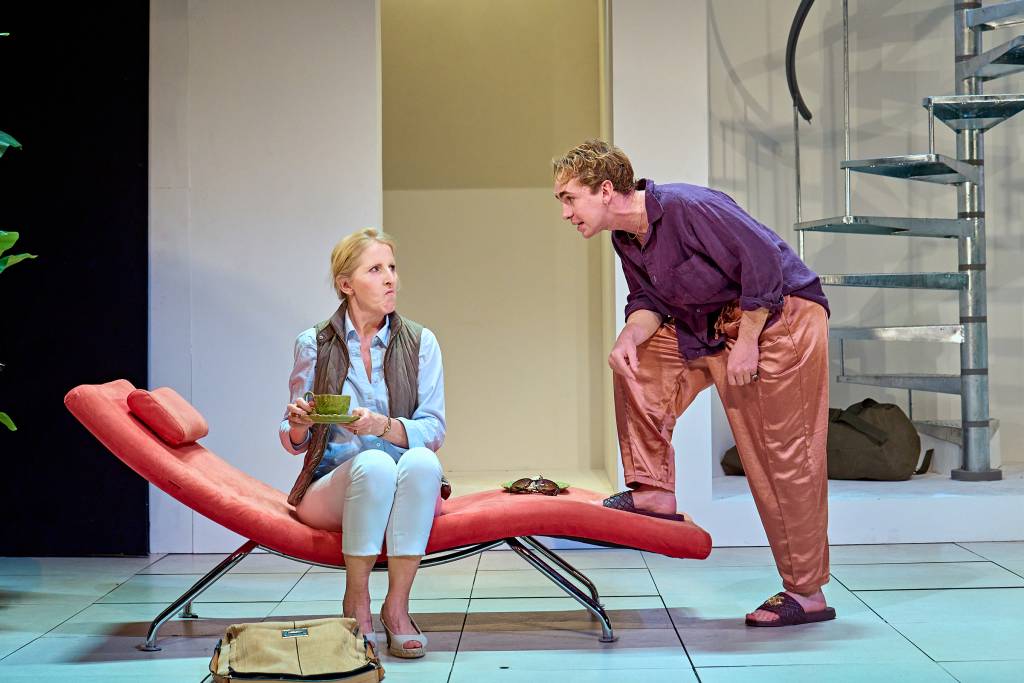
Directed by Sam Pritchard, the production features some interesting scenery (credit to Milla Clarke), mixing a figurative, realistic style with a more experimental approach by the end of the show – combined, in between, with campy, spoof-like visuals. Though aligned with the script’s tone to some extent, this might be the montage’s single flaw, as despite its understandably gimmicky trait, there’s a lack of attention to detail when it comes to immersing us into the story’s universe. Perfectly crafted during the first scene, it’s rather surprising that so much of the backstage is revealed during the second act (and I’m referring to its opening) – creating an effect that, far from the perhaps intended idea of presenting the family’s castle as the epitome of their ludicrous existence, just takes us away from the action by not masquerading what we shouldn’t be supposed to see.

As for the cast, no one in the company goes anywhere cheap with their acting – with every member exuding excellent comedic timing, blended with driving stage presence and hugely palpable rapport (you really can’t blame them for almost breaking character and bursting into laughter a couple of times). Among them, Fenella Woolgar makes a memorable impression through her uptight, yet charming portrayal of Lady Agripina (I know, money doesn’t equal taste… and now you’ll be telling me that that’s your mother’s name…). On the other hand, George Fouracres stands out as Charlton Thrupp, delivering his part with magnetic energy and much impressive naturality despite the edginess (for posh standards) of his role. Nonetheless, the highest praise goes to Laurie Kynaston in the lead part of Tug (Theodore, for his mother) – exuding incredible magnetism and confidence, while also giving him a rather sympathetic vibe despite his underlying obnoxiousness.
A cracking jaunt from start to finish, Mates in Chelsea brings the house down through an entertaining and, above all, hilarious trip through the absurd. Inspired by the style of Oscar Wilde (and, to some level, getting close enough), the show has landed with remarkable strength by becoming the best one the Royal Court has produced in the last year. With astoundingly engaging performances and packed with great moments to talk about and maybe… impersonate (yes, I’m that kind of person…), the piece is destined for a longer life that its current limited run. But until that happens, do rush to get a ticket – because surely this check won’t bounce back!
All pictures credit to Manuel Harlan.
Mates in Chelsea plays at London’s Royal Court Theatre until 16 December. Tickets are available on the following link.
One response to “Review of ‘Mates in Chelsea’: “A rich seam””
[…] Read our review here. […]