
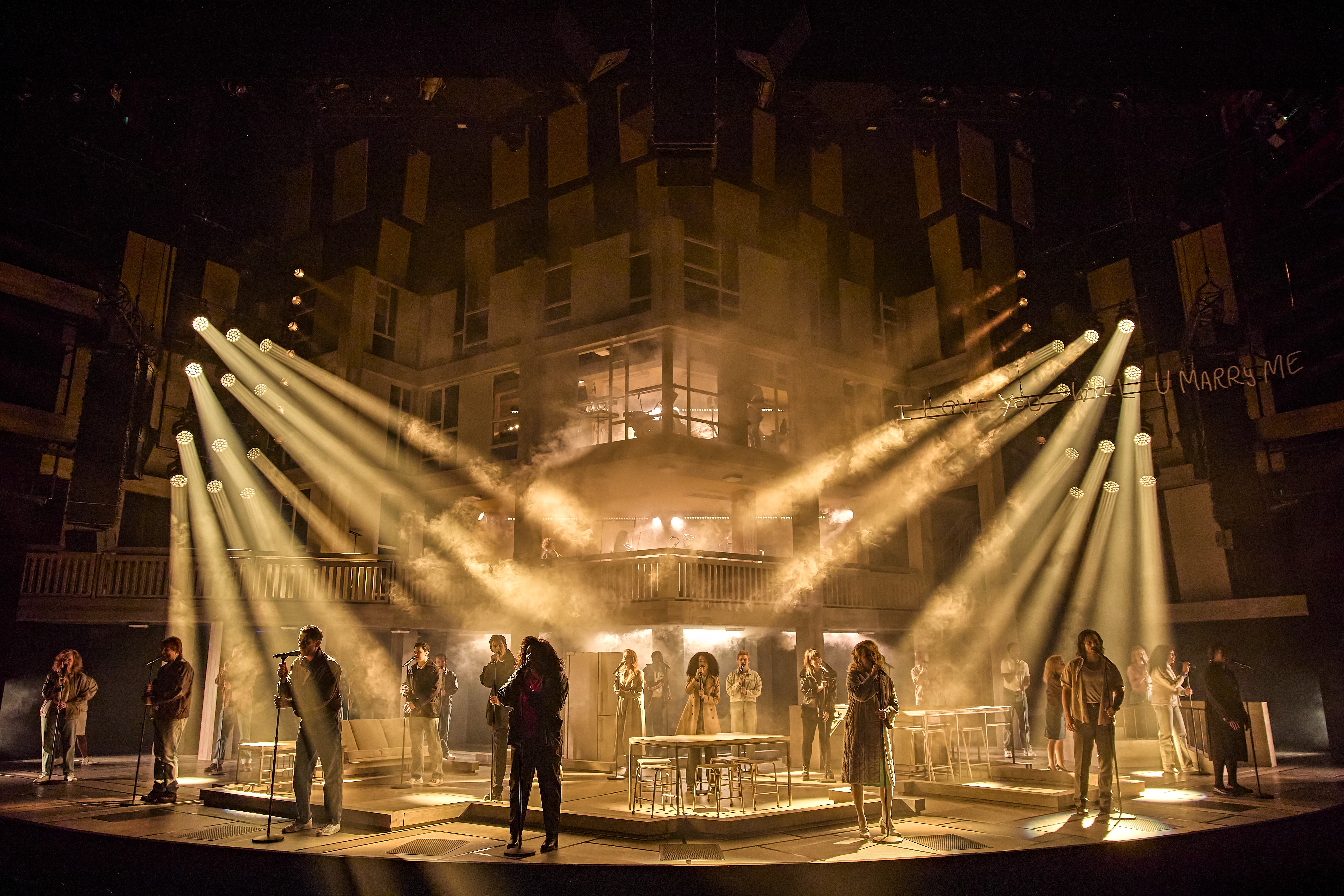
Sheffield’s edificial love story returns to the London stage after its acclaimed first run at the National Theatre. Guillermo Nazara shares his views on the show, now transferring to the West End, to let us know if this built-up romance toes the line.
“Love is in the air”, claims that gentle melody that John Paul Young forever dropped into our hearts. Yes, love does in fact float around us. Just one breath, and it’ll infect us. Stay for longer, and it’ll take it away. Things are however a little different up in the North, where emotions are not gone with the wind, but carved into the solid concrete that shapes its living history. This is not just a story, but three. Or maybe only one, constantly shifting through the many paths that cross over steel-forged its background. Welcome to Park Hill. Welcome to a tale of a building.
Six decades of everyday recounts erect this scaffolding of music, verse and visual doggerel. Standing at the Sky’s Edge, an homage to an icon of ever-changing reputation, is probably the most accurate example of what a love sonnet (transformed into a bewildering extravaganza of aesthetic lush) is all about. Directed by Robert Hastie, the piece mirrors Victor Hugo’s Notre Dame de Paris by giving character, soul and identity to a place that, one way or another, has honed part of Sheffield’s course.

Comprising the journeys of three different families (all of them interconnected in some manner), the work is a superb achievement in depicting, analyzing and resonating the most vivid traits of human nature – compiling a highly sincere, introspective narrative that, far from sounding dull or cliched, draws out the drama, passion and strength of a simple yet meaningful existence. These stories often do not make to the news. But they do make it to our memories. And they manage to connect with us so intensely, they stay with us for good.
With music and lyrics by Richard Hawley, the score is, among its many praiseworthy elements, one of the greatest accomplishments in the montage. In a time where too many new works feature bland, unimaginative and frightfully forgettable soundtracks, Standing shines through like a beacon of light – regaling us with hit after hit, and weaving a varied though cohesive fabric of catchy but, most importantly, intricately crafted tunes. There’s depth, emotion and honesty. There’s beauty and buzz. But also crudeness and grief. In other words, there’s truth dwelling in every note, chord and rhyme.

Featuring an uneven structure when it comes to its musical numbers, the show exudes some levels of originality by transitioning from a play with songs (where the renditions stop the action as either a reflective or transitional method) into a fully functional musical. This, nonetheless, becomes to some extent the only issue its writing presents – as the bonding with its personages takes longer to materialize by not providing us, at the beginning, with enough moments allowing them to fully open up.
Of course, this just poses as a very tiny problem when taking into account Chris Bush’s rather compelling book – creating incredibly powerful scenes of electrifying resonance. In addition, the production values are, too, risen to the very top, through Ben Stones’s towering set design – introducing us into a fast-moving universe of extreme dynamism despite needing hardly any changes. This is seamlessly supported by Mark Henderson’s decidedly atmospheric, sometimes picture-painting, lighting, as well as Lynne Page’s elegantly suggestive choreography. A fair mention also deserves to be given to Tom Deering thanks to his brilliant orchestrations, endowing the score with further layers of texture, detail and complexity – thus, granting it the opportunity to wholly permeate into the audience’s sentiments and bloom from within.

As for its cast (with size almost as monstrous -in the best sense!- as the building they pay tribute to, the entire company is both skeleton and facade to this delightfully polished performance. Among them, Samuel Jordan gives one of the most noticeable portrayals as Jimmy – boasting charm and presence through a mellow, sympathetic delivery of an extraordinarily likable character. On the other side, Laura Pitt-Pulford emanates frankness, flair and relatability in the part of Poppy, giving insight and veracity to who’s possibly the personage that speaks the loudest to nowadays viewers – despite Poppy’s last decision feeling a bit too sugar-coated and probably not the best choice to make in reality. Yet, the biggest applause goes to Joel Harper-Jackson as Harry, playing his role with such integrity and poignancy (apart from his seductively raspy vocal skills) it’s absolutely impossible not to fall for his plight.
A consolidate triumph cemented in know-how, talent and intuition, Standing at the Sky’s Edge brings both tradition and innovation to the British musical by obliging us with a quintessential form. Enchanting, absorbing and greatly touching, the hype about the piece is by no means exaggerated – and chances are you will be joining the fan club with immediate effect. Explosive, tranformative and refreshingly entertaining, its elated view on the lives of normal people is, from every angle, a poetic fantasia made of colorful stanzas – almost as bright as the Park Hill refurbishment, but half as tacky.
All pictures credit to Brinkhoff-Moegenburg.
Standing at the Sky’s Edge plays at London’s Gillian Lynne Theatre until 3 August. Tickets are available on the following link.