
Queer identities and lush romance blend together in this explosive comedy bringing back the allure and stories from classic times. Guillermo Nazara shares his views on the show, to let us know if this Greek gift could actually open Pandora’s box.
Passion is that rare force of nature that both makes us and destroys us. We’re driven by its strength, but also broken by its turmoil. For it gives us purpose to continue, but also a reason to end. Nothing encapsulates this concept better than those matters closer to our heart. Doomed romance is, in some aesthetically sadistic way, the guilty pleasure that any writer relishes on when trying to touch their audiences’ hearts. Whatever the subject is, whatever it’s surrounded by, we can’t help but fall (and usually, relate) to the ill fate of two souls condemned to walk apart.
A lesbian tale set on the island of Lesbos. No pun or failed attempt for subtlety there, it’s actually where the term comes from. Narrated, nonetheless, through a farcical and camp-intended approach, Sappho brings the Ancient Greece poet back to life – taking us through a loosely historically accurate recount revolving about the artist greatest longing beyond her words.

An excellent premise to set the piece’s grounds, it’s the rest of its elements that, most unfortunately, seem to crack down and, eventually, plummet through what turns out to be a rather dull and shallow exploration of what should have been (and actually, is) a rather complex theme. Dealing with a huge variety of intricate topics ranging from philosophical perspectives to political upheaval, the script fails to take any advantage of their potential, presenting us instead with a plot that generally feels too basic and underdeveloped – giving very little substance to both characters and arc, and thus preventing us from connecting with their evolution; a journey which, most unfortunately, also looks too blurred and sketchy.
Written by Wendy Beckett, the play relies on a blend of Shakesperian-style dialogue with modernised comments on morals and values – combined, at the same time, with some slapstick, slightly sophomoric remarks. Wistfully, none of them seem to do the trick – lacking either the necessary naturalness or wit that would allow them to land. On the other hand, though the cast makes a noticeable effort to help the performance flow, the acting, on the whole, feels a bit unpolished – preventing their roles from fully unraveling; sometimes, too adjacent to a caricature.

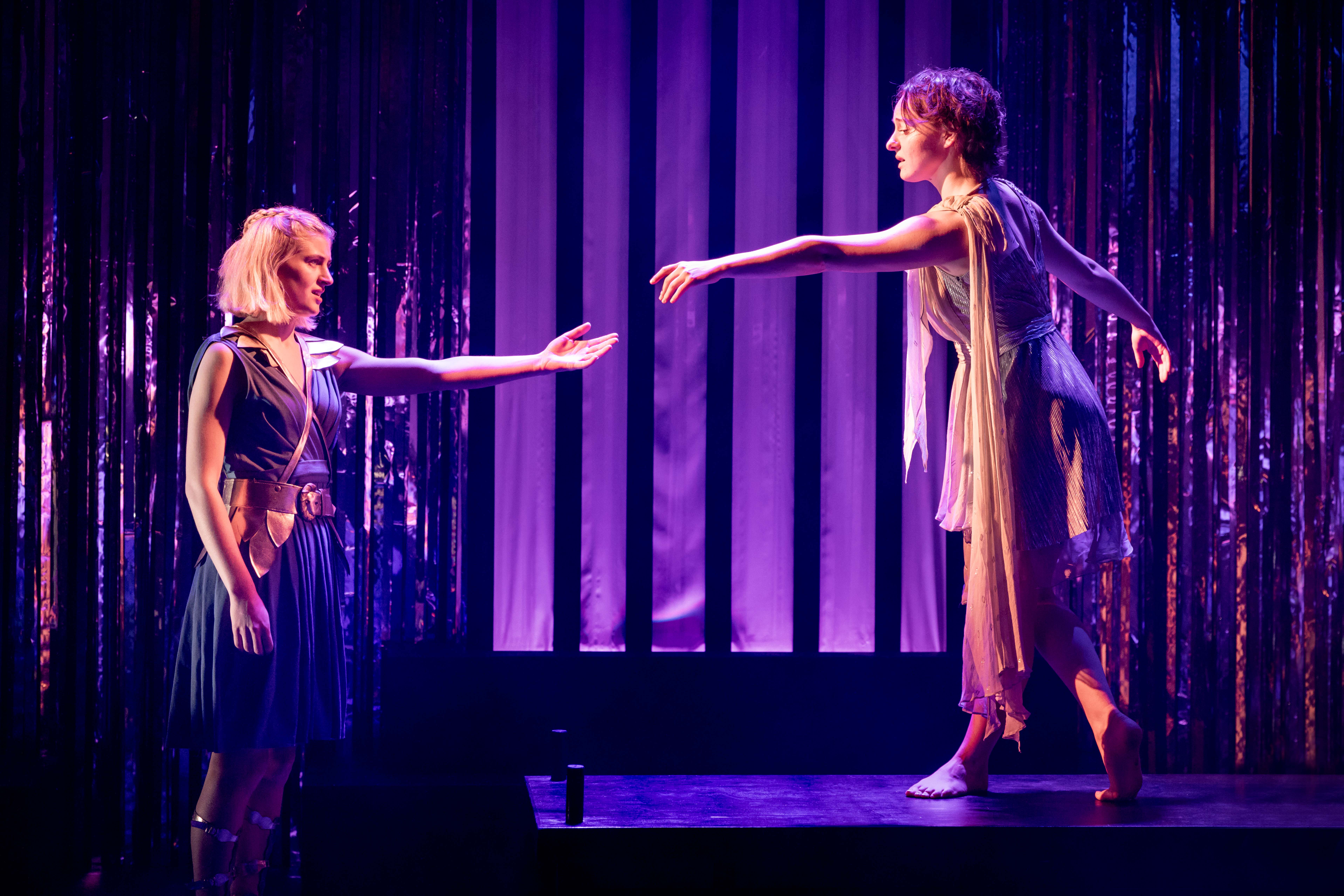
Some credit must be given, in any case, to Halcyon Pratt’s glittering stage design – creating a compelling set of visuals that gives both enticement and dynamism to the montage. In addition, Adam King’s lighting crafts an engaging atmosphere that endows the production with rhythm while also enhancing its appeal.
A classic tale of classic issues happening in classic times, Sappho makes an engaging promise through its fulfilling initial idea, but doesn’t follow through in its delivery by laying all of its trust on a rather unsupported surface. A fight for love is always worth the risk (and indubitably, the watch), but no battle can be won without proper preparation. There’s many things to be told and many things that have been told. But so far, they still haven’t found a match.
All pictures credit to Mark Senior.
Sappho plays at London’s Southwark Playhouse Elephant until 25 May. Tickets are available on the following link.