
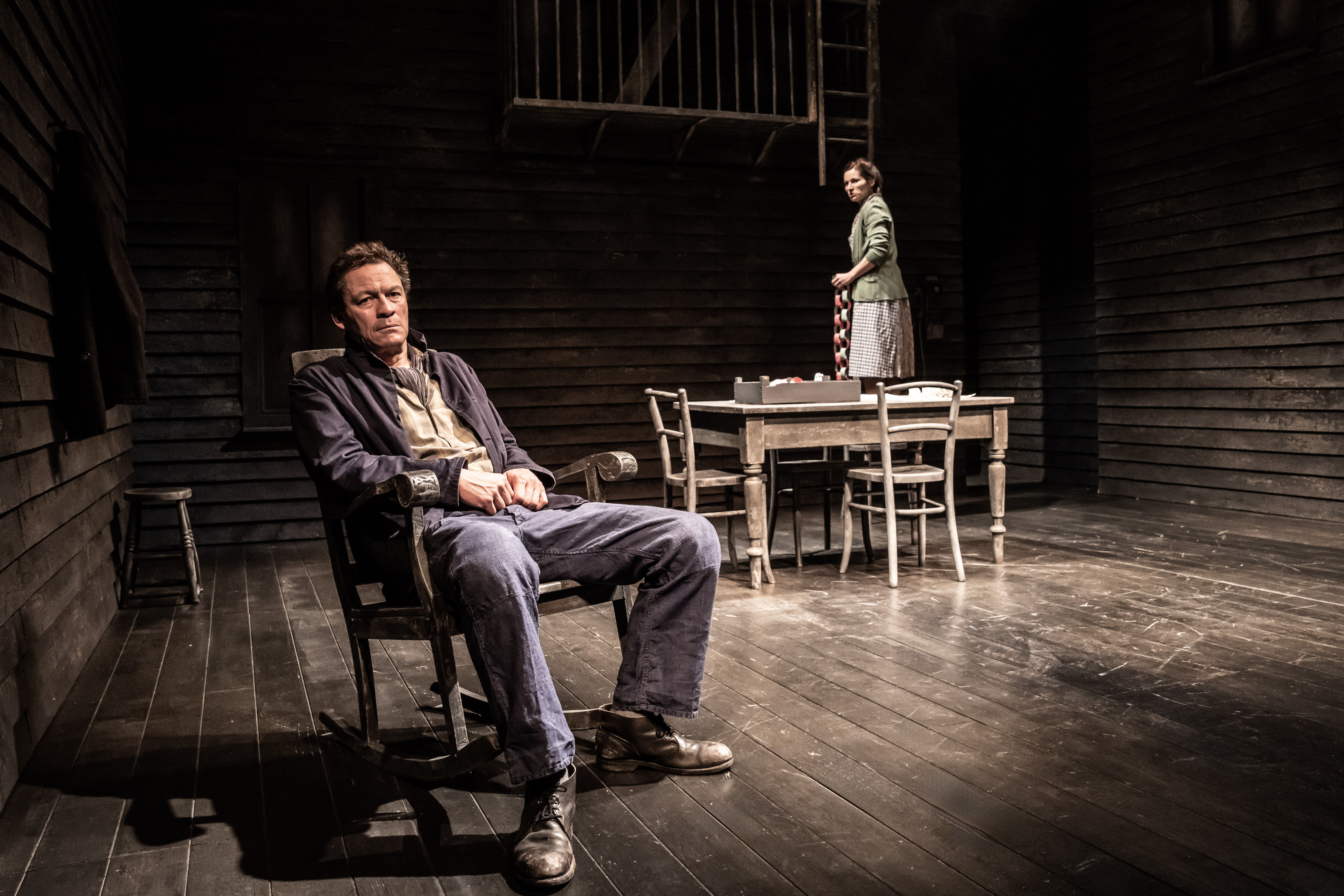
Dominic West stars in this new production put together by the Theatre Royal Bath, currently playing in the West End until the middle of summer. Guillermo Nazara shares his views on the show, to let us know if this version on one of the greatest contemporary classics deserves the cross.
Life is a permanent struggle between the halting ties of duty and the burning hopes of freedom. It doesn’t matter when or where, what or how. Arthur Miller’s roughness-splattered portraits of the human condition line up towards the same path, exploring the complexity of our nature in a manner very few other authors could accomplish, and subliming reality by feeding from the very core of truth – through stories where good and evil are replaced by fear and camaraderie, but above all, the irretrievable need for survival.
A classic among classics, A View From The Bridge brandishes every single characteristic that defines and places Miller’s writing as one of the most influential, compelling bodies of dramatic work in the last century: his exceptional ability for flow and structure, outlining a plot that evolves with incredible naturalness and sly subtlety; the allegorical concepts that provide universality and endurance alike to the material; and his empathetic understanding of the clashing journey every person goes through, where their blemished actions are only led by the virtuosity of their authenticity.

A perfect picture of the flawed essence of our existence, the piece takes us into the short-fused powder keg of an Italian-American household in the slums of the New York outskirts. There, Eddie, an overprotective family man diving into an obsessive concern about his stepdaughter’s future – first infatuated by, and later betrothed, to an illegal immigrant. His initial suspicion would soon lead to an irrational array of fear and hostility, paving the way into a journey of personal obscurity with no other destination but everyone’s own demise.
An absolute triumph of storytelling enriched with philosophical value, Theatre Royal Bath’s new production, currently in its West End transfer, does compelling justice to the original work – through what, in the end, results in a faithful and rather gripping treatment of the piece. Directed by Lindsay Posner, the montage succeeds in immersing us into the knavish air of the play’s volatile universe – presenting us with a tangible depiction of a world we don’t belong to, but we’re however able to grasp and submerge ourselves into through the open window that rises behind the curtain.

With designs by Peter McKintosh and lighting by Paul Pyant, the three elements work in aligned tandem to bring out the musty flavour of the play’s piercing reality. However, the staging doesn’t indulge in the same kind of victory when it comes to its narrative effectiveness. Relying on a still set to illustrate the decadent subsistence of a New York low-profile neighbourhood, the montage fails to properly take us from one scene to another – occasionally, giving vague clues as for where the characters are supposed to be.
The problem stems from what, on the whole, seems like a lack of dynamism all throughout. Parting from a stylistic approach that, in some manner, reminds of John Napier’s scenographic take for Les Misérables, its visual proximity fairly prompts the desire for similar solutions – where different props could be moved in and out (revolving stage or not) to offer us a clearer guidance as we travel through the recount. On the other hand, some directional choices could benefit from some minor tweaks to improve its efficiency. The use of a Sicilian-hearted underscore as a transition device works superbly, but its brilliance is sadly shaded by its absence during the show’s conclusion – thus, preventing it from completing the emotional cycle it lures us into, but then abandons us midway.

In any case, the entire rendition is, by all means, an extremely enjoyable, profound and thought-provoking jaunt packed with the same crude honesty that pours through Miller’s words – the merit for that result co.ing primarily from its beguiling troupe. Playing with infectious rapport and impeccable flair, the first mention goes to Callum Scott Howells in the role of Rodolpho, who despite his Welsh-sprinkled Italian accent, manages to carry out a truly charming interpretation as the naive, good-nature suitor.
In addition, Kate Fleetwood brings charm and stamina to her personage as the desperate, yet resilient mother Beatrice, while Pierro Niel-Mee regales us with the strongest portrayal of all the supporting cast, through an incredibly genuine, enchanting and detailed delivery as Rodolpho’s struggling brother, Marco. Nonetheless, the highest praise goes, unquestionably, to Dominic West in the lead part of Eddie, concocting a magnetic, multilayered persona filled with charisma and likability in spite of his ongoing moral decline.
Following last summer’s bewildering production of The Crucible, the West End welcomes this year an accomplished new installment of Miller’s illuminating look into the human spirit. Arranged with elegance and recounting flair, this version pays a much applaudable tribute to the legacy and value of Miller’s revelatory understanding on the specks of glow and darkness that dwell within all of us. With just a few polishes needed in its blocking, apart from the removal of a prerecorded track at the end and the usage of more accentuated pauses in between monologues, this production could easily be one of the finest revivals of classic American theatre we’ve had recently. The bridge is crossed. Let’s stand and watch it burn.
All pictures credit to Johan Persson.
A View From The Bridge plays at London’s Theatre Royal Haymarket until 3 August. Tickets are available on the following link.