
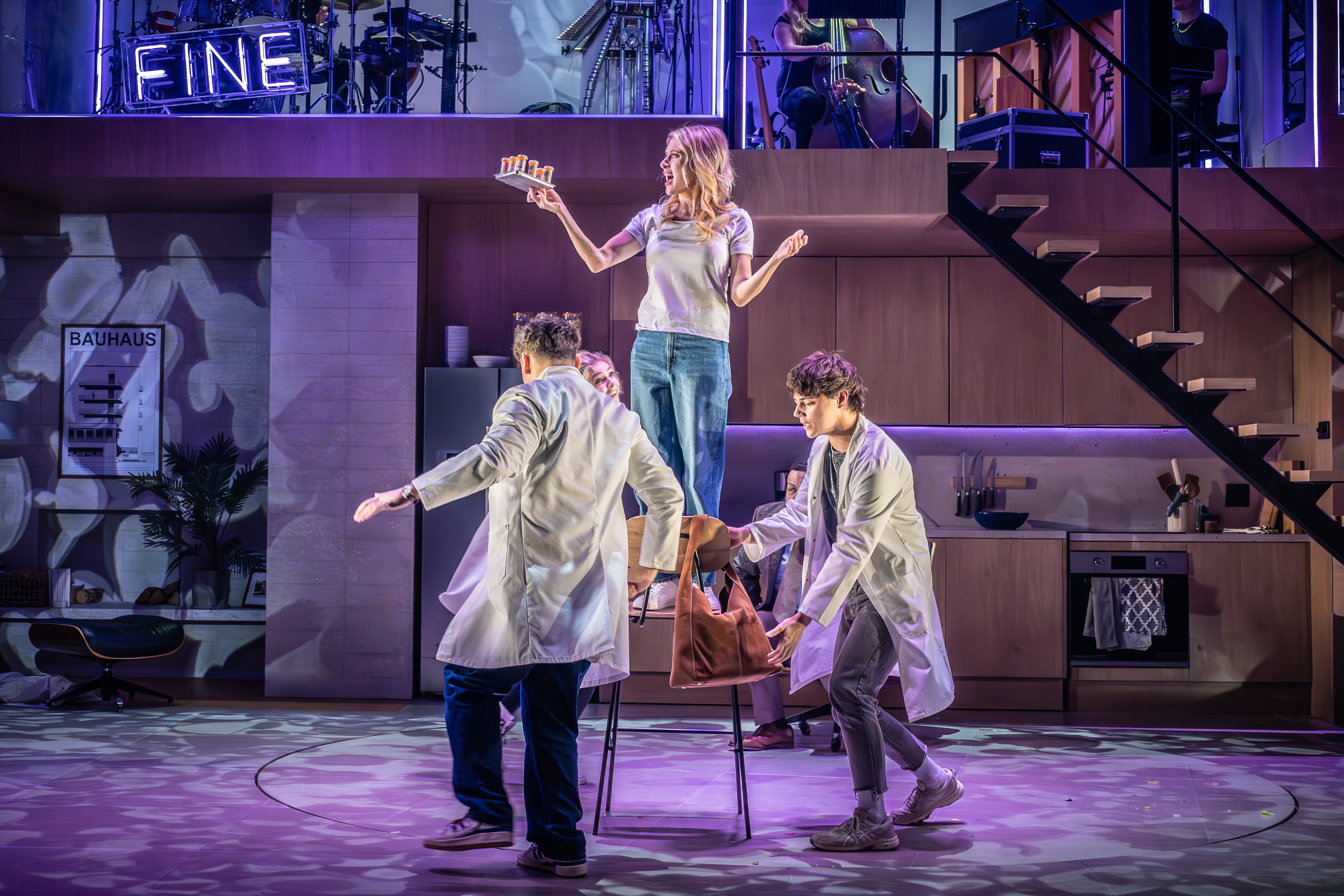
The acclaimed Donmar Warehouse revival celebrates its West End transfer, bringing back the original cast from this last year’s montage, in a strictly limited run playing until the end of summer . Guillermo Nazara shares his views on the show, to let us know if this reinterpreted version of the mental health-themed musical still has it in to blow our minds.
Most people who think they’re happy are really just stupid. Ah, nothing boosts your spirit better than a good dose of condescending negativity. She has a point, though: people are, in general, idiots. Not you, though. Definitely not you. Please keep reading me. Love me. Comment. Subscribe. Leave me all you will…. What? Just quoting Oliver!… Although, if you want to go to those lengths… Seriously, though, the understanding of the human mind is probably one of the most fascinating subjects to be explored throughout story – maybe because, when it comes to true life, very rarely are we capable of finding any towards others’, but most especially, ours either.
This week, the London scene celebrated the West End transfer of the much anticipated Donmar Warehouse production of Next To Normal, the 2008 Pulitzer Prize winning musical dealing with the struggles of a middle-aged woman, as she copes with the long-standing trauma of a reality she doesn’t manage to accept – or a fabrication she’s unable to break away from. Featuring music by Tom Kitt and book and lyrics by Brian Yorkey, the show (as any parishioner in the genre is meant to be cognizant of) shatters the usual taboos related to mental health issues (a subject that, fortunately, we’ve learnt to be more outspoken about as a society) by bringing to the table the fundamental principle to comprehend our paths: it’s okay to have a problem, and shame is never a solution to it.

Directed by Michael Longhurst, the montage preserves the explosive feeling of the original material – flaunting the toughness of the topics it tackles with, while also adding some element of sweetness and showmanship in both its visuals and delivery. It’s a dark tale depicting the flaky cruelty of fate (through a family doomed by tragedy and the aftermath it carries along), but just as the last number calls for, there’s light shining all through it.
Designed by Chloe Lamford, the set mirrors, to some extent, the style of the original Broadway production. A compartmentalized square-shaped structure serves as both backdrop scenography and band-onstage pit – as a set of stairs connect us to the multi-functional kitchen-dining room space, whose all-wonder counter diversifies its skills from a rock-gig podium all the way to an electroshock therapy bed. Also counting on a revolving platform, enhancing the dramatism of its already unhinged roller-coaster flavour, Lamford’s approach is superbly complemented and reinforced Lee Curran’s brilliant lighting – exuding incredible intricacy all through the rendition, and flaunting such refreshing dexterity at heightening both sentiment and atmosphere through its duality between verity and illusion.

Taking us through a compelling ride, despite its discomforting essence, the only breakdown comes in the way of its pacing. Though outlining the whole recount with sufficient poignancy and the necessary levels of development, the rhythm feels slightly flawed at some moments, giving the sensation of the plot being constrained and preventing from fully breathing. The reason may lie in the architecture of its score: though all of the numbers moving the story forward with much of a satisfactory beat, some songs require some extra components in between for the entire machinery to even out its motion. If you want to go for the rock opera vibe the piece boasts, then some recitatives are bound to be included. Otherwise, a lengthier book is crucial for the synapse to finally occur – added to a more varied taste in the music, which though cohesive, catchy and, ultimately, beautiful, looks a little repetitive when put altogether.
In any case, the piece is able to keep the grip on its audience thanks also to its amazing cast. Proving impressive vocals and portraying their parts with great emotional strength, the whole company demonstrates not only their proficiency at handling the roughness of the material, but their interpretative force to make of them a more than solid argument (even if that’s the single one) to pay a visit to the theatre. Among them, Caissie Levy makes a long-lasting impression through her rather absorbing rendition in the lead role of Diana, working in perfect tandem with Jamie Parker as her husband Dan – both oozing galvanizing energy and chemistry, wit Parker endowing his character with heart-touching probity. However, the biggest praise goes to Jack Wolfe in the part of Gabe, showing off unqualified charisma and presence – and making of his personage an absolute treat every time he’s onstage.

Set to give you more than a piece of mind in regards to the difficulties that are more common to our everyday that, historically, we’ve been willing to admit as a community, Next to Normal racks our brains while injecting entertainment, wit and sensitivity into our souls. It’s a polished piece which, nonetheless, still could benefit from a tweak or two; but, all in all, the experience is thrilling enough to make of it both enjoyable or worth. It may have not be craziest person about it, but I would give to it the fact that it’s insane.
All pictures credit to Marc Brenner.
Next To Normal plays at London’s Wyndham’s Theatre until 21 September. Tickets are available on the following link.