
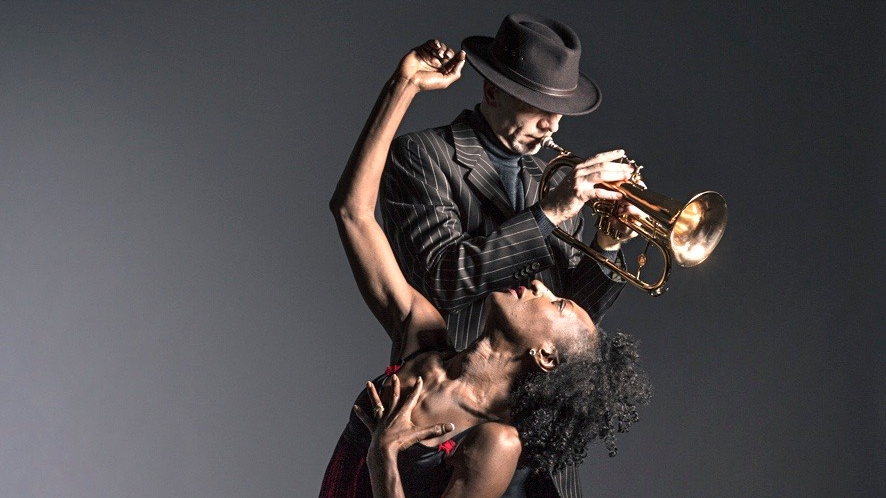
Founders of the long-standing BOP Jazz company return to the London stage with their latest showcase, digging into the genre’s roots through original music and choreography, while also introducing new emerging talent. Guillermo Nazara chats with the creative duo, to learn all the facts about this ambitious artistic venture serving as the zenith of a 26-year journey.
Where does the idea for this show come from?
Paul: The show comes from 2 ideas, the first being to conceive, interpret and display original works which expresses the legacy of the jazz art form. The second, is looking at how we as composer and choreographer can create and produce work that is highly artistic and relevant and can be viewed as contemporary high art. In truth we aim to reflect the old and the new of the jazz theatre arts expression, staying as close to the improvisors’ way of creating through jazz concepts that brings together the past, present and potential future.
Dollie: We have realised, particularly here in the UK, jazz has not been given the platform to shine and develop in the same way other art forms have. The dance more often is viewed as commercial. However, that comes from a lack of education and knowledge of the historical context and lineage of the jazz art form. The generalisation of Jazz as being a bit of fun and frivolous, has dampened the viewing expectations for the public and audiences who want to see great dance, music and theatre do not get to see the whole expansion of the jazz expression be that from its past to that of the present. As creative artists and through BOP, what we are trying to offer is the full expression of Jazz in a theatrical setting. This in itself is a unique concept.
Paul: As an artistic company, we are not trying to copy or manipulate what has gone before, our interests lay in creating new works, set to original jazz compositions and groundbreaking jazz choreography. The wonderful thing about jazz is that we’re able to conjure up an original work, its interpretation from both the compositional point of view but also the choreographic point of view and every time we do a show it differs. As jazz artists we work on a day-to-day basis to create work that represents the times and stories we want to share.
Dollie: The performance programme we will present at The Place is a double bill, we will share two works that includes Act One – Footprints in Jazz
Footprints in Jazz provides a platform to share Paul’s original jazz compositions, which in turn allows me to devise and choreograph more narrative jazz dance theatre pieces and works, to show the individual and the collective of the company. Every time we bring a new company together, this brings something new and fresh to the outcomes. Each new concept is created with the dancers I have in front of me, which allows me to bring something new to my creative work and outcomes. Not one dancer is the same and I am all about allowing the dancers to shine. That’s the exciting part of being a jazz creative, we are afforded the opportunity to realise new ideas of how to create jazz theatre, both for the individual as well as the collective whole.
Paul: Act Two offers Touches of Miles. We have always paid homage to the great artists that have gone before and have inspired us to share and reinterpret their work. Touches of Miles is inspired by the great late jazz music icon Miles Davis. The piece has evolved since it was first premiered at the South Bank in 1995. It has become the inaugural work of the company and has changed along its journey over the years. If you saw the work in 1995 it will be an adapted work you will see in 2024. What make this work so special is the inclusion of a live jazz ensemble who play the wonderful music of Miles, but it is the timeless and effervescing choreography from Dollie, that bring the whole work together.As the musical director, I have arranged the music so the band play for the dance, but also allows the musicians to really play with freedom to shine in their own musical right.The beauty of Jazz Conversations is it presents the full range of what jazz dance, music and theatre can be and can offer.
Two new works bringing back the concept of jazz to its very roots. What are we to experience by that premise?
Dollie: What we are doing as a company through BOP is taking our work and exploring it and the practice of being a jazz artist and then taking it onto the stage in a theatrical setting. People often ask what is jazz? The answer is simple, you must see it to believe it, but also you need to understand the arc of the jazz art form and its many branches it has fostered to realise it is more than just jazz hands or trad jazz music! You need to know and appreciate the practice of the jazz art form. You need to know the historical context and lineage of this great art form. Our work as a company is purely about creating work that shows the premise of the art form, the premise of the dancer, the premise of the creatives and then we put that all together and create something quite unique and special, which we identify as jazz art.
What, would you say, is the true essence of jazz?
Paul: In many ways the true essence of jazz is creative expression through improvisation. So, we’re always looking at what we as the individuals can bring to the table and how we can express ourselves through the medium of jazz, both as a collective or as an individual.
Dollie: As a black practitioner, it’s important to connect and lean through the historical lens and appreciate those that have gone before and whose shoulders I stand upon. The journey of jazz is important, and knowing where the true essence of jazz stems from is imperative. I often say Jazz is more than a four-letter word – behind those 4 letters stands an art form that is as strong as it is old. We are not taught this is in dance education. I know many dancers and teachers who think Jazz started with Fosse, but we must go way back to see the line of black artists that have paved the way and opened the door and whose work and legacies have been appropriated and codified, without a trace of acknowledgment.
Paul: As dance and music educators, both Dollie and I we both spend much of our time breaking down the walls and misconception of jazz music, but for Dollie even more so in the dance. In truth, we do not see jazz art in the theatres today, we see a commercialised version of what many think is jazz. I think the true essence of jazz is much deeper, it’s more organic, it’s about the improvisation, it’s certainly about the individual but it’s also very much about the historical journey of the art form itself.

What’s been the process of developing these new works?
Paul: Dollie and I are in a fortunate position as a husband-and-wife team. We’ve been working together for over 26 years now, so our process is tried and tested.
It really makes no difference whether we are working with existing music or compositions I create for the company; the goal is to achieve the best outcome and delivery for the productions and performances we want to achieve. However, generally the process and time span of creating original music scores for jazz dance theatre is a much longer process and therefore a lot of ongoing discussions until the we reach completion of the final work. When using pre-existing music, Dollie generally needs me to edit down, reshape musical tracks or add live instruments as additional soundscape to allow her to achieve her vision and narrative ideas. Although a choreographer, her ear for music is immense!!
As Dollie has many decades of experience creating dance for TV, Musical Theatre, Concert Dance and Jazz Theatre, she has developed the ability to ‘see’ a lot of the choreography in her ‘mind’s eye’ before she works with her dancers, which does speed the creative process up somewhat. However, the creative response and ability of the individual dancers Dollie is working with are paramount, which generally means the work will continue to develop and evolve and need reworking for a considerable period, defining and focusing until we have a work that we’re both happy with.
Dollie: It’s not easy to write music for dance. I have worked with other musicians in the past, who do not understand the nuances of creative dance. It’s a very intelligent composer who recognises the movement and how a choreographer/dancer needs to feel the music to create to it. In Paul I have found our soul mates both in life and in creativity. He understands dance narrative from the outset of any new work and understands the importance of creating and producing music that has enough depth and gravitas for me to create too.
The collaboration between a choreographer and composer is a unique creative expression. The composer cannot simply produce a score that does not consider all the rhythmic diversity, movement and emotional depth that a choreographer needs to express through their creative work. Similarly, as the Choreographer I need to be able to articulate the images that are being created in my ‘mind’s eye’ effectively to Paul and recognise that the depth and detail of the composition is a long and involved process and often needs to be reworked and adapted before completion. Above all the choreographer and composer need to respect and practically understand the difference between the disciplines of dance creation and music composition.
Paul: What is important to articulate is we have been working together creating and devising BOP Jazz Theatre together for over 25 years. Although we have developed a certain amount of shorthand when creating we both understand the importance of respecting and appreciating each other’s individual creative processes. The most important facet of any creative partnership is creative trust.
Dollie: Luckily for me I’m working with dancers that I have been in company over years and then there are the occasions when we bring new dancers in to join the BOP family. I always look at my dancers as being the canvas from which to create upon, developing the work that I want to show. This also allows me the opportunity to start creating new repertoire as well as adapt existing repertoire. With every dancer we work with, my aim is to let them shine as individuals, but at the same time come together as a community or family. I look to enhance what they have a flair for and what they have to offer from their physical and technical ability and play and create upon that. The choreography itself is dependent on the dancer and the nuances of the dance. However, I always remind all my dancers and dance students to bring their true personality and let that be the conduit from which to share themselves. For me, it is so important that each dancer is unique and not a copy of anyone else. I do not want another Dollie on the stage, I want the dance to transcend through and from each dancer on stage. Paul has already spoken about the music, which is everything within the jazz tradition. The music and the dance have always been married and together so we’re both forever creating hopefully something that’s new, that’s tangible, that’s acceptable not only for us but also for the dancers and our viewers/listeners.
In a world where the commercialization of arts has become the norm, what the challenges of are putting together these more alternative montages?
Paul: To be truly honest, I would not call jazz alternative and I would not call the work that we do montages. However, I will say this … we need to remember that jazz is the springboard for all art forms of the late 20th century. Jazz has a deep narrative that runs from African drums to New Orleans and came out of the Blues and swing and so much more. The jazz tradition has had the greatest influence on rock and roll, pop music, commercial music and Hip Hop and crosses every spectrum of the arts. All the above and more are part of the jazz tradition, so it’s not alternative. In that way clearly, it’s commercial and the reasons why it was commercial was for really the last 100 years since its inception Jazz was never really considered high art or accepted that it was close to the type of art that was expressed and offered by white practitioners.
Dollie: Adding to what Paul has said, I think for me as a black practitioner and particularly as a woman, the glass ceiling is very hard to break through, even with my experience and established career of 46 years. As a jazz practitioner there are even few fewer opportunities for people like myself. But going back to your question, the most difficult thing with commercialization, have been and still are the gatekeepers. Here in the UK, you must look at who makes the decision about what the public want to see. We have been banging at the door for many decades now and have come across the same generalization about jazz arts and the power of commercial gains. We have realized that making money is often the prime starting point for any venue, before they consider you or even answer your emails!
Paul: Supporting our kind of art generally differs depending on personal likes or dislikes. It’s easier for venues and theatre programmers to consider the same kind of work, thinking that’s what the local community wants to see, until companies such as us, come along and share something new, diverse and inclusive, high art and not expensive to produce unlike commercial theatre. We know our audiences over the years have a real experience when watching us perform.
Why, would you say, it’s important to develop works that go outside the mainstream trend?
Paul: Without wishing to charge you each time for your marvelous questions. I would once again argue, that jazz is not outside the mainstream trend! We must remember that jazz is and has been part of the education system for decades now. It is studied from GCSE through to the level of degrees, to postgraduates, to PHD’s and doctorates. So, you can’t really say it’s outside the mainstream trend. The point here is jazz is simply not recognized for its greatness and profound ability to bring everyone together with its no boundaries Jazz is for all … As Miles said “Jazz is an attitude”
Dollie: There are different ways of expressing the jazz idiom. For many years sadly, jazz has had to deal with its own commercialisation. In dance we have commercial aspects of the genre through musical theatre, commercial dance and TV show, music videos and pop music backing dancers. There is a place for that, but there is also a place for those of us who work and seek to pursue a creative and artistic approach.
Do you think the times have got harder regarding alternative artistic options?
Dollie: It’s always been hard as a jazz artist, because jazz is not recognized in the same way that other art forms are so yes, it’s a much harder and longer journey. If we look at the dance side of things, ballet, contemporary and even hip-hop get a lot of funded support and money.
Paul: And if we look at the music side of things, classical music and opera gets all the money and jazz music artists get very little and that’s something that the Funding bodies and supporters of the arts could look at. We have an Arts Council of England that says it’s inclusive, and it’s diverse, and it’s open to all artists, then the financial implications and the outcomes need to be reflected through the grants that they give. Its only in the last two years we as a theatre organization of 26 years, have been successful in receiving support, but that’s project to project. We have a long way to go to show Jazz is worthy, has a community (which it does) and can play on the bigger stages.
There is a brilliant survey written by the jazz musician Chris Hodgkins of the Jazz Parliamentary Group, who spent many years crunching all the data and looking at audiences, the numbers who attend jazz concerts, the number of participants of the jazz art form, and found that the numbers were more positive and greater than classical music. So, my question is this, as jazz artist why I have to go out there and do a gig for £150 when the colleagues of mine playing a classical orchestra can attain £50,000 a year plus a pension and have that position for 25 years. Why should that be the case because jazz artists are just as qualified and quite frankly just as good as all other musicians?
Dollie: To be quite honest, as a black choreographer, it’s become tiring to think that after so many years you’re still banging on the glass ceiling to be acknowledged as a creative artist doing something that is on parity with any classical or contemporary choreographer. However, that has never stopped me pursuing the dream to create and produced high art of the jazz genre. I know the journey is harder, but you work things out and find a way through.
It is not easy to be any kind of artist but being a jazz artist there are quite a few barriers and hurdles you must climb over. Jazz comes from a people trying to do and find better in life, that’s the legacy of Jazz. The struggle for a jazz artist is real and has been that way since forever, but the resilience and lessons learnt along the way certainly outweigh those hardships. I’m sure some say … why doesn’t she give up! but I’m not ready to give up something that I love and is part of my being and calling. Beside with Paul we are still chasing our dreams and goals that we’ve set out for ourselves and for BOP.
How necessary do you find it for producers to support new work and emerging artists?
Paul: As jazz artists, we’ve had to learn how to produce ourselves, because at times it can be difficult explaining the work that we do. Over the last 26 years, we’ve had many producers and artistic directors say “oh my goodness if I’d known it was like that, then I’d have done X, Y and Z“, or comments such as “the audiences loved you, I had no idea that was jazz!“. Its only when people view and feel what we do, they then get it. Although it has been testing at times, what the tests have given us, is an overview of how to be the complete artist, creative and producer. This takes in everything from inception to creation to production and that’s builds invaluable knowledge, skills and confidence to allow you to be self-reliant and always forward thinking. On top of that, we’ve learned how better to express ourselves and bring the jazz community together. In 2023, Dollie and I have pulled together the first Jazz Dance Symposium entitled JAZZ ARTS REWIRED.
Dollie: Through the Jazz Arts Rewired platform, we were able to show great community of UK Jazz Theatre. The 2-day event included a day of jazz dance masterclasses, Jazz Talks, Dance/Music Teachers CPD Program finishing with a night of performances.
The performance gave a secure space to seven established UK jazz choreographers and their dancers to perform theatre works identified under the jazz idiom, plus a platform to four emerging jazz dance practitioners. The event was support by ACE and presented in association with The Place and One Dance UK. The event was an important step forward in creating a space to drive the message of the art form and build the ecology of jazz dance theatre and those who practice and participate within it. Our next Jazz Arts Rewired Convention will be in September 2025. We are already looking for our next emerging artists and choreographers to take to the stage.
Apart from its purity what do you think makes this show new unique?
Paul: The shows we share are not unique to us because we’ve been creating our productions and house repertoire that has been in the company for 25 plus years. However, we are aware BOP and what we produce in jazz theatre may be new and unique to other people. Dollie has always believed and firmly sets the company on these values, that the music and dance are a unified part of the jazz story and so we have always aimed to present our work in this way. In our production Jazz Conversations, we have on stage an award-winning 6-piece jazz ensemble interpreting and playing great jazz music inspired by Miles Davis. This is complimented by groundbreaking original jazz theatre choreography from Dollie.
We have 9 incredible dancers who convey the versatility and flair through the repertoire that weaves narrative theatre dance expressed through the jazz genre. This is a complete show and the clue is in the title Jazz Conversations. It is a performance program that you can listen to, learn from, live the experience and find your own place within. So, what’s not to like about it and all for the price of a pizza!!
Dollie: What’s special is the purity of our work, its fresh and original. We are certainly not recreating anyone else’s style or vision. BOP is about creating original work, new music compositions for dance and paying homage to the jazz music icons.
I’ve always said that Paul and I are a bit like Nijinsky and Stravinsky, in the same way that you have a classic collaboration in music and dance, here we have the jazz collaboration between myself and Paul. Together we try to bring everything from the two of us that makes the whole and then we take that purity of what we do, we share it with our company of dancers and musicians, and we then share it with the audience that come to see our work. So, I think everything that we try to do is coming from that pure sense that it’s never been done before and we’re the first to do it.
Why come see Jazz Conversations?
Paul: If you love dance, music and theatre and if you love jazz then there are 2 performances to come see us in action. If you have never attended any of our performances before, now’s your chance. For sure you will be entertained, you will be enlightened, you will be educated. You might cry (many have) and hopefully you will smile a lot as we take you our audience with us on the BOP jazz journey.
Dollie: Over the years we have had dancers and musicians, national and internationally share the stage with us and more importantly offer a bit of themselves to the ongoing journey of BOP. We feel very blessed to once again get a chance to share with an audience our work that has spanned time and yet is still current and relevant. A quote that I wrote 27 years ago and still stands true today …
“To create any unique company takes many talented and creative minds. The company is a credit not to one individual, but to a BODY OF PEOPLE simply know as BOP”.
Jazz Conversations will play at London’s The Place on 20 and 21 September. Tickets are available on the following link.
Help us continue our work
We count on your support to keep bringing the greatest quality in theatre-related content, from interviews with the biggest names in the industry to reviews of every show in town and beyond.
We appreciate every donation to maintain our high pace and standards and continue to grow.
Thank you for believing in us!
***************************************************