
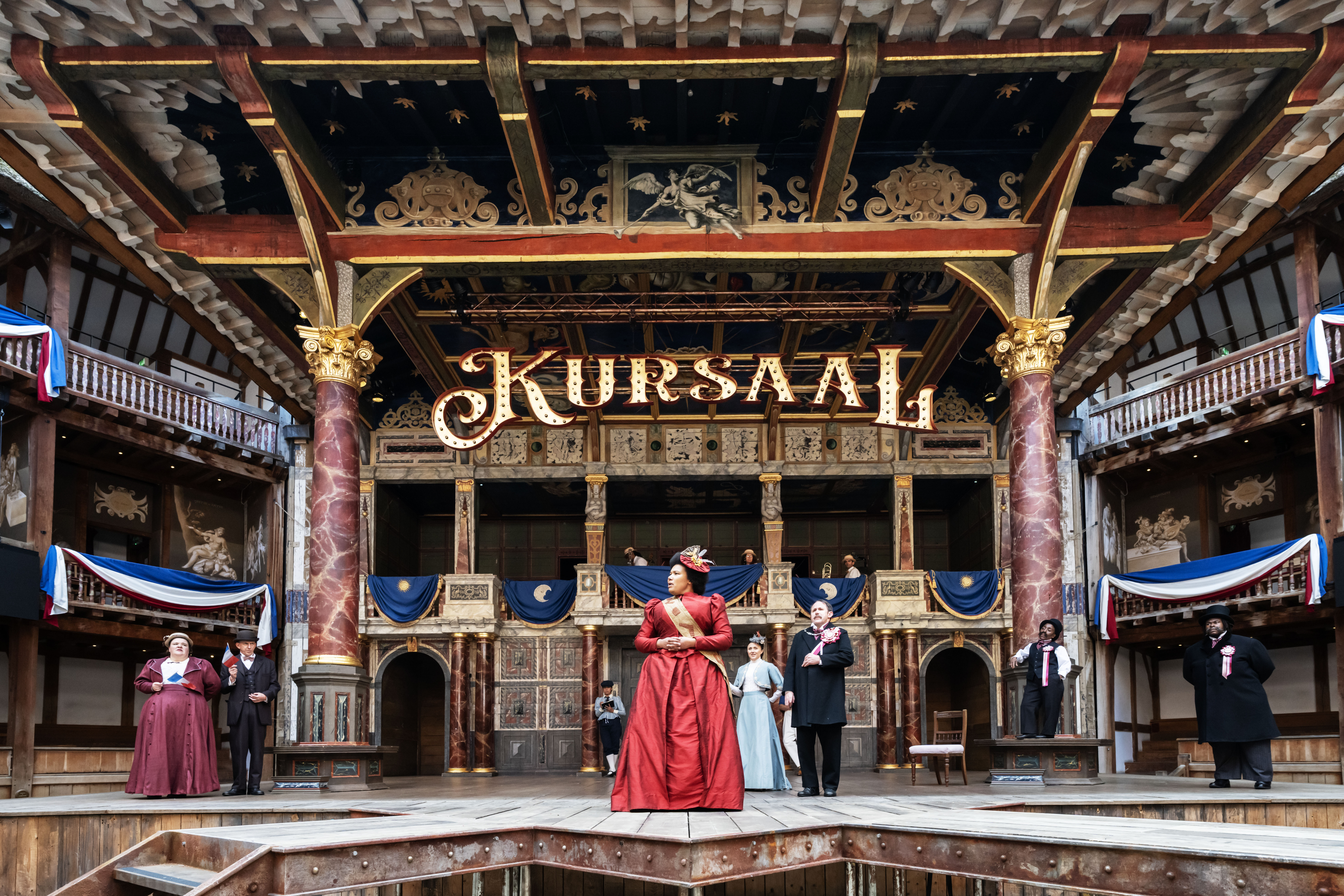
Shakespeare’s Globe hosts the world premiere of Anne Odeke’s historical farce, depicting the trials and tribulations of the first black woman in Great Britain to ever compete in a beauty pageant. Guillermo Nazara shares his views on the show, to let us know this comedy dealing with questionable monarchs ends up being fit for a queen.
I feel pretty. Oh, so pretty. I feel pretty, and witty, and gay! There’s at least one element in that statement that nobody can rebuke – I’ll admit that sharpness and joy are biased matters, though. But why should you care about my own personal impressions in an entry that’s intended to express… well, my own personal impressions? I’m glad you asked. After all, I’m here to grace my readers with my eternal wisdom. And as much as I like complementing myself, all I want is to encourage people to do the same. At the end of the day, the more admired I am, the better.
Moving on with today’s show (the second I’m writing about today – I’m not asking for huzzahs but… you know…), how well are you acquainted with the story of the Senegalese princess that managed to compete, against all odds, in a Southern English beauty contest by the turn of the century? Neither was I. And to be fair, that’s an extremely enticing promise you just can’t resist wanting to find out more about? If that’s the case (otherwise you’ve already wasted minutes of your existence you’ll never get back – and while we’re on the subject, I’ve also called you slow), you might like to pay a visit to the Globe during the next few weeks, because (surprise, surprise!), this time we’re not talking about Shakespeare!

Enter Princess Essex, a new play by actor-writer Anne Odeke, taking a humourous approach at a story that, to a bigger or smaller extent, instigated its own revolution. Introducing us to a half-British maid going through a life of struggle and disappointment, her path will take an impetuous turn after venturing into the arguable wonders of a carnival exhibition. It would be then that she’ll decide to finally take the the reins someone else have been pulling for her up until that moment, and lead her own journey into a trail of success and overcoming.
Set upon quite a compelling inventory of themes, the play manages to present a perceptive, sometimes sharp view on society and the contentious values it so often (and much regrettably) it stands for. However, the script is unable to go anywhere further than its rather archtypical form – establishing the basis for what could have been a much transcending, profound and blissfully moving recount, but unfortunately proving itself incapable of providing more than the expected pulls from the heart’s strings, whose absent touch of insightfulness prevents them from delivering the desired effect.
It would be unjust to say that the piece fails to entertain, nonetheless. All through the account, there’s specks of narrative appeal that, in some way, manage to give interest to the plot and, to some level, build a minor connection with the viewer. However, both the tales and charscters’ arc lack truthfulness and introspection – intending to be a reflection of the endeavours not only the protagonist, but all the people that serve as a mirror image of herself, must face, and yet ending up focusing too much of the action without giving its personages the chance to open up about their inner strives.

In any case, the production still deserves acknowledgement, starting with Hayley Grindle’s perfectly integrated and overall efficient design, and continuing with its magnificent company. With the whole cast portraying their roles with high energy and rapport, author Anne Odeke is able to make a satisfactory appearance as the lead, missing some minor additional intricacy in her delivery. Yet, the biggest praise goes equally to Lizzie Hopley and John Cummins, playing their parts as Mrs Bugle and Edward VII with outstanding flair and uproarious comedic skills.
An amusing jaunt exuding enough potential for a much more compelling opportunity, Princess Essex climbs up the rank to a respectable position, but lacks the attributes (no pun intended) to be crowned anywhere above. Played on the same stage endured by the man whose immortality stems from his singular understanding of the human condition, the standards are indisputably high for any other creator to achieve something of the same richness – but there’s still enough fabric to cut from in order to weave something way more meaningful. It’s a tale of resilience, but for that to be protected, the writing must be endowed with the same solidity.
All pictures credit to Johan Persson.
Princess Essex plays at London’s Shakespeare’s Globe until 26 October. Tickets are available on the following link.
Help us continue our work
We count on your support to keep bringing the greatest quality in theatre-related content, from interviews with the biggest names in the industry to reviews of every show in town and beyond.
We appreciate every donation to maintain our high pace and standards and continue to grow.
Thank you for believing in us!
***************************************************