
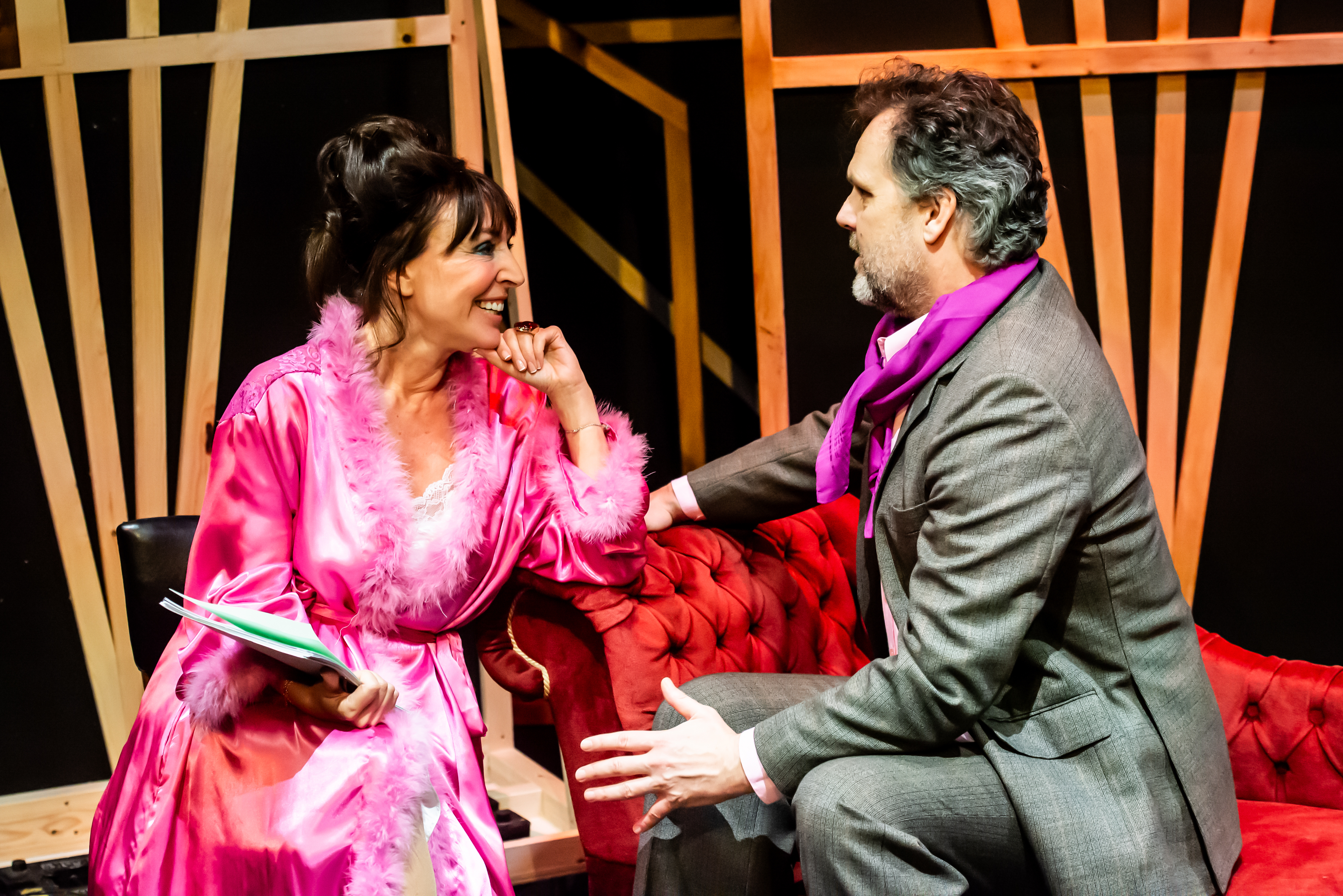
Jean Poiret’s 1977 play returns to the London scene in a revised adaptation starring acclaimed French performer Edith Varnes. Guillermo Nazara shares his views on the show, to let us know if this lively recount by the man who gave us The Birdcage ends up striking a folie-à-deux.
Animals, actors – two kinds of hell! Oh, come on! Don’t be offended if you’re one of those. I had no intention of hurting your feelings… that much. Okay, you’re right – what happens behind the scenes is always a joy! After all, if there’s something that, by all means, defines the showbusiness industry at all, that’s peacefulness among its members. Because there are definitely no attitudes, or egos, or psychotic episodes when you’d just like to pour gasoline on them and let a match do the dirty job… I’ve just been reading a lot of Stieg Larsson lately…
Welcome, ladies and gentlemen (and everyone in between) to La Cage Aux… Oh, no, wait. That was the sane one. Trust me when I tell you things are truly going to get crazy in this one. But maybe not exactly the way some may have been expecting, or even hoping for. Written by the same man whose internationally acclaimed play became the basis for one of the most successful, inspirational musicals of all time, Jean Poiret’s Fefe de Broadway (renamed as French Toast in this new adaptation) brings back the farce, edge and madness that characterizes his style into a another theatrically themed venture – returning his amusing, and despite its extreme touch, universal approach to the struggles of real life, by depicting the biggest threat to it that’s ever walked this earth: as stage diva!

An old premise starring an older archetype of the declining celebrity who just can’t accept her years of glory are long gone, its resonance with a modern viewer from both an entertainment (and, to some extent, philosophical perspective) is still possible, and easily achievable, if handled in the right way. Regardless of the decades passed since the original work was produced, some things (unlike its protagonist) just don’t age – that one’s been in my arsenal for a while… Yet, we must understand that humour evolves at a rapid speed – and, as much as some works remain immortal, it’s always wise to revise what we’re offering to an audience that simply wasn’t the same when it premiered back in 1977.
The creative team behind this reinterpreted version may have taken that notion into account. Featuring Marianne Badrichani as its director, Poiret’s dramaturgy is tweaked by Sam Alexander and company – a credit that, in some way, gives us the impression that we’re in for a different, perhaps more personal look into the French author’s classic. Sadly, though, the only feeling that we’re left with is of an underdeveloped, slightly dysfunctional and apparently not very rehearsed jaunt.
Starting with its rather unfulfilling dialogue, whose severe lack of flow is only surpassed by its generally predictable humour, not only does the play fail to entice us as whole (providing us with not much more than a roughly sketched account with very little exploration of its characters), but also to reveal any hints of individuality or memorability. Too many times, pushing excessively hard to be funny, instead of letting the comedy flourish by itself more organically, the performance continues to stall all the way through by what seems to be an absence of rapport and chemistry among its cast.

There’s little to no timing in their punchlines, and on too many occasions, we end up with the uncomfortable sensation that each member has no awareness of the rest of the troupe – delivering their lines without any back-and-forth energy towards their partners, and repeatedly stumbling on each others’ in a rather clumsy manner. On the other hand, though some of its in-between-scenes transitions are visually compelling, the blocking finds it difficult to direct the spectator’s attention with proper synchrony – making, during the choral moments, not too adequate an use of the space; too often, generating more confusion instead of guidance, especially when the action jumps from one simultaneous conversation into another.
With a set and lighting designs by Hugo Dodsworth, these two assets are by far the highest accomplishment in the entire montage – which, despite its simplicity, both exude sufficient versatility and intricacy to serve and, every now and then, even enhance the narrative. Wistfully, though, that’s not enough to compensate for the flaws of its storytelling, whose deficiency in structure, wit and engaging quality make of it quite hard to swallow – let alone, clink our glasses for.
Walking on the footsteps of one of the greatest, French Toast falls short in their attempts to revive the flame that made of Poiret’s oeuvre a tour de force. Though proving some effort and determination to make things work, the production is yet to find a recipe that can separate fact from fiction, and leave its chaos relegated to the imaginary place where it belongs. It parts from an uproarious idea that could have genuinely cracked audiences up through bitter portrayals and cultural clashes, but beyond its insipid lost-in-translation bits, audiences will strive to hear (or exclaim) any oh-la-las.
All pictures credit to Lidia Crisafulli.
French Toast plays at London’s Riverside Studios until 26 October. Tickets are available on the following link.
Help us continue our work
We count on your support to keep bringing the greatest quality in theatre-related content, from interviews with the biggest names in the industry to reviews of every show in town and beyond.
We appreciate every donation to maintain our high pace and standards and continue to grow.
Thank you for believing in us!
***************************************************
One response to “Review of ‘French Toast’: “It is what it is””
Being both British and French by birth, my 14yo daughter and I both wholeheartedly had an extremely enjoyable evening watching this bold and brave production and I am no technocrat. She especially enjoyed the sleazy jokes and kept turning to me in amused shock-horror! After all these years of hearing Franco-British stereotypes I thought I’d had enough but in French Toast they are displayed in ever more amusing ways. The flaws and inconsistencies are only further reflection of the love-hate relationship my two people have for each other. Edith Vernes reminds us much of Camille Cotin in “The Parisian Bitch, Princess of Hearts”.For only £30, we had a thoroughly evening with laughter guaranteed for all ages and all nationalities – not a small feat has been achieved here! All I can say is hoepfully someone will die on stage!