
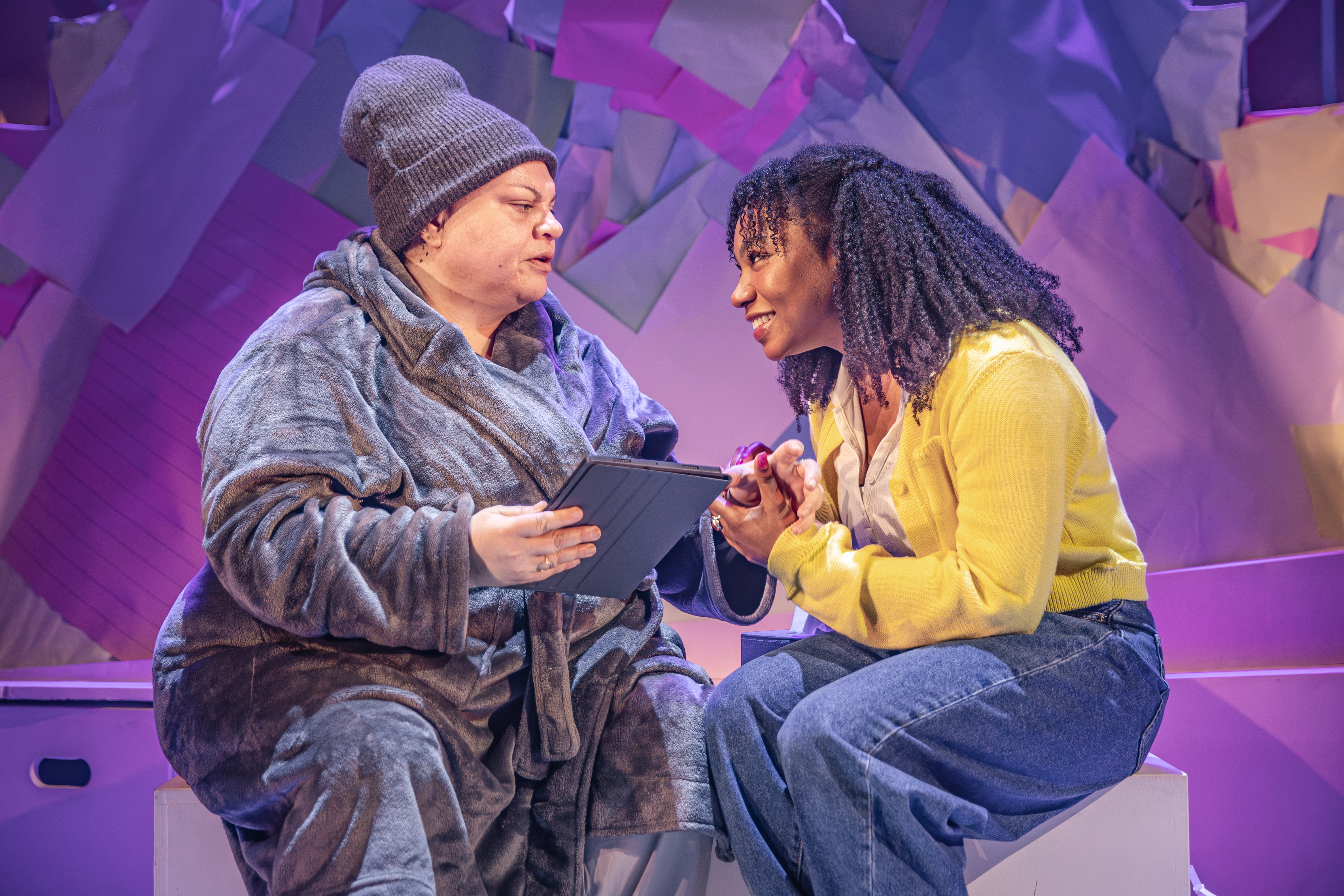
The Southwark Playhouse hosts the London premiere of the American teenage musical, featuring Broadway star Keala Settle. Guillermo Nazara shares his views on the show, to let us know if its escalating drama manages to climb up the mountain.
Art enthrals an audience’s spirit – and heals its creator’s soul. Anyone who’s ever faced the blank sheet and brought to life through either notes, words, or strokes knows how truthful that statement is. Even those who are driven by that natural impulse to dive into universes of their own making sometimes do it to escape the harshness of a reality they can’t endure anymore – or can only reconnect with it through the pages of their imagination.
An early family loss serves as the premise, conflict and essence of London’s latest Off West End musical, Fly More Than You Fall. Upon its original run in the New York scene, the show premiered this week at the (still young) Southwark Playhouse Elephant, featuring a new-face based cast led by legendary Broadway star Keala Settle. Revolving around a thriving teenage writer, whose soaring passion for storytelling will turn every moment of her life into a staggering adventure on paper, all of her universes (particularly, the one she can’t pen) will suddenly be put on hold when she’s confronted by a turn of events she can’t cross out and rebuild: her mother is suffering from a terminal disease.

An effective hook that, if given the right treatment, could also lead to a rather meaningful and introspective exploration, authors Eric Holmes (book and lyrics) and Nat Zegree (lyrics and music) manage to deliver a first step into that opportunity. Featuring what’s probably one of the most enjoyable scores new musicals have offered in the last couple of seasons, the whole repertoire proves understanding of the genre (perhaps, in too much of a purist way sometimes) as well as its own narrative. Every song has purpose, is capable of transporting us from an emotional angle, and conveys, with more or less strength, a significant message that, more that once, ends up resonating with its audience.
The same, though, can’t be said about the dialogue. And it’s there where the duality of this show pops up in full form. While the music is beautifully written (with extremely well crafted melodies, a cohesive general approach, and flaunting versatility in its content), the script loses all of that robustness by making very little contribution to the solidity of the material. There’s basically no reason to include it other than to serve as a bridge from number to number. But, by relegating it to that, instead of allowing it to serve as an essential part of the plot’s structure, both pacing and arc are compromised – preventing the recount from developing its final shape, and consequently getting the production closer to a concept album performance than a full-length musical.
Yet, it would be unfair not to acknowledge that, despite what’s anyway a considerable flaw, its now-and-then excessively melodramatic flavour doesn’t prevent us from being entertained all throughout. Yes, some lyrics could benefit from a bit more subtlety. And there’s a whole bunch of jokes that need to go faster than my morning appetite (don’t make it sound filthy). But the overall inspirational, feel-good tone of the piece makes up for those problems to a substantial extent. Of course, there’s an absence of character evolution still to be amended (which a couple of additional songs that could deepen into the protagonist’s relationship with her parents could solve), but the final impression is of a musical which, though not life-changing, is still charming and heartwarming.

As for the performances, the company exudes energy, presence and some soft chemistry in their executions – with their vocals (despite some tiny, and honestly, rare issues) being the highest achievement of all of their renditions. Among them, Edward Chitticks makes a memorable appearance through his grounded, and somehow touching rendition as the protagonist’s invention, Flynn – while Robyn Rose-Li boasts confidence in her portrayal of the grieving lead, Malia. Yet, the greatest praise goes to Keala Settle, for her magnificent singing as well as poised interpretation – which, in spite of the material not giving her personage enough space for a proper bonding with the viewer, takes every opportunity she’s given to truly compel.
There are stories we choose to make – while others are just thrust upon us. But the way they unravel, from that point on, depends on the next paragraphs we decide to print. Fly More Than You Fall is a tale of resilience, overcoming, and ultimately, letting go. With some homework to be done, the show however has enough basis to satisfy its public if looking for an evening filled with an amusing (and slightly moving) plot and absolute musical earworms. It’s not perfect, but at least it’s been able to build its own entity – with the potential of progressing into something with more stirring, eye-opening, and ultimately, distinct. It never plummets, though, it only keeps looking up.
All pictures credit to Craig Fuller.
Fly More Than You Fall plays at London’s Southwark Playhouse Elephant until 23rd November. Tickets are available on the following link.
Help us continue our work
We count on your support to keep bringing the greatest quality in theatre-related content, from interviews with the biggest names in the industry to reviews of every show in town and beyond.
We appreciate every donation to maintain our high pace and standards and continue to grow.
Thank you for believing in us!
***************************************************