
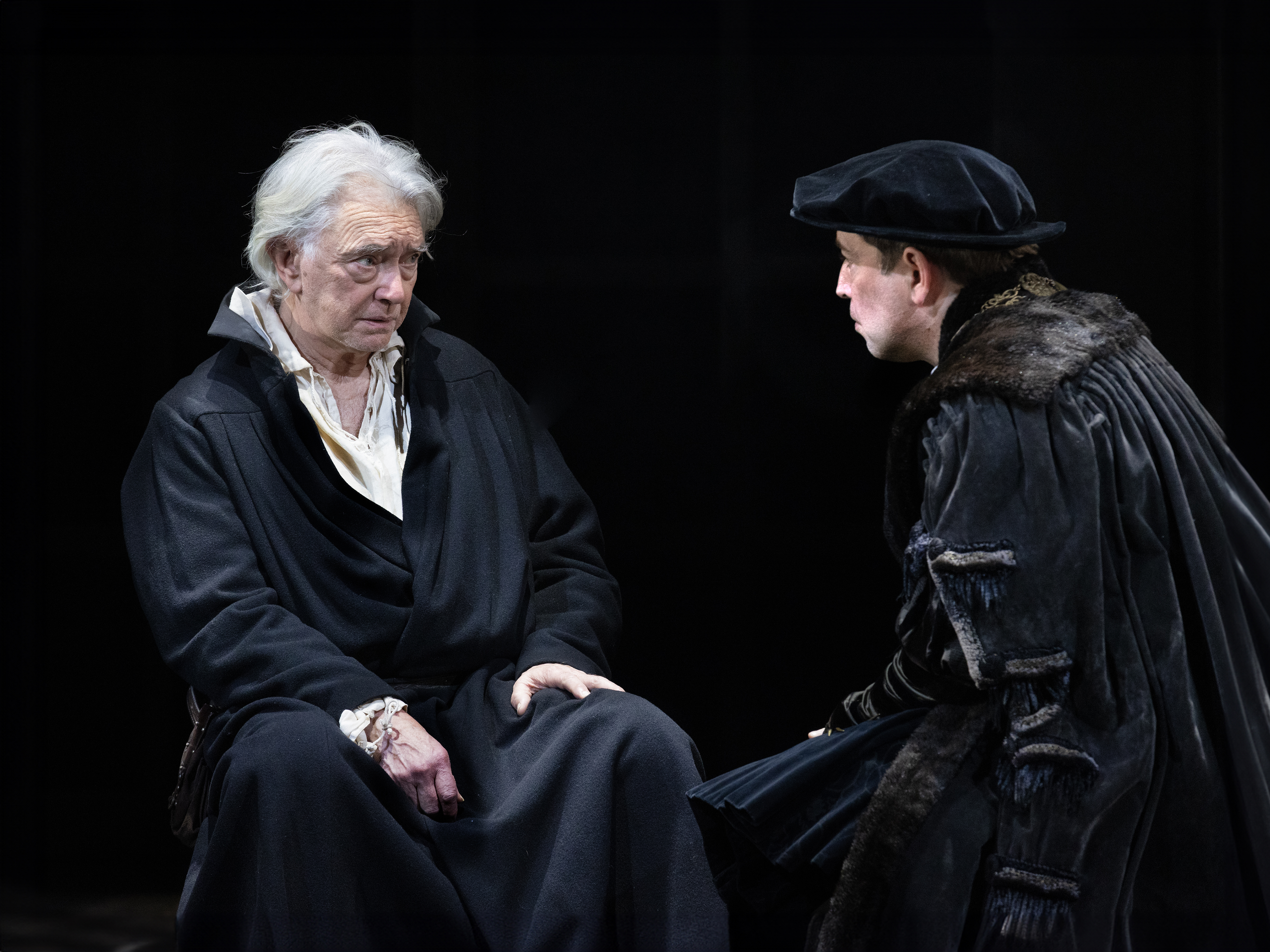
The Richmond Theatre welcomes the revival of Robert Bolt’s historical play, depicting the late life of Sir Thomas More and starring legendary actors Martin Shaw and Gary Wilmot. Guillermo Nazara shares his views on the show, to let us know of its narrative about the strong-headed man has an axe hanging over it.
The truth will make us free. So many of those who have fought for that principle have irremediably faced its paradoxical nature. Yes, truth does in fact liberate our minds. Speaking it, however, comes with different consequences. What’s remarkable, though, is that this is not the story about someone who just said too much – but who talked too little. It was not his words that sealed his fate, but his silence that eventually brought his final sentence.
I wonder what it was like to live in a time when opposing the ruling opinion even the slightest could get you in big trouble… Those were days, right? Yeah, you see where I’m going. Anyway. It doesn’t matter when it was written. It doesn’t matter when it happens. Robert Bolt’s acclaimed classic, A Man for All Seasons, has returned to the English stage – and with good reason.
Put together under the direction of Jonathan Church, and featuring a cast led by the legendary Martin Shaw and Gary Wilmot, this new production opened last night at the Richmond Theatre – reviving its turbulent recount about probably one of the most fascinating characters in both British and Catholic history. A martyr in the eyes of the Church, a traitor to the knowledge of King Henry VIII, the resilience of a man who stood up for his own ideals to his very last breath makes of him an excellent subject for a play – and almost as excellently it’s been executed (no pun intended).

Set during Thomas Cromwell’s rise to power, the plot collides the virtuosity of someone concerned about remaining faithful to his moral values against someone who’s only loyalty lies in his own personal benefit. The premise poses such a rousing conflict, it’s impossible not to be gripped by it. And generally, Bolt serves the cause with grace and flair.
Thoughtful and philosophically driven, the dialogue flaunts skillfulness all throughout – adequately crafted, and growing in poignancy and intelligence as the piece progresses. There are some issues to be pointed, nonetheless. While the second half works almost flawlessly, Act One struggles at some points in terms of pacing and subtlety – with several lines lacking that same level of sharpness, and the dramatic strength of some scene occasionally withering down.
Yet, the text works rather well on the whole. Every role is handled with acuteness and depth – maybe not delivering as much pathos as we could hope for, but balancing it out quite successfully through the stir and acumen of its narrative. It’s impossible not to be absorbed by what we’re being told – especially when that is presented in such an impeccable manner.

With set and costumes by Jonathan Church, the staging is one of the most praiseworthy elements not only in this production alone, but the touring ones altogether. Intricate and visually imposing, the grandeur of the scenography is matched by the cleverness of its design – seamlessly transitioning from one ambiance to another through its, all in all, triumphantly achieved versatility and dynamism; effectively complemented by Mark Henderson’s highly detailed lighting.
As for the performances, the company boasts exceptional chemistry, as well as great dexterity in their portrayals. Martin Shaw brings along his usual magnetism and prowess through his most compelling rendition of Sir Thomas More, while Gary Wilmot carries out his part as The Common Man with the charm and aplomb he’s regaled us with in previous acts. However, the big mention is earned by Edward Bennett as Thomas Cromwell – drawing out the antagonist’s insidious appeal through a most captivating and effortlessly accomplished interpretation.
Not surprisingly, it’s often the works that deal with other ages the ones that are the most likely to resonate with ours – and probably, never feel dated. Maybe, that’s what Robert Bolt predicted when he came up with the title for A Man For All Seasons – or maybe he was thinking about me (we’ll leave that opportunity open).
Whatever the case, the firmness of the material, along with the distinction its latest revival conveys, makes of it a solid and much safe bet as for what to see this week. Though in need of some minor tweaks, including a more fulfilling epilogue, the show can easily and fairly be considered a tour de force – where a fine opus meets at even finer effort at bringing it back. It’s a tale from the past that doesn’t sever ties with our present – crystallised through somebody who had the chops to give his mind a voice.
Help us continue our work
We count on your support to keep bringing the greatest quality in theatre-related content, from interviews with the biggest names in the industry to reviews of every show in town and beyond.
We appreciate every donation to maintain our high pace and standards and continue to grow.
Thank you for believing in us!
***************************************************
All pictures credit to Simon Annand.
A Man Of All Seasons plays at the Richmond Theatre until 15 March. Tickets are available on the following link.