
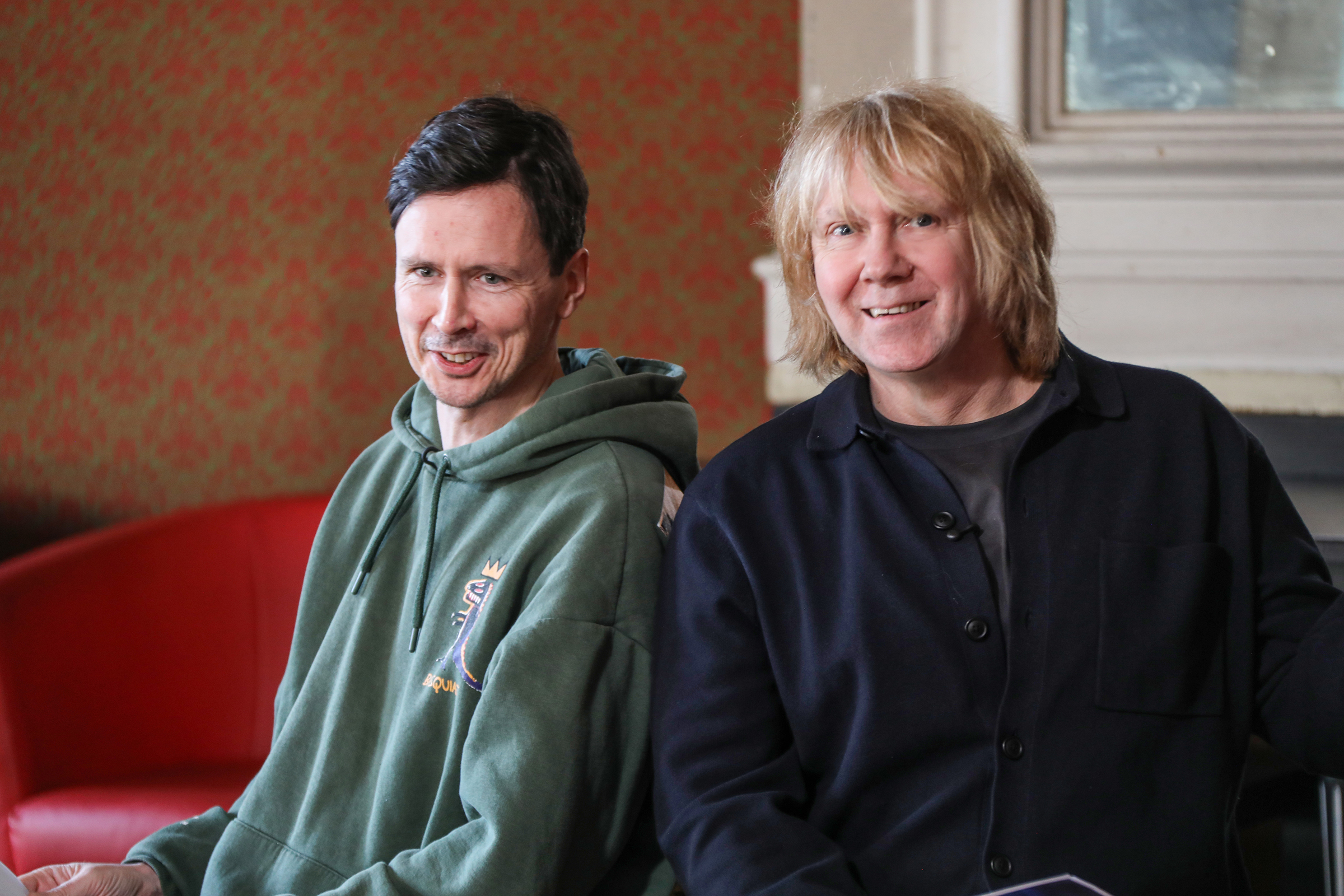
Upon its initial run at London’s Upstairs at the Gatehouse, the puppet show gets ready for it first German-language production – playing in Halle and Saale at the start of summer. Guillermo Nazara chats with the two men pulling the strings, to learn more about the development of this toilet-themed musical, as well as the workings of their creative flow.
How did the idea for the show come about?
M: There’s no easy answer to that question. People still struggle with the misapprehension that, to create, all you need is an idea and then you can go do it. But to write a novel or a movie or a musical, you have to keep having ideas. One idea is nothing. You have to have hundreds of ideas, and then you keep the best ones, throw away the worst ones, and then have some more. It’s very long to explain and listen to. So, put more simply, here’s how the idea for the show came about: I was standing on the edge of my toilet, hanging a clock, the porcelain was wet. I slipped, hit my head on the sink, and when I came to, the entire show was fully formed in my mind.
T: Mark and I had been involved in the production of Copperfield! – The Musical in spring 2022, he as one of the main actors and me as the composer and musical director. After one rehearsal, Mark and I went to a pub and a few drinks later we decided to write a new musical together. Another few drinks later and that musical was titled “The Loosical”. So then, we built the story around the title.
The piece draws some inspiration from previous icons like Avenue Q. Apart from its storyline, what makes this show different in terms of style and approach?
M: The show is entirely voiced by only two actors – the concept being that of a father and daughter making up a bedtime story together. Also, the puppeteers not only operate the puppets but double as puppets themselves by lip-syncing. It makes sense to say it draws inspiration from Avenue Q, but I have not seen the show, so that is more of a happy accident. However, I was brought up on Spitting Image, which might explain the presence of two particular characters. In fact, in order to avoid too much comparison, here Queen Elizabeth II is a stringless marionette, and Margaret Thatcher is a talking portrait.
T: We started to write it as a normal piece. Then Mark came up with the idea to have the part of the little girl be done with a puppet. In the process of writing, we saw that we had too many characters for an Off West End production. So, I remembered my connections to the Puppertheatre Halle and we went there to see if they were interested in collaborating. The difference to Avenue Q is that we don’t parody an existing show. We created a new plot, which is a funny and weird bedtime story, told and sung by only two actors, a father and daughter. They are talking and singing all the roles such as Queen Elizabeth II, Margaret Thatcher, Elvis Presely, and so on. The characters are played as puppets by four respective puppeteers who only move their mouths and don’t speak or sing on their own.

What themes have you attempted to explore through this musical?
M: “There’s no subtext, there’s no message, there’s no underlying theme” – lyrics from the opening number Don’t Expect Too Much.
T: It’s a bedtime story told by a father and his little daughter who is trying to extend the time until she has to go to bed by staying in the toilet . So, we always have the funny conflict between the grownup and the child. Mark and I created the story together, where I gave some good headlines and catchy tunes – but Mark is the brilliant storyteller, and he gave all his wit to the lyrics and the dialogues. As I’m a native German speaker, I had the task to translate it back into German, which I did with Michal Kuhn. It was not easy to find ambivalent terms for most of the typical English jokes, but it was good fun to do it.
In a time when political correctness seems to dominate every aspect of our lives, how challenging is it to put on a satirical show?
M: Satire seems impossible these days. Donold’s AI video of his Golden Gaza Getaway makes The Day Today look like an episode of My Family. With that in mind, I’m delighted to inform you that there is nothing remotely satirical about the show, it’s a toe-tapping, frothy romp set in a heavenly loo.
T: Well, I can only speak for the Germans, but I think shows like “The Office” wouldn’t be possible at the moment there, which I think is sad as some people have unfortunately forgotten how to laugh at their own and other’s little shortcomings. But I think there is always a need for fun and sarcasm. Maybe it’s the same in the UK. I was growing up in the socialist part of Germany until the wall between the East and West fell down. I was told so many different truths in my life which is why I didn’t want to include current politics in “Death On The Throne”. But if Louise, the daughter, lets the conservative Margaret Thatcher fall in love with the East German socialist chairman, Erich Honecker, who then become human in the uninviting environment of purgatory (which is a lavatory in our play), then it reveals the absurdity of politics and politicians. In our show, we make jokes but we don’t upset anybody. That is what I like about the British sense of humour.
Have we lost our ability to poke fun at ourselves?
M: If you’re talking in terms of an increasingly polarised world, some have, yes. But it’s important to still poke fun at ourselves and others even if it’s uncomfortable.
T: I hope not, but if so, maybe the English people who are not able to poke fun at themselves should come see the German version and just enjoy the music.
What other challenges have you found in the creation and development of this piece?
M: We’re doing a show that ideally should have more than thirteen puppets and twice as many puppeteers. We have four puppeteers. So, given that grafting additional arms onto our performers was not an option, it’s been something of a 4D jigsaw.
T: It’s always a challenge to create a brand new piece in a world with so many existing and already successful shows. I’m very grateful for having found such wonderful partners who believed in us and invested money, effort, heart and soul into our show.

How would you describe the essence of the show? Is there any message you’re trying to convey through it?
M: At one point in the show, Mahatma Gandhi sings:
Lenin is on the Loo,
L-l-lenin is on the loo.
Last night he had some of my vindaloo,
He’s going to be another hour or two.
If you can find the hidden message there, I’ll eat ma hat (sic).
T: We don’t want to educate people, we want to entertain. But we show that the innocence of children is mainly the right way to look at the world.
What are the prospects for the production after this initial run?
M: We will be leaving an empty seat for Sir Mackintosh every night, should he feel the urge to come to Highgate. But in lieu of a West End transfer, it has already been translated into German and will be performed in Germany this summer.
T: After the run at Upstairs At The Gatehouse, we’ll bring the German version to Germany, where it will be on for another three weeks in Halle/Saale. We hope promoters will see it and send Death On The Throne – The Loosical across the UK, Europe, around the whole wide world, and to other planets.
Why come see Death On the Throne?
M: The theory goes that if you have an infinite number of monkeys and an infinite number of typewriters, eventually they will type out the complete works of Shakespeare, but as God is my witness, they’d never be able to write Death on the Throne.
T: It’s much better to have seen it than to be told what you missed. And this show will definitely be told to everyone who missed it.
Help us continue our work
We count on your support to keep bringing the greatest quality in theatre-related content, from interviews with the biggest names in the industry to reviews of every show in town and beyond.
We appreciate every donation to maintain our high pace and standards and continue to grow.
Thank you for believing in us!
***************************************************