
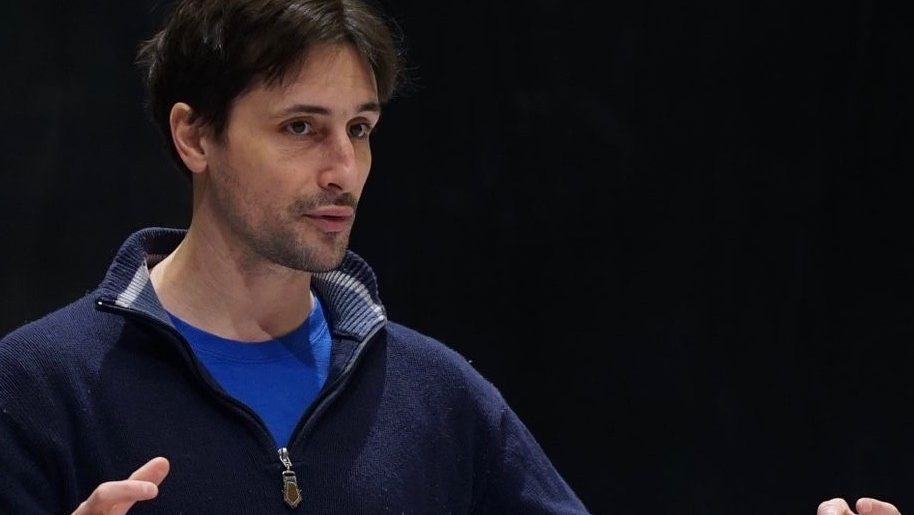
Pushing the boundaries of storytelling through their mixture of music amd physical acts, the company presents their latest productions, exploring the fragility of the human condition through experiences of memory and pregnancy loss. Guillermo Nazara chats with the group’s lead creative, to learn more about the gestation of these pieces and how their real-life inspirations were recollected.
How did the idea for these shows come about?
We tend to start each devising process with a question. Something that we don’t have the answer to. The Nature of Forgetting started with what is eternal. BIRTH started with when does memory begins. Bluebelle started with why live theatre. The way we respond is very open and encompasses a wide range techniques, art forms, and theatre traditions. The whole process is always guided by a sense of play and the joy we find in it.
What prompted you to deal with the subject of pregnancy loss and fertility?
For BIRTH, we focused on secrets within families and discovered the world of psychogenealogy, which is about recognising parallels between our own lives and the lives of our ancestors, and how issues or traumas might have been subconsciously passed down. We used this to ‘study’ our family trees and unravel some of these secrets. Pregnancy loss was the one thing that all our trees had in common and was never talked about. Surprisingly, ‘losing a baby’ is also something that came up in our improvisation sessions without us consciously looking for it.
Our journey on Bluebelle took us from corporeal mime to clown work; from imaginative transformation to visual vernacular; from rich musical textures to sound design; from philosophy to silliness; and from real life experiences – gathered from interviews with parents and carers to ancient folktales.
Throughout the process, we have been very keen to explore the themes of responsibility, care, over protection, guilt, and continuance – or, in other words, what one would want to pass on to their children. One quote from Angela Carter stayed with throughout the process when thinking about folktales: “The common unspoken goal is fertility and continuance.“

One of the key features of your shows is the inclusion of community groups throughout their development. How has that translated into the creation of these pieces?
For Bluebelle, we collaborated with the Fertility Network to explore the struggle to conceive and the impact that it can have on individuals and couples. We engaged with groups of carers to explore the notion of care and our relationship to those we love. Through an open call, we also interviewed parents at various stages of their parenting journey.
These conversations had a crucial influence on the development of the work and have allowed us to ground our discoveries and make connections with real-life experiences. But it is important to mention that, just like with every other Theatre Re productions, we are not making verbatim theatre, so none of the words, characters and personal stories are being used on stage.
For BIRTH, to explore the subject of pregnancy loss specifically, we first collaborated with Anyone Everymum (organisation supporting women and families in their journey through birth). Along with sharing their expertise, knowledge and experiences, they took us through the various steps they use in their sessions with women. Many discoveries made during these workshops were then developed and worked into the piece. Some of them are invisible, others led to the devising of full scenes. This collaboration also helped us to create the right atmosphere around the work and helped guide our research.
Later in the process we also engaged with Aching Arms (nationwide baby loss charity run by a group of bereaved parents) and were able to get an insight into what it means to loose a life. Their feedback on the work helped us ensure that our piece was a faithful representation of what some parents go through without being patronising nor sentimental.
The shows have also been developed in collaboration with National Institute for Health and Care Research. What has been their involvement in this process?
The journey of Tom and the people around him in The Nature of Forgetting was informed via workshops and interviews conducted with people living with dementia and their carers throughout our development process (16 months). Our aim was not to collect personal stories but to explore the special bond that exists between music and memory. Music seems to be using parts of the brain design for purposes other than memory, therefore people living with dementia keep responding to music and that is where we understand that memories do not disappear, they just become inaccessible. We also collaborated with Professor Kate Jeffery of the Neuroscience Department at the University College of London. Our aim was to use forgetting mechanisms to develop our piece, and create links between the science and the real human experience.

What theatrical techniques have you applied specifically for these shows?
One of the things that sets us apart is our unique style of storytelling – bringing original live music with visual theatre to deliver a strong story. Through our combination of inventive theatre and rigorous dramaturgy, we are able to connect with audiences in an intuitive way, and deal sensitively with taboo subject matters. Every action becomes a metaphor resonating with people across the world regardless of where they are from and what language they speak.
When it came to developing Bluebelle, we were keen to collaborate with Deaf and Visual Vernacular Artists. This ensured that Bluebelle could be accessible without the need for BSL interpretation, but it also enabled us to challenge our physical and visual style, as well as our way to communicate without words. It has also showed us that there is so much more we could do to make our work fully accessible, starting with more BSL interpreted workshops.
Have you faced any particular creative challenges in the creation of the show?
The whole process of making something out of nothing is a challenge! Bluebelle was developed during COVID, and it’s interesting to see how that experience has had a major impact on the work. Bluebelle became a piece about hope, and our desperate need to believe in the magic of ‘once upon a time’.

Are there any highlights in these shows you’d like to flag?
For me the highlight in all our shows is the team. We are very fortunate to be collaborating with extraordinary people on and offstage. It’s a privilege to be able to do this with all of them.
Why come see BIRTH, Bluebelle and The Nature of Forgetting?
People should come and see us because I truly believe that our work is unique. There isn’t any magic per say in our shows, but the adjective that most audience members use to describe our work after a show is that it was magical. Who does not want to experience something magical?
Help us continue our work
We count on your support to keep bringing the greatest quality in theatre-related content, from interviews with the biggest names in the industry to reviews of every show in town and beyond.
We appreciate every donation to maintain our high pace and standards and continue to grow.
Thank you for believing in us!
***************************************************
Further information on Theatre Re’s current productions is available on the following link.