
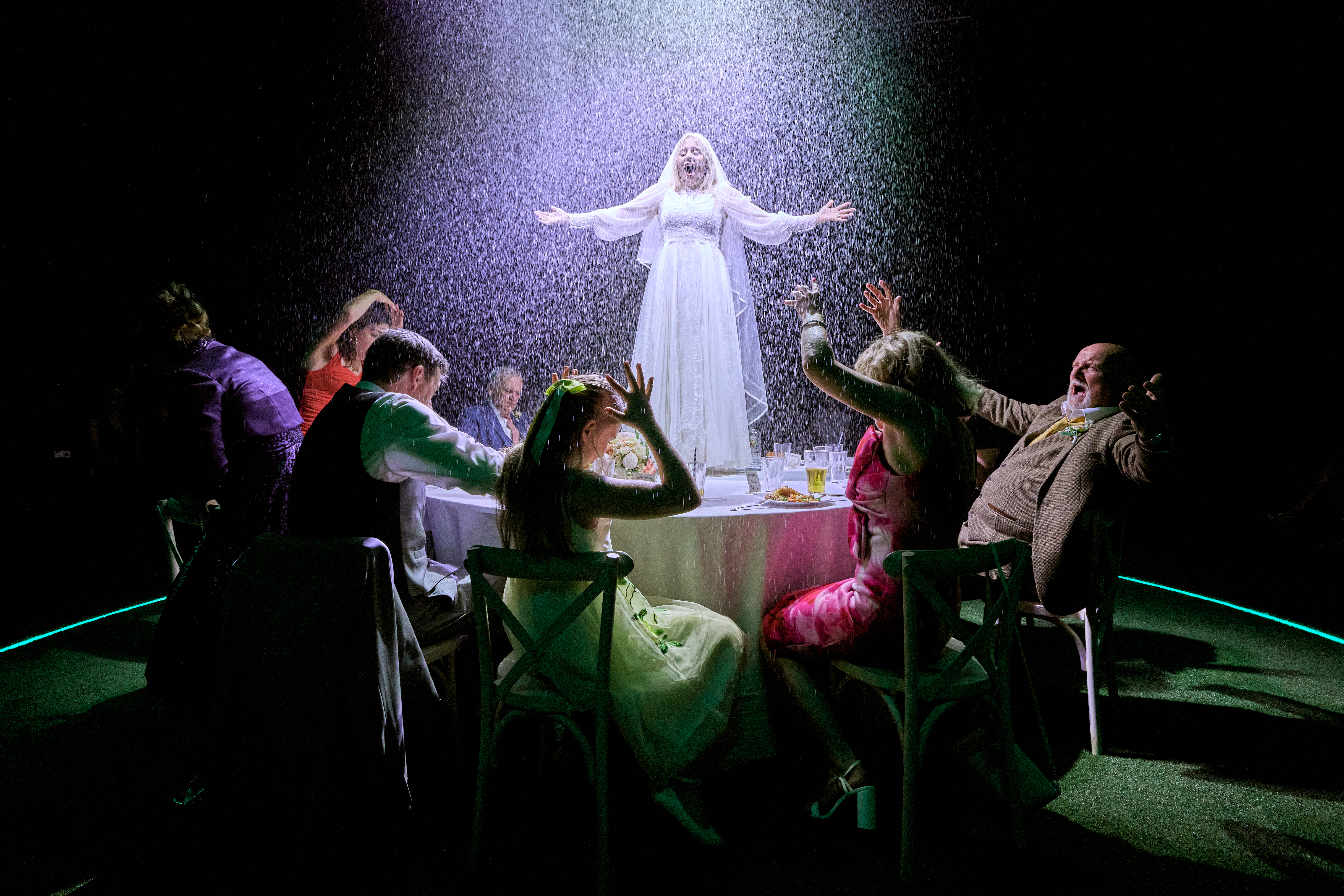
The National Theatre’s production celebrates its West End transfer, playing at the Theatre Royal Haymarket for a 12-week limited run until the end of summer. Guillermo Nazara shares his views on the show to let us know if this tragicomical proposal comes off as a match made in heaven.
Mamma Mia! Here we go again! Another play about another bride being an absolute nervous wreck just a few hours before her wedding. Only that time, though, the actual wreck will be making its appearance a few hours after walking down the aisle. And not surprisingly, it will come in the shape of a culturally prejudiced family with no intention of pulling any punches back — literally.
It’s not a premise that screams originality. But its resonance in today’s world couldn’t be stronger. In a time when polarisation has become the shield to protect us from any critical thinking, a plot concerning the biased views some people hold against immigrants seems to have landed at the most appropriate moment. And so, its enticement is therefore guaranteed. Yet, it won’t take long for the writer to break her vows in this soon-to-become blood wedding. For as much as all the pieces are in the box, the puzzle is a long way from being finished.

It all begins with the event’s preparations. We encounter an anxious bride-to-be whose dress won’t fit. Instead, she chooses to wear her mother’s. Meanwhile, a load of irrelevant small talk has taken place. We get to know her sisters and nieces. They’re the usual everyday people. Nothing out of the ordinary — that includes their particular taste for vulgar remarks.
The exposition is thoroughly sketched but not too well-crafted. For almost 30 minutes, it constantly feels like the recount isn’t going anywhere. After a whole first act, that sentiment still lingers in our minds. And though the second half does provide us with a more suitable conflict, its exploration and resolution are so frightfully vacuous and rushed, we’re hardly given a chance to hop on its journey — if there’s any.
Playwright Beth Steel struggles to build a cohesive emotional arc for any of her characters. Though the themes she wants to tackle are compelling, none of them achieve any level of poignancy due to the shallowness of their approach. In many ways, the text resembles a first-time author’s attempt, where the germinal idea shows promise, but its delivery proves how its creator is still stretching their creative muscles.
There’s no proper structure. And the pacing, on the whole, is flawed. Some excerpts hold a decent grip, but many others come across as too empty and pointless, packed with lazy jokes and forced humour for no other apparent reason than filling the script. And in that endeavour, it detaches itself from its path to poignancy, leaving all those opportunities behind by confusing soulfulness for melodrama and narrative individuality for storytelling chaos.

The staging fails to bring too much value to the experience, let alone stand out. With some aesthetic reminiscences of People, Places, and Things (another member of the National’s large offspring), the piece is presented in the round, taking some viewers onstage to watch the performance from the background and across the wings. A grass-coated floor with a central revolving platform serves as the core element of its scenery — the rest consisting of several fluttering props and the usual lighting cues. None of it lands in too satisfactory a manner, and while it’s able to paint the picture with enough deftness, the design choices still look debatable and often uninspired.
The company does all it can to squeeze the little substance the material offers. Regardless of how superficially the roles are penned, every rendition still comes off as extremely truthful and natural, moving past the piece’s overall unripe tone and the dialogue’s occasional clunkiness, and concocting more than adequate portrayals that exude a great degree of charisma and personality.
Popping a few thought-provoking questions but incapable of preserving the engagement throughout, Till The Stars Come Down suffers from a lack of identity about what kind of play it wants to be. Moving from a farcical sitcom into a tragic but not too harrowing tale of moral misery, the piece stands closer to a blue-sky assortment of rough ideas than a honed work of fiction, losing most of its potential due to its inability to separate the good from the bad. There are robust enough elements in it that could assemble into a worthy marriage. So far, though, they all seem to be filing for divorce.
Help us continue our work
We count on your support to keep bringing the greatest quality in theatre-related content, from interviews with the biggest names in the industry to reviews of every show in town and beyond.
We appreciate every donation to maintain our high pace and standards and continue to grow.
Thank you for believing in us!
***************************************************
All pictures credit to Manuel Harlan.
Till The Stars Come Down plays at London’s Theatre Royal Haymarket until 27 September. Tickets are available on the following link.