
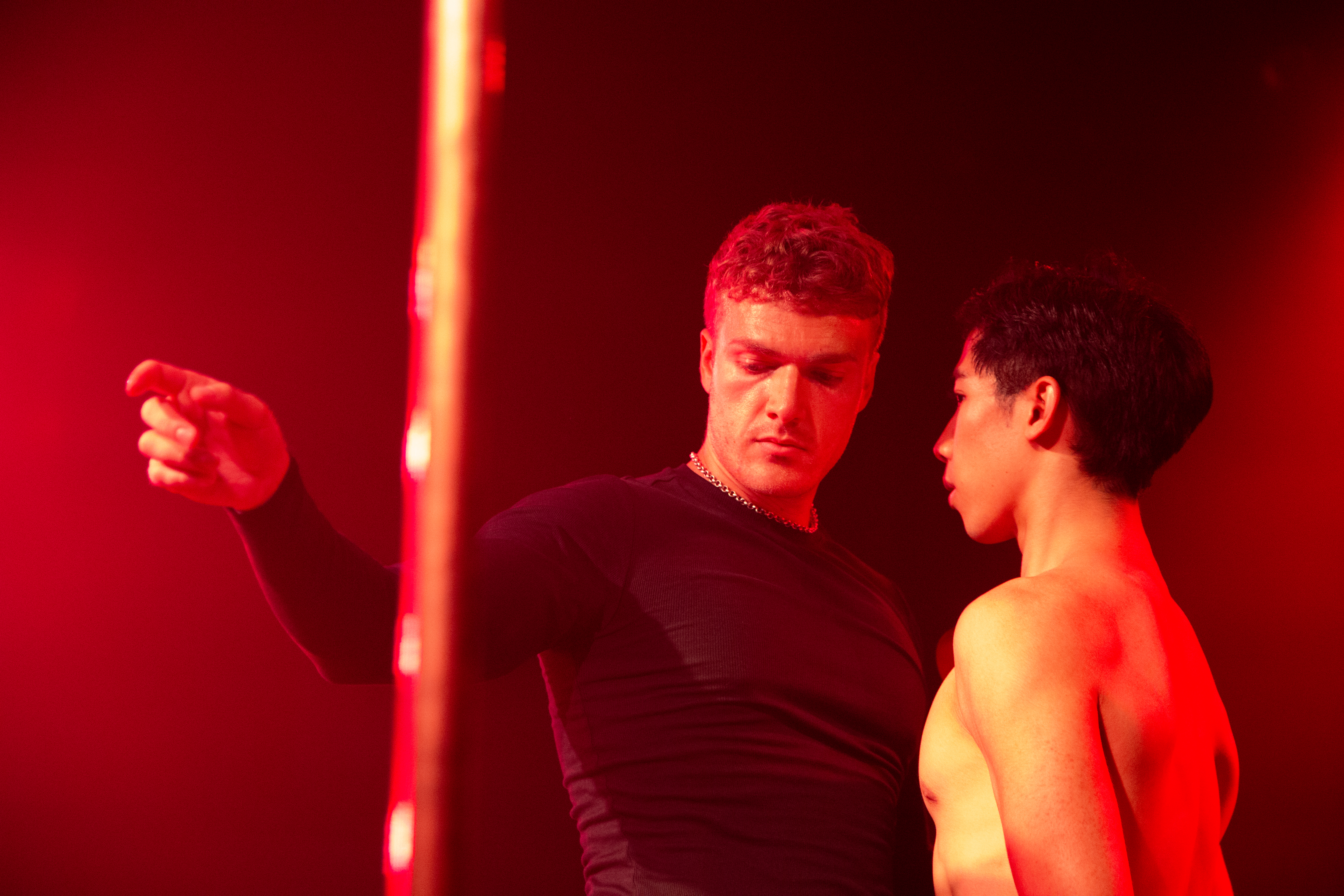
Jake Brunger’s play returns to the London scene in a new production directed by Jack Sain, running at the King’s Head Theatre until mid-August. Guillermo Nazara shares his views on the show to let us know if its narrative about sexual exploration comes off as a big enough satisfier.
Here it comes again (no pun intended). Well, perhaps a little. And that’s just as many double entendres as I can handle for an opening. Darn it. But yes, here we have another gay play dealing with (surprise, surprise!)… SEX! They’ve been done so many times (well, some of us more than others) that the element of shock is less likely than avoiding dickheads on Grindr — in every possible sense of the word. And it’s not like many of its viewers will be getting acquainted with it for the first time, as Four Play has been around for a few years now — tell me about it.
But for those who you can’t have enough (I think I recognize a few faces there), the King’s Head Theatre welcomes you to the latest revival of Jake Brunger’s piece, which celebrated its gala performance last night before the thirsty looks (projecting) of every guest enticed by its suggestive title (I’m just making sure you got the pun, babe). If that’s what you were after, I’m sorry to burst your bubble after busting your balls — you shall not indeed find any nudity throughout the rendition. And that’s probably one of the most laudable aspects of it.

Anyone familiar with gay theatre should be aware of its recent decline in quality. The subjects are all the same. And its checklist doesn’t seem to let go of any points: weak plots, lazy writing, and archetypical characters that represent every possible cliche in the fairy book. But, of course, all of that can have a pass (cough) as long as they offer us some bare eye candy.
Four Play may use sex as its key narrative driver, but it avoids relying on gratuitous full frontal exposure for the sake of actual exposition and character development. And though the latter could still benefit from some additional honing, the way it bones up on its themes doesn’t leave audiences halfway.
Two households, none alike in dignity. Both couples have been together for a while. But things aren’t going well for any of them. While in one relationship, both partners have allowed each other to fool around for a while now, the cracks are starting to show. The other has remained monogamous for over 7 years. Yet, the lack of flame has put everything they’ve built together. It’s time to bring something else to the party. And the solution has been erected in front of them for this whole time. Inviting one of their non-exclusive friends over might help with the problem, or unintentionally causing a bigger problem by not telling the other one.
It’s a premise that doesn’t shine with originality. Yet, it manages to achieve a compelling degree of individuality. Though far from an identical copy, its similarities with Afterglow (another precious gem in some queenly theatrical vaults — Prince Albert style) are noticeable. The difference comes from the deftness of its execution, flaunting a much more robust structure and palpable growth, and not falling so plain-spokenly into predictability.

Despite some occasional banal lines, the dialogue exudes sufficient depth and flow to enhance the plot’s gravitas. The scenes are often well-concocted, and though approximately 20 minutes of additional material are missing, the arcs lead to a satisfactory resolution. It’s true, however, that the nexus connecting the starting and ending point feels somehow sketchy. Yet, the script still achieves the poignancy it aims for decently enough, resonating with its viewer for most of the journey.
Jack Sain’s direction stands out visually through an excellent exploitation of the entire space. Combining a thrust stage with the usual aisle entrances (a signature trend at the King’s Head), his approach still leaves room for imaginativeness, featuring a few unexpected resources that effectively enhance the recount’s rhythm and dynamism. At the same time, Daniel Carter-Brennan’s intricate lighting makes the most refreshing asset of the design, creating a pulsating tone that builds a solid atmosphere while also accentuating the piece’s emotional ride.
The cast’s delivery is overall adequate, not sharing the strongest chemistry, but still boasting enough flair and rapport, with two portrayals coming across as rather enjoyable. Daniel Bravo emanates presence and nuance in his rendition of Michael, generally convincing and well-layered despite some overly choreographed mannerisms. However, the highest praise goes to Jo Foster as Andy, becoming an undeniable show stealer through their remarkable magnetism, instinctive comedic timing, and inviting naturalness.
Edging the viewer with a rich load of penetrating topics, Four Play sets the path for a moderately interesting, occasionally thought-provoking, and mainly relatable theatrical experience, making a crude but honest depiction of modern romance. Despite some condom-lences should be offered for not going all the way in with its subjects (kinky lad there), its discernible imperfections have not deprived it of its ability to touch me and my heart. And the fact that I have one might come off as the biggest twist of the evening to many.
Help us continue our work
We count on your support to keep bringing the greatest quality in theatre-related content, from interviews with the biggest names in the industry to reviews of every show in town and beyond.
We appreciate every donation to maintain our high pace and standards and continue to grow.
Thank you for believing in us!
***************************************************
All pictures credit to Jack Sain.
Four Play runs at London’s King’s Head Theatre until 17 August. Tickets are available on the following link.