
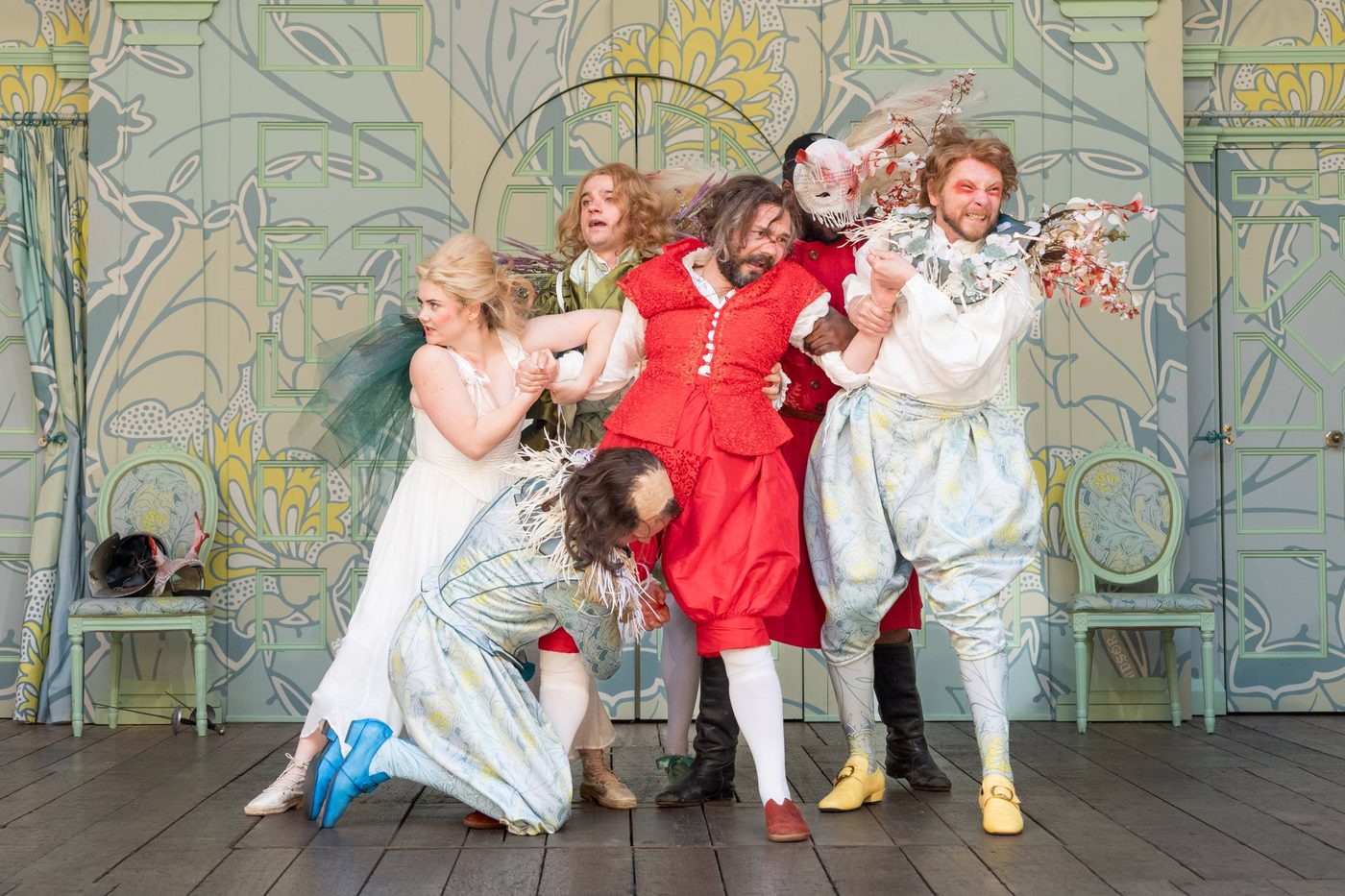
The Bard’s comedy returns to the London stage in this new production envisioned by reputed director Sean Holmes. Guillermo Nazara shares his views on the show to let us know if this latest approach to the classic play shall let audiences drink down all unkindness.
Well, sooner or later there had to come the moment when I wasn’t mesmerised by one of Shakespeare’s efforts. In all fairness, that already happened long ago, but I’ve always defended that a good take on a not-so-excellent material can still lead to a decent outcome. And to be honest, The Merry Wives of Windsor isn’t by far the Bard’s worst work — there have been greater disappointments coming from the Stratford genius’ quill and undoubtedly from those who have laid their hands on them.
But we’re not here to bitch about the revered author’s least accomplished feats. Yet, the sense of betrayal some fans may experience could easily evolve into a fine tragedy in its own right, consumed by the rage of not being given the depth and soul-stirring humanity his masterpieces flaunt. That probably was never the intention behind the writing of this play, commissioned by Queen Elizabeth I upon her desire to see the infamous Falstaff fall in love. And falling in love, he did alright — well, perhaps not that much.

A tale of doomed romantic affairs performed to the delight of roaring audiences, the script’s entertaining skills are not as deft as in other of Shakespeare’s comedic triumphs, Much Ado About Nothing and The Comedy of Errors being a personal favourite of mine. Of course, countless lines have been penned about the subject, with the lack of time he suffered from (he completed the work in roughly two weeks) being the primary suspect of its not-so-palatable flavour.
With a repetitive plot that, despite its gimmicks, loses much of its interest during the second half, delivering an engaging narrative that respects its source while resonating with modern audiences sounds like a kamikaze challenge to say the least. Director Sean Holmes survives the incident with decency, following his signature style of period-inspired staging blended with farcical drollery, much in the same manner as we’ve seen in previous seasons.
To some extent, it works. There are moments of absolute bliss, where both Shakespeare and Holmes’s minds seem to feed from the same creative muse. However, that doesn’t translate into a full-length comedic coup, with too many segments remaining dull and unappealing. Holmes’s responsibility for this not-so-captivating execution is only partial, however — some of the cracks in this piece are just too hard to fill. Yet, the production’s shortcomings in terms of originality can’t be ignored either, as beyond its slapstick stunts and over-the-top tone, this version has little more to offer other than its visually striking design.

Some of the acting choices are also questionable. An unimpressive opening scene features the characters moving around as grand-guignol puppets — perhaps, a symbolic nod to the themes of manipulation explored through the recount. It hardly lands, nonetheless, making the renditions feel too detached and unnatural, and consequently exposing the play’s weaknesses rather than solidifying its charm.
As the performances adopt a more grounded approach, so does our attention, with the narrative reaching its highest peak during Master Ford (a.k.a. Brook) and Mrs. Page and Mrs. Ford’s initial schemes. After that, the story’s allure starts to wither, and despite the company’s endeavours to keep the machinery moving, the sense of stagnation becomes unavoidable, relying excessively on physical humour without bringing much else to the table, except for the redeeming humanisation that Falstaff (often limited to a punchbag character) receives at the end.

Despite these flaws, the renditions are generally enjoyable, several demonstrating an exceptional command of the material as well as excellent timing and flair. Among them, George Fouracres makes the most memorable appearance as Falstaff, once again proving his ample register through his traditional take on the role of the frisky bon-vivant. In addition, Emma Pallant and Joylon Coy’s portrayals of Mrs. Page and Master Ford are also worthy of praise, bringing out their personage’s goofiness and likability through a most endearing interpretation.
Introducing an exciting proposal but far from resulting in a perfect alliance, The Globe’s latest production of The Merry Wives of Windsor may still trigger a few good laughs in its audience. Yet, its uncompelling resourcefulness can’t guarantee a long-term commitment for theatrical amusement. The last link in Holmes’s until-now successful chain of classical remakes, this version separates itself from this trail by not building the happiest marriage between the old and the new. It might not be Shakespeare’s proudest accomplishment, but saying there aren’t probably better ways to salvage it would be false stuff.
Help us continue our work
We count on your support to keep bringing the greatest quality in theatre-related content, from interviews with the biggest names in the industry to reviews of every show in town and beyond.
We appreciate every donation to maintain our high pace and standards and continue to grow.
Thank you for believing in us!
***************************************************
All pictures credit to Marc Brenner.
The Merry Wives of Windsor plays at London’s Shakespeare’s Globe until 20 September. Tickets are available on the following link.