
Doug Wright’s highly anticipated play lands on the London stage for a limited summer run, exploring acclaimed Hollywood pianist and personality Oscar Levant’s struggles with mental health and his haunting relationship with composer George Gershwin. Guillermo Nazara shares his views on the show — to let us know if this Haye’s willfully graceful rendition comes across as a smattering of ignorance.
Art is the finest form of lunacy. At least, that’s what the romanticised idea of a creative person makes us believe. You’ve got to be crazy to build something that pushes the boundaries of your time; to shed a new light in a world that often lives in darkness; and to extrapolate beauty from the ugliness of one’s mundane existence.
The concept of the tormented artist, whose talent is a double-edged sword of pleasure and grief, is nothing groundbreaking. Neither is the premise of honouring the legacy of long-gone celebrity through more flattering lenses — especially when that celebrity is film icon and sharp-toothed legend Oscar Levant.
1960, NBC Studios. The network’s director is in the middle of a heated argument with popular television host, Jack Paar. Something big is about to happen. Perhaps too big for the small screen. Oscar will be making a one-off comeback that night. Known for his skilful tongue and fingers (a foul-mouthed comedian and even more exceptional pianist), the publicity attention his interventions always draw may not be worth the risk anymore, if they ever were. There is too much at stake at the moment — and someone’s personal opinions, no matter how brilliant or accurate they might be, aren’t simply enough to put everything else in jeopardy.

It may have taken place during Hoover’s Reign of Terror, but its resonance with our era is uncanny. Writer Doug Wright does an excellent job of holding the past and present together through the play’s reverberant themes. In a moment when cancel culture is in vogue more than ever, the image of a perceptive man forced to repress his thoughts in fear of how others might feel couldn’t be more universal.
The script doesn’t pull its punches when delivering this notion, but it doesn’t sacrifice subtlety or believability in its effort either. Overall, the flow of dialogue is highly satisfactory — it consistently exudes depth, wit, naturalness, and storytelling drive throughout. There is a latent poetic cadence lingering through, which, in addition to the characters’ novelesque style when reenacting some anecdotes, can compromise part of the text’s realism. Yet, its narrative flamboyance never comes across as phoney or excessive — instead, it reinforces the interest and rhythm of the piece through the nostalgic charm of an old-fashioned raconteur.
The quick-minded humour, perfectly aligned with the protagonist’s signature sourness, is a delicious treat that becomes more addictive than the drugs Levant himself clings to — acid, explosive, and unexpected, with probably just a couple of predictable punchlines. However, I blame my inborn bitter cynicism for its early discovery.

The piece’s comedic astringency doesn’t deter its pathos from materialising. The degree of poignancy Wrought conveys throughout the recount is rather compelling. Here, we have two frail souls, constantly shattered and restored by each other. Oscar’s psychological struggles are key to the plot’s arc, battling an obsessive-compulsive disorder triggered by the haunting memories of composer George Gershwin and his consummate achievement, Rhapsody in Blue — for whose performance Lavent was allegedly told he would never be as good as its creator. But then, there’s also Oscar’s wife, June, desperately trying to bring some sanity back to her and her family’s life after years of scarring suffering.
It’s a stirring journey that holds the viewer’s heart with an untamed grip. The script’s intelligence goes beyond its acrid allure of its lines and the entertaining quality of the whole recount. The ride they take us on is incredibly arresting, occasionally pulsating, and all in all, effused with sorrow and empathy. None of those features is shoved down our throats; they just emerge as genuine sentiments we can’t help but profess toward what we’re seeing.
By the time Oscar does his infamous (to some) interview, the entire scene lands as sinfully enjoyable as Kadner & Ebb’s insidiously funny Gorilla Song, albeit it shoots its venomous jest from the very start. It’s impossible not to laugh at his acerbic comments, but it’s also harder not to feel pity for someone who most likely is just being used as one more broken toy of show business.
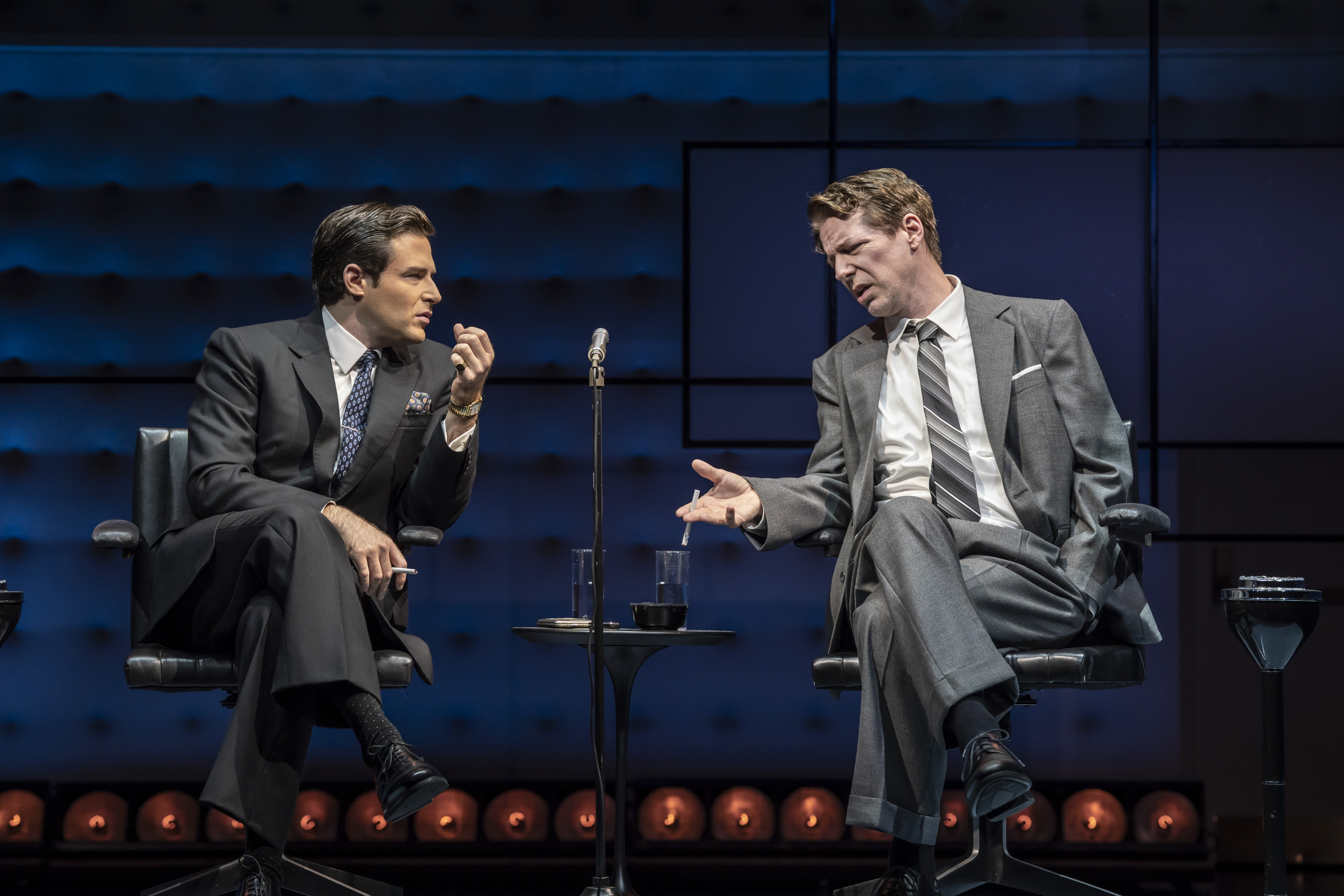
The staging isn’t exempt from some strokes of genius either. Though opting for a figurative approach, its metaphorical reading, intentional or accidental, breaks through the piece’s climax. Foam-coated walls box in the recording room for the TV program’s broadcast, and two separate realities begin to converge through the same setting. Beyond its plain depiction of a soundproof backstage area, there is a persistent reference to a padded cell, reminding us of the personage’s never-ending fight with both his inner and outside demons — and in that attempt, cementing our sympathy towards his plight.

All the portrayals flaunt strength and presence. Rosalie Craig gives a fine performance as June Levant, perhaps deprived of some specks of layering while unable to expose the woman’s palpitating fragility, but nonetheless oozing flair and magnetism throughout.
Sean Hayes comes off as the big winner of the evening, regaling audiences with a most committed (no pun intended) rendition packed with passion and truthfulness. It’s a gradual conversion into the role, fully realised as his interpretation warms up. But from then on, the precision and intricacy of his take are galvanising. To have the opportunity to see him play Gershwin’s Rhapsody live on the piano, executed with the same bright phrasing and colourful tone the script alludes to, is a rare bonus to applaud. To watch him do it without breaking character and bringing out his mental turmoil all along is an act of mastery, and further evidence that Hayes’s dramatic abilities are above being just a jack of all trades.
Hooking, amusing, and thoroughly thought-provoking, Good Night, Oscar delivers a cerebral analysis of the human condition through mind-blogging writing and performative frenzy. Intermittently raw, while always preserving a sense of endearment, the play stands as a striking tour de force in terms of subtext, artistry, and storytelling prowess — paying tribute to a prominent figure in Hollywood history while also forming a solid bond with the viewer. It will confidently drive you mad in every possible way, and each of them is a reason to see it.
Help us continue our work
We count on your support to keep bringing the greatest quality in theatre-related content, from interviews with the biggest names in the industry to reviews of every show in town and beyond.
We appreciate every donation to maintain our high pace and standards and continue to grow.
Thank you for believing in us!
***************************************************
All pictures credit to Johan Persson.
Good Night, Oscar plays at London’s Barbican Theatre until 21 September. Tickets are available on the following link.