
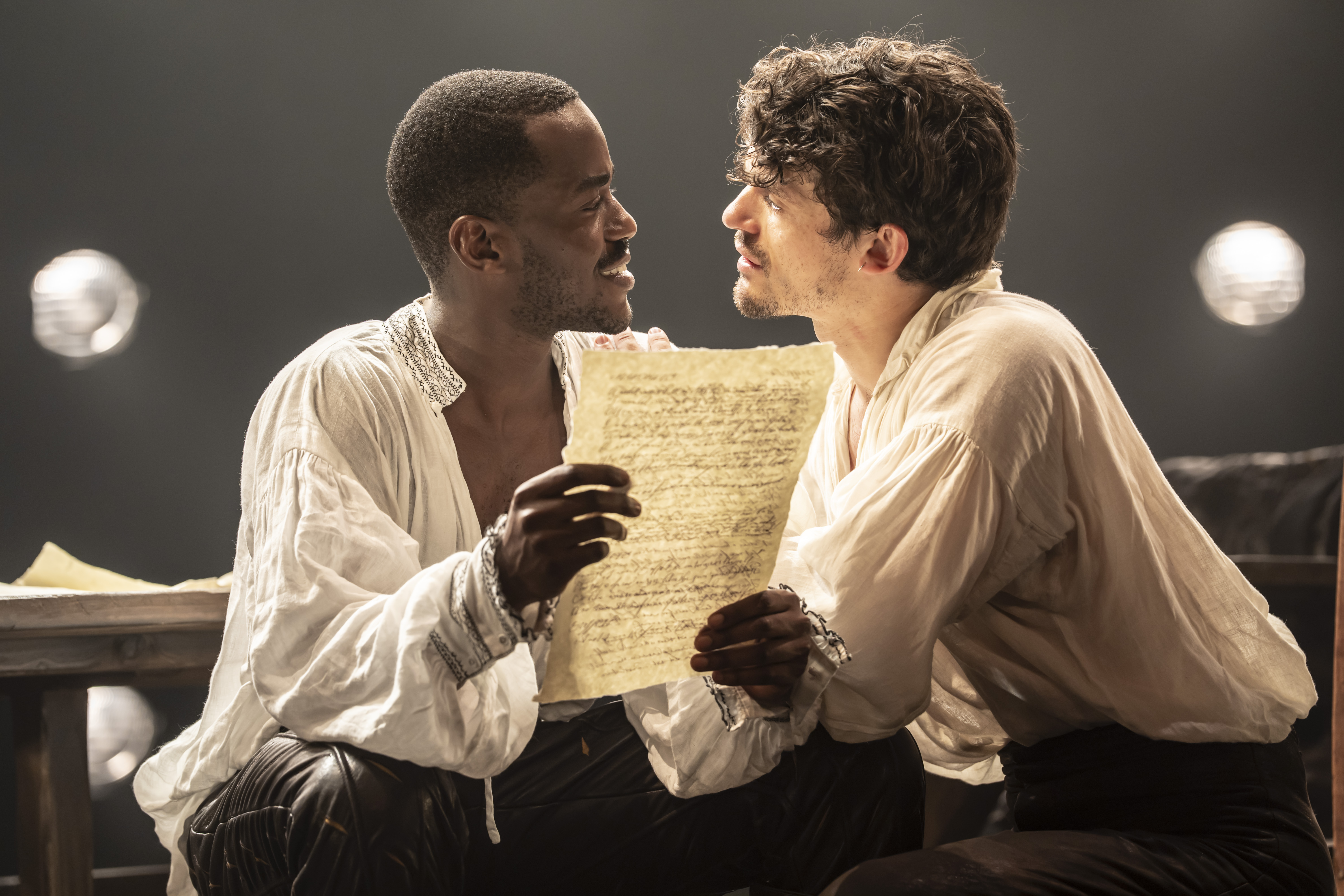
London’s Wyndham’s Theatre hosts the West End premiere of Liz Duffy Adam’s fictional depiction of Shakespeare and Marlowe’s relationship beyond the stage. Guillermo Nazara shares his views on the show to let us know if this romantic fantasy makes itself immortal with a kiss.
It would be unfair to compare this play to a summer’s day — it’s far from lovely and certainly not that temperate. Speculations about the Bard’s sexuality are no news to anyone minimally acquainted with his personal life. Some say his quill wandered outside his second-best bed in Stratford, while others claim that, when it came to his backstage interests, his heart never beat to the essence of a woman.
The alleged queer-coded elements in Shakespeare’s plays serve as the basis for Liz Duffy Adams’s two-hander play, Born With Teeth, which celebrated its West End opening this week at the Wyndham’s Theatre. With an A-list cast featuring Edward Bluemel as the reputed author and Ncuti Gatwa as his fellow writer (and conspirationists’ favourite) Christopher Marlowe, this revisionist story presents us with a hypothetical scenario — where both wordsmiths gather in secret for a series of sessions where their writing is the last thing they want to explore.
We will probably never know if Marlowe and Shakespeare ever shared more than professional rivalry. But it’s easy to see how two men resolving their tension outside the workplace could get a few titillating. Sadly, that seems to be this show’s only purpose, which, on the whole, comes across as a stagnant display of ham-fisted eroticism — and where it’s hard to put our finger on what the playwright’s aim actually is.

There’s absolutely nothing going on apart from Marlowe’s repeated attempt to let Shakespeare’s genius inside him — or vice versa. A very thin subplot involving Marlowe’s espionage activities and his ambivalent intentions towards Shakespeare in that field hopelessly acts as an excuse for a narrative driver. It doesn’t take three witches on a heath to anticipate how little an effect it makes. Should they have drawn the curtains and got down to business, most of the plot would have concluded in literally five minutes — it is that short and disappointing, and you’ll be lucky if it makes you feel anything at any point.
The text’s execution suffers from a severe lack of structure and pacing. All in all, the entire thing seems like a vague concept outrageously stretched way beyond its ability. The key issue relies on the archetypal approach to both characters. They exhibit no depth, personality, or even humanity — all of which are unforgivable sins when we are talking about depicting two men regarded as the ultimate embodiment of those virtues.
The dialogue is excruciatingly clunky. There’s no sense of organicness or credibility, struggling to array any profundity and plagued with sophomoric double-entendres that are too lazy even for The Cleveland Show. At the same time, the script is so focused on turning the heat up (and probably something else) that it completely forgets to acknowledge, in a compelling manner, the suffering and oppression of the queer community across history. Of course, not every story involving gay men needs to center around homophobic persecution. Yet, the fact that the play reduces such a pivotal, defining reality for its personages to just a few passing comments is, to the very least, irritating.

Joanna Scotcher and Andrzej Goulding’s designs are arguably the only satisfactory assets in the whole production. With a retro-futuristic approach blending nods to the digital era with period-accurate costumes, the show’s ethereal atmosphere, reinforced by the use of spotlight-studded walls, creates a visual pulse that allows the performance to regain some interest. Yet, the writing’s ineptitude often clouds these discreet strokes of brilliance, which the portrayals are wistfully incapable of matching.
Edward Bluemel gives a fine rendition as William Shakespeare. Playing the Bard as a gullible, self-conscious new author, the likable vulnerability he brings to the character is his most compelling aspect. However, there’s just as much as he can add to such a sketchy role, where there’s hardly any evolution and whose individuality is as present as Ophelia’s sanity. Ncuti Gatwa fails to give a believable interpretation as Christopher (Kit) Marlowe, opting for exaggerated mannerisms and forced speech inflections that rarely come off as natural, and whose sole accomplishment is to build a greater distance with the viewer.
Introducing audiences to a relevant, stimulating concept, but putting the provocation before the thought, Born With Teeth suffers from too many cavities in its delivery — leaving us with a sour mouthful of unprocessed themes, many of which would not concoct an appealing recipe in the first place. Difficult to swallow for most of the part, Liz Duffy Adams’s hasty handling of the topic proves her imperious need to chew on the subject longer until she can floss the play’s severe flaws out. A doomed Marlowe at the end of her tale might be asking Shakespeare to remember him. Yet, all that comes to mind from that Hamlet quote is the father’s description of his assassination.
Help us continue our work
We count on your support to keep bringing the greatest quality in theatre-related content, from interviews with the biggest names in the industry to reviews of every show in town and beyond.
We appreciate every donation to maintain our high pace and standards and continue to grow.
Thank you for believing in us!
***************************************************
All pictures credit to Johan Persson.
Born With Teeth plays at London’s Wyndham’s Theatre until 1 November. Tickets are available on the following link.