
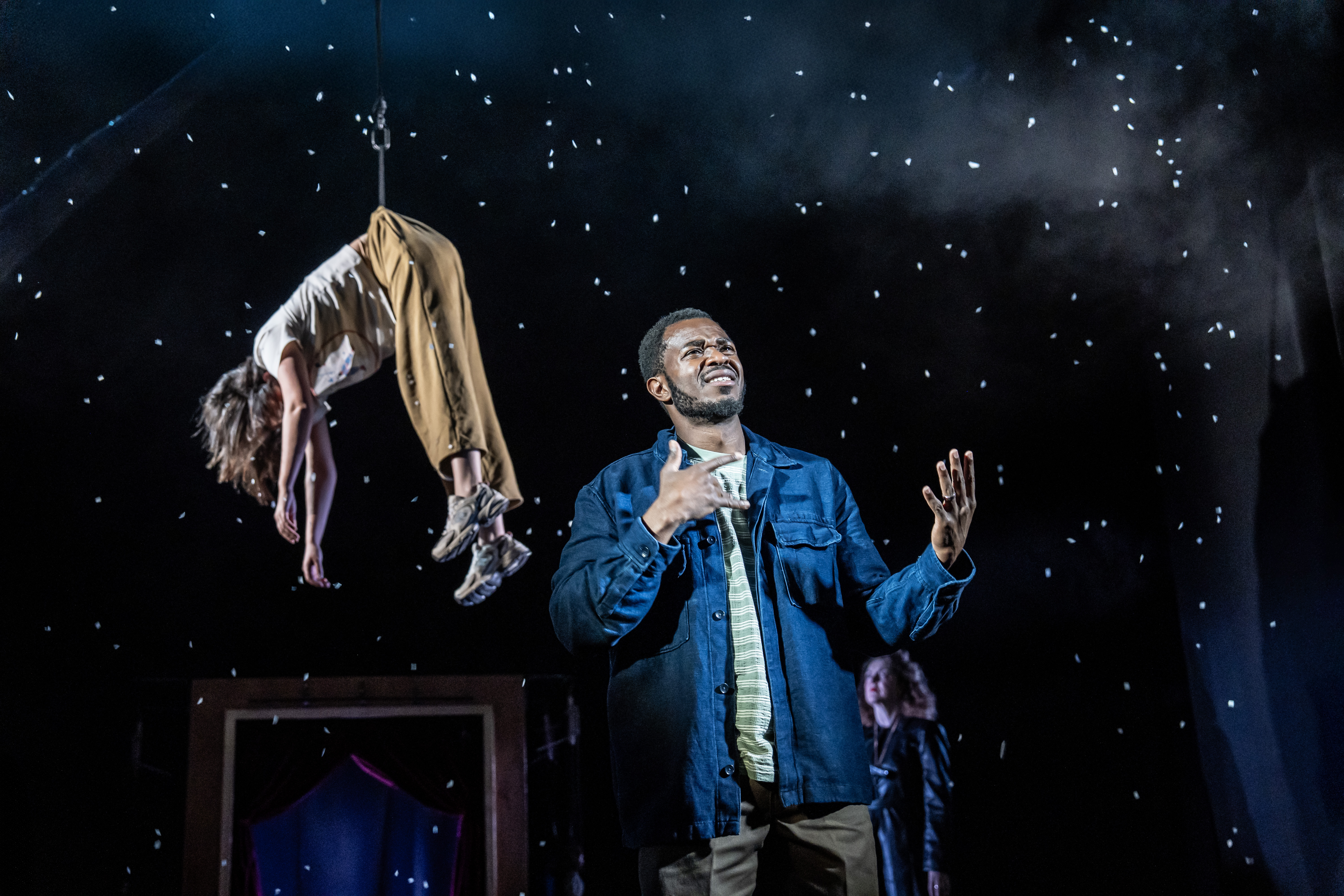
The Royal Court Theatre welcomes this dystopian drama featuring a unique array of theatrical crafts to convey an unsettling tale of struggle and resilience. Guillermo Nazara shares his views on the show to let us know if its vociferous message and delivery bear anything unheard of.
We all dream of a better world for everyone — or at least that’s what we say when we want to earn virtue points. Society is allegedly a shelter. But it doesn’t take a magnifying glass to realise how many predators it’s often packed with. Even when we belong to a system that’s supposed to protect us, we fight for our survival every day of our lives. Some do it by fighting to keep a roof over their heads. Others do it so they can have a voice wherever they exist. And some pursue the inclusion that convention has automatically denied them.
Deaf Republic makes a resounding statement through its sign language-based opening, as does the overall framing of the piece. You don’t need to know BSL to understand what is going on. If you can hear, they will also perform out loud at least a third of the script. If you’re also able to see, the surtitles will complement the experience.
It’s not a groundbreaking technique. It’s happened before, and not only onstage — Ryan Murphy did almost an entire episode of the Jeffrey Dahmer series with hardly any spoken dialogue. Yet, anything that immerses the viewer into both its universe and message is always welcome back. The issue, though, is that there’s not much to scrape from what, in the end, comes across as a feeble storytelling attempt.

There’s great form but poor content — not in terms of ideas but of execution. It’s a rather messy show. Presenting us with an Orwellian dystopia, where the hearing-impaired secede from their former country’s oppressive administration, its exceedingly underdeveloped plot consists of nothing but an array of sketchy scenes interconnected by a very thin narrative, where both character development and originality are constantly silenced.
Not only does the work come off as derivative. Wistfully, it provides no elements to counterbalance its lack of innovation. The dialogue, on the whole, lacks flow and naturalness, pushing too hard to make an impression — and in that forced effort, solidifying the clunky overtone that prevents it from having any effect.
At the same time, the roles are highly archetypal. None of them exudes sufficient complexity. All in all, they are reduced to a mere concept, exhibiting no personal depth or individuality — an ongoing flaw that compromises the audience’s investment in their journeys, and which ultimately snowballs to a point where, sadly, we can’t care about them anymore.

There’s still brilliance shimmering throughout the rendition. The staging is, in fact, an absolute triumph. There’s nothing in it that you may not have witnessed at a different production. And yet, it manages to turn every single part of it into its signature.
A combination of live broadcasts, puppetry, and drones contrives a post-apocalyptic landscape built on hope and mauled by despair. A fitful front gauze displays the same performance from a different angle that only the camera can access, simultaneously showing a translucent image of what is taking place behind.
The use of marionettes accentuates the narration’s whimsically dark aura, adding a layer of symbolism and theatrical craftsmanship. And eventually, the juxtaposition of the show’s fairy-tale coating with its characters’ bestial actions creates an alluring assortment of wonder and horror, where every moment is as harrowing as it is seductive — gruesome in essence but irresistible in feel.

None of the portrayals manages to excel on the same level, with possibly the exception of Eoin Gleeson as the torturous embodiment of the tyrannical establishment. There is chemistry and rapport in their deliveries, but not enough presence, strength, and distinctiveness to make any of them stand out — with some also coming off as excessively camp and short of nuance and credibility.
Holding the means to make a thunderous impact, but seemingly playing by ear a little too much, Deaf Republic shies away from its potential to convey a poignant and sonorously thought-provoking plot, as it refuses to malleate its themes into a more united, richer, intricate piece where story and meaning feed from each other. Already flaunting a compelling design, it’s the dramatic engagement that requires a higher volume of robustness — and that’s just sound advice to follow.
Help us continue our work
We count on your support to keep bringing the greatest quality in theatre-related content, from interviews with the biggest names in the industry to reviews of every show in town and beyond.
We appreciate every donation to maintain our high pace and standards and continue to grow.
Thank you for believing in us!
***************************************************
All pictures credit to Johan Persson.
Deaf Republic plays at London’s Royal Court Theatre until 13 September. Tickets are available on the following link.