
The Almeida Theatre hosts the world premiere of Alice Birch’s latest play, exploring male-related issues through the trials and tribulations of three siblings. Guillermo Nazara shares his views on the show to let us know if its depiction of brother and individual resilience is, in frat, worth seeing.
Manhood — once an honourable term, now a cause for dispute and confrontation. It doesn’t take a reality check to realise how society has turned its back on men in many ways. It’s not something new either. Men don’t cry. Men can’t complain. Men must live through abuse and accept it as part of their journey. Fight that status quo, and both sides of the spectrum will laugh at your ‘man’s tears’. Most have nothing else to do but cope with it. Some of them deal with it just fine — or so they’re forced to say. But for many, that powder keg of repression is bound to explode sooner or later.
The imposed ideas of traditional masculinity are the core and driving force of Romans, A Novel (we get the pun), a new play premiering at the Almeida Theatre this week, which explores the lives of three brothers as they build their separate paths away from a traumatic childhood. A scarring chapter at a boarding school, rooted in the archaic concept of physical punishment as a fair method of education, is the starting and defining point for the two eldest. Jack will try to have as many experiences as he can while pursuing his dream of becoming a writer; Marlow will find comfort in material success, going from a formerly sensitive boy into a materialistic, self-centered sociopath. There’s a third one, Edmund, the youngest and most vulnerable of the bunch, whose only wish is to be someone who’s let be.

Writer Alice Birch concocts a thorough analysis of how social constructs can tarnish the purity of the human soul. Although it turns its focus on the male experience, doing so with adequate deftness, the characters’ relatability holds a universal appeal to the viewer. There’s no question that a great deal of their suffering stems from the imposition of an overwhelming gender archetype. Yet, anyone can see themselves reflected in their plight — how we live in a world where the dog eats the dog; where value is reduced to economic achievement and people are exchanged and disposed of as rapidly as common currency; and how having your own voice can be tough (if not impossible) where no one is interested in hearing it.
Penned with a poetic, novelistic filter and filled with intricate descriptions and vibrant introspection, the script holds a firm grip throughout the entire recount. It entices the audience through the external beauty of its execution and deepens their interest through an engaging narrative that preserves its resonance almost permanently. Flaunting sharpness in its dialogue and combining it with a generally fast-paced rhythm, the first three quarters of the recount move along flawlessly — until we get to the final installment, and the cracks in the structure begin to show.

For the whole of Act One, we are invested in the siblings’ individual arcs to a similar level. Jack may open the play and serve as its initial raconteur, but as the piece progresses, its choral style becomes evident. When we return for Act Two, the situation has changed exponentially. An exceedingly long yet enjoyable first scene has now turned Jack into the sole protagonist — and it’s not after we reach the middle of the performance that the rest of the trio is back onstage. There’s a catch, though — we don’t get to see much of what’s happened to them, as their lives are wrapped up in a simultaneous sequence that deprives them of the profundity they so beautifully encapsulated before.
Consequently, the play loses momentum, leading to an ending some might find touching, but which certainly many will perceive as anticlimactic. There’s an unapologetic speech Jack delivers as part of the conclusion, storming off before his hostile ex-wife while expressing his anger and frustration for the lack of empathy he’s recently received. Yet, regardless of the poignancy in that excerpt, the absence of a stronger sense of culmination makes its conclusion feel weak and rushed, losing part of the dramatic impact it so masterfully held for most of the rendition.
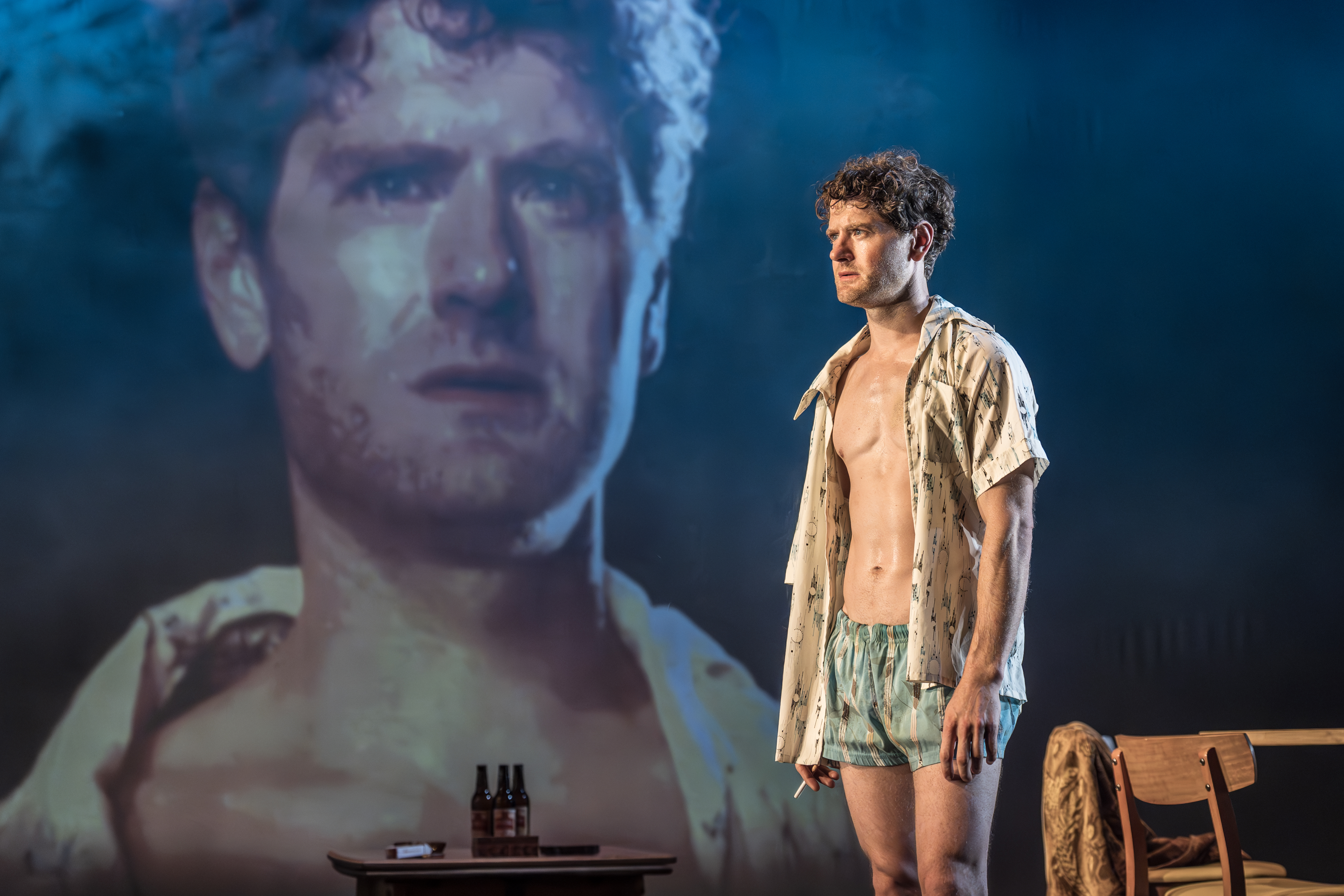
Directed by Sam Pritchard, the production strikes audiences with a powerful array of visuals, which also endows the show with an identity. A bare stage enclosed by a blemished white backdrop forms the unpredictable environment the characters face. A mixture of cold and warm lighting hues transforms the space from the icy days of their upbringing to the summery sunsets of Jack’s adulthood. The occasional use of a camera, a revolving platform, scattered props, and a water compartment hidden under a trapdoor provides the rest — all put together with effective blocking and resulting in an evocative, arresting, and boldly assembled design.

The cast excels on a similar level, if not higher. The exquisiteness of their portrayals makes up for the production’s true worth. Crude but poised. Tragic but fanciful. Brutal but elegant. The brilliance the company exudes as a whole is effused by the three leads, to whom the greatest praise goes. Stuart Thompson gives an endearing performance as Edmund, effortlessly emanating the character’s heart-moving defencelessness. Oliver Johnstone regales viewers with a carefully layered rendition as Marlow, whose tenacious facade masks a collapsing, feeble interior. Finally, Kyler Soller’s Jack oozes fortitude and flair, carrying out a phlegmatic interpretation that still blares with emotiveness and pungency.
Taking guests on a steep yet entertaining voyage across the struggles of masculinity, Romans, A Novel demonstrates skillfulness and dedication in every department — crafting a compelling storyline that allows each of its participants to grow and evolve, despite wasting its opportunity for a more enduring and meaningful finale. Trimming an unnecessarily lengthy start to Act Two and balancing out by giving more room to the remaining protagonist is the obvious solution. The author may see it as a tough row to hoe. But as the saying goes, bros must come before.
Help us continue our work
We count on your support to keep bringing the greatest quality in theatre-related content, from interviews with the biggest names in the industry to reviews of every show in town and beyond.
We appreciate every donation to maintain our high pace and standards and continue to grow.
Thank you for believing in us!
***************************************************
All pictures credit to Marc Brenner.
Romans plays at the Almeida Theatre until 11 October. Tickets are available on the following link.