
Gersher Theatre’s revival of Oscar Wilde’s provocative biblical drama celebrates its West End debut through a strictly limited run playing until mid-October. Guillermo Nazara shares his views on the show to let us know if this new take comes across as a butchery (or decapitation) of the classics.
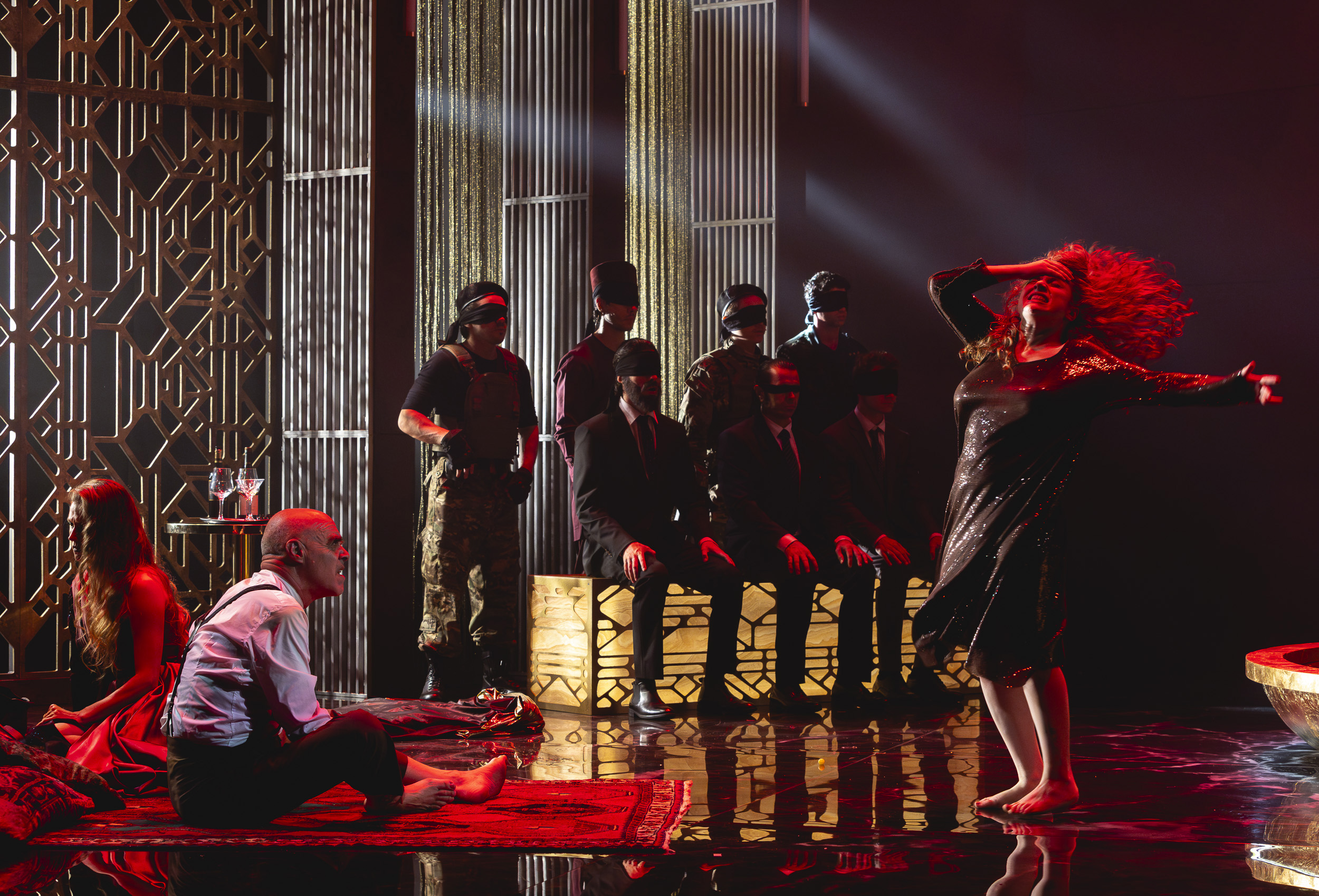
She’s not dancing the dance of the seven veils anymore. Instead, now it’s the dance of the seven blindfolded guests. No apparent reason for that change, except perhaps accentuating the sordid, mischievous nature of her art. It’s a compelling dramatic choice. And its effect onstage could have been extraordinary, if it wasn’t for her wearing a golden robe made of curtain fabric and a spangled dragon mask for half of the choreography. Still, an enthralled King Herod watches every move in complete bewilderment — captivated enough to grant her infamous wish.
He must have been the only one seduced by last night’s confusing performance of Oscar Wilde’s biblical play. The anticipation for this coproduction between the Theatre Royal Haymarket and the Israel-based Gesher Theatre company hasn’t been small — and it’s fairly justified. There’s something magical about experiencing a brand new take on a classic on the same stage where its author premiered two of his works. And there’s an extra pinch of amusement when political advocates try to jeopardize its rendition seconds before it starts.

But none of that hype could prevent a stinging feeling of discomfort from the viewers as the show celebrated its West End opening last night. It was not a good interpretation. And as such, it must be exposed — plain and simple, just like how every portrayal came across.
Salomé is not an easy text. Oscar Wilde’s distinctively elaborate prose adopts a more Shakespearean tone throughout this script. And just like with the Bard’s ouevre, actors are required to dig deep beyond the beauty of its wording and find the truth in every line. Director Maxim Didenko’s vision (or at least, its execution) does the exact opposite. There’s no nuance, layering, or any remote signs of character construction in any rendition, all of which feel flat, underdeveloped, and ultimately one-dimensional.
There is no sense of allure or insidiousness in Neta Roth’s depiction of Salome. Camp and childish, the impish essence of a role that encapsulates danger and desire altogether is simply not there. Doron Tavori’s version of King Herod isn’t any less flawed. There is virtually no complexity, detail, or variety in his approach to the role — always conveying the same droll style that was hardly the best to begin with, and which consequently leads to an excruciatingly dull impression.
Gathering an international cast, one can only deduce that some of their members’ limited fluency with the English language might be what compromises their credibility, inevitably sacrificing subtlety for an intelligible translation. We can no doubt give credit for that — it’s never easy to communicate in a system different from one’s mother tongue, and to put yourself under the spotlight (no pun intended) is incredibly resilient. Yet, it would have been sensible to reconsider before presenting something that clearly isn’t ready, at least, not for a city where classics such as this are constantly revived and for which the standard is significantly higher.

There are some redeeming features we can still acknowledge — and even praise. The entire design is, admittedly, a striking tour de force. Galya Solodovnikova transforms Herod’s palace from the exotic Greco-Roman paradise of countless previous adaptations into an Art Deco, turn-of-the-century ambiance with a few nods to Middle Eastern culture.
Gleb Filchtinsky’s intricate lighting elevates the staging’s ethereal spirit, underpinning the recount’s thematic clash between good and evil, the holy and the sinful, and above all, the human and the divine. Finally, the use of a live pianist playing uninterruptedly throughout the entire performance, sometimes accompanied by Shir Sayag’s heavenly countertenor voice as Jokanaan (John the Baptist), gives the show an additional coating of craftsmanship that’s utterly refreshing.
Eye-catching for the most part but terribly heavy-handed in terms of acting and narrative understanding, Gesher Theatre’s revival of Salome is unlikely to be granted half a kingdom for its contributions, and sadly, more prone to be severed and returned to the drawing board. Some may find some glimpses of sparkle in a few and very punctual renditions. But in the end, none of them is heading for an ovation.
Help us continue our work
We count on your support to keep bringing the greatest quality in theatre-related content, from interviews with the biggest names in the industry to reviews of every show in town and beyond.
We appreciate every donation to maintain our high pace and standards and continue to grow.
Thank you for believing in us!
***************************************************
All pictures credit to Alexander Khanin and Isaiah Fainberg.
Salomé plays at London’s Theatre Royal Haymarket until 11 October. Tickets are available on the following link.