
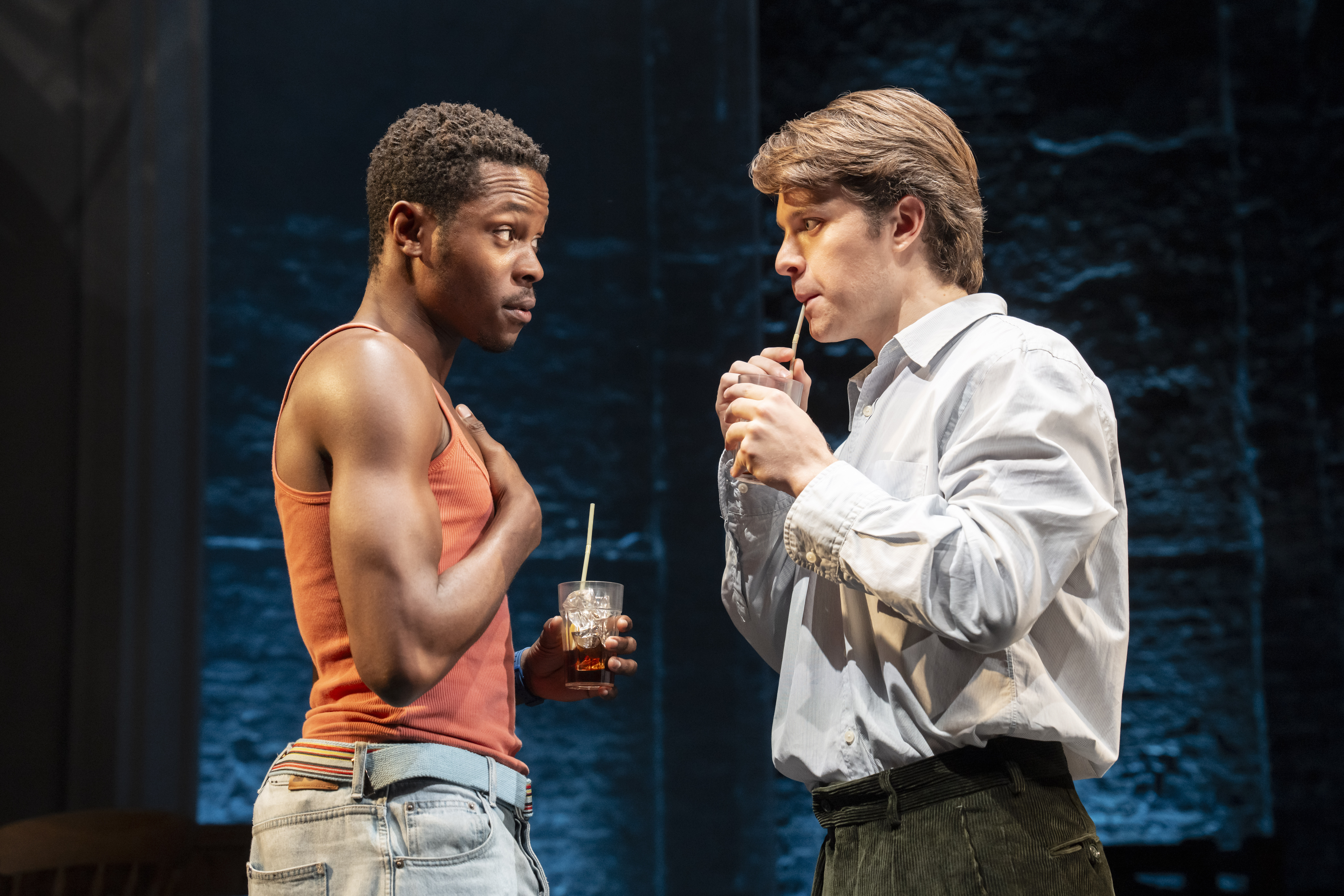
The stage adaptation of Alan Hollinghurst’s queer novel celebrates its world premiere, featuring a script by Jack Holden and direction by Michael Grandage. Guillermo Nazara shares his views on the show to let us know if its depiction of gay life during the Thatcher era ends up in the right section.
The word ‘struggle’ seems to permeate every gay story, and ultimately becomes its raison d’etre. It couldn’t be any other way, though. Even younger generations can still relate to the unkindness, exclusion, and persecution LGBT+ people have been forced into for challenging the norms that others created for them. It gets better, however. We made it better. And that’s why it’s so important to remember those who came before us and set the path we walk.
This background, added to the popularity of Alan Hollinghurst’s 2004 novel, has generated such extraordinary hype for the stage adaptation of The Line of Beauty, which opened this week at the Almeida Theatre. Featuring a script by Jack Holden, whose critically acclaimed Cruise precedes him, and direction by the legendary Michael Grandage, the show relives the Thatcher era through the eyes of an Oxford postgraduate and his incursion into the gay scene.
Living as a lodger in the house of an affluent and politically prominent family from Kensington, Nick Guest (a very subtle name) would start embracing his sexuality, which, despite his hosts’ involvement in the Tory party (let’s not forget what Maggie did to our kind), doesn’t seem to bother them; they even encourage it. From then on, Nick would begin a relationship with a lower-class boy from Camden. Yet, what would soon evolve into actual love will get tarnished by Nick’s desire to keep experimenting, and the horrible plague that brought so much grief and desperation to our community, added to the shame and blame that the rest of the world wanted to inflict upon us.

There is no question about the dramatic force this premise carries. And Jack Holden does more than an adequate job at exploiting it. There is depth, resonance, sharpness, and intrigue. The first half ponders the highest levels of perfection. The pacing is immaculate. The dialogue flows in a continuous stream of delicious satire, pathos, and poetic flair. And every plot line intertwines seamlessly while delivering a strong social comment that doesn’t come across as preachy or judgmental, but instead, perceptive and, ultimately, sincere.
The problems emerge as Act Two unfolds. If the first part moved at a flawless rhythm, its successor is hindered by its inability to create the same cadence. It’s still hooking throughout the entire narrative, but its grip loses some of its strength during a few key sequences — and also, due to the lack of them.
There is too much to wrap in too little time, and most of it isn’t given much of a chance to do so — and that applies to its core topic. Although the AIDS crisis is one of the story’s cornerstones, the script appears to tiptoe across the subject. We’re told about the terrible consequences it brings upon the characters, but their journey to that fatal destination feels a little sketchy — and so do many of their arcs.

We don’t get to see the end of Nick’s relationship with his first love interest, a young black man with an extremely religious mother, and so much promise as a role. Instead, his sister reappears to inform Nick about his passing — making him another name in that cursed, ever-growing list. We witness some of his grievances (roughly 5 seconds of crying), but the emotional connection that was slowly cemented throughout Act One seems neglected at this moment. Those expected sentiments of loss, anger, and frustration are simply not there. And if before we were standing by the characters’ side on every step they took, now it feels as if we were watching them from a glass wall.
The same goes for some other narrative lines, whose conclusions are either unfinished or rushed. There are several stirring scenes, nonetheless — the heated argument between Nick and his former landlord, Gerald, who accuses him of humiliating his family by bringing the so-called ‘gay disease’, is exceptionally powerful. But eventually, the play comes off as at least 30 minutes too short, and the climax doesn’t have the same degree of poignancy we could grasp so easily in the beginning.
The staging is one of the production’s greatest achievements. Christopher Oram’s uncomplicated set design vividly brings every scene to life. A white boiserie proscenium delineates an empty space covered in shiny black tiles. Chairs, tables, and a few casual props descending from the rafters provide the rest, as Howard Hudson’s impeccable lighting seamlessly takes us from the vibrancy of a night club into the austere warmth of a working-class home. The whole execution is absolutely faultless — and in many aspects, a tour de force.

As for the company, their slightly Cowardian approach works in unison with Holden’s savvy writing — flaunting excellent comedic timing while also delivering the most piercing harrow when required. Jasper Talbot gives a decent performance in the lead role of Nick, mainly through the charm and innocence he gives to his character. However, his rendition could benefit from more layering and subtext, with his closing monologue sounding a little too flat. His chemistry with Alistair Nwachuckwu, nonetheless, is faultless, and Nwachuckwu’s portrayal of Leo brims with confidence and sass. The highest praise goes to Charles Edwards (Gerald) and Arty Froushan (Wani), regaling audiences with two astounding performances filled with presence, naturalness, and finesse.
With a solid premise, compelling themes, and a captivating plot, The Line of Beauty features every necessary element to deliver a striking, thought-provoking, and potentially iconic piece of storytelling — able to pull at the heartstrings while also hitting a nerve or two. Wistfully, though, about half of these possibilities remain either unused or disregarded.
In the play’s own words, there is pure beauty and pure feeling in the recount, but the script’s hasty, incomplete resolution denies access to it on too many occasions. Yet, no showstopper gets any better than taking Maggie Thatcher on a dance after doing your first trial of coke (not the beverage).
This site is proudly sponsored by

Help us continue our work
We count on your support to keep bringing the greatest quality in theatre-related content, from interviews with the biggest names in the industry to reviews of every show in town and beyond.
We appreciate every donation to maintain our high pace and standards and continue to grow.
Thank you for believing in us!
***************************************************
All pictures credit to Johan Persson.
The Line of Beauty plays at London’s Almeida Theatre until 29 November. Tickets are available on the following link.