
The first instalment in the acclaimed book series lands on the London stage in an immersive production featuring lavish numbers and state-of-the-art scenery. Guillermo Nazara shares his views on the show to let us know if this latest dramatisation of the novel and its custom-made theatre are the chosen ones in the district.
Yes, the seats do move — squeaking swoosh included. If that was part of their SFX pack, I guess the effects are on top of their game. No one seems to care, though. And why should they? It’s a tiny flaw compared to the grandiose spectacle that, at least for half of the show, audiences were regaled with last night, as The Hunger Games on Stage celebrated its big London opening amidst nasty critics, anxious investors, and questionable fashion choices.
The anticipation has been through the roof. So has the polemics — the first preview made headlines and went viral on social media due to its poor handling of timing and allocation. They appear to have fixed it now. That might be the shortest interval I’ve experienced in my whole life. A quick trip to the loo (thank God for male toilets!), and barely any time to get ourselves our drink. An imposing (ish) security man warns us with a gentle shout: “You’ve got one minute! One minute! Get back inside!”. They’ve really made us feel a part of the story — the slightest delay on our side and we might have ended in a deadly combat.

But there’s no need to sink your tears in alcohol when watching The Hunger Games. Even for someone who’s admittedly not a fan of Suzanne Collins’s revered young adult book series, the show is a kaleidoscopic explosion of true spectacle, combined with a rather engaging recount.
If you’re not familiar with its dystopian universe, you’d be relieved to know it’s not too far away from the Orwellian nightmare we are currently living in. The Big Brother archetype adopts the menacingly calm, almost sterile, form of President Snow, played by a synchronized video recording of John Malkovich. The rich control the population (quelle surprise?!). And the poor enter a callous competition — they will fight for their survival and the improvement of their home district. Suffice it to say, only one can win.
You don’t need to read the novel or watch the film franchise to understand the show’s narrative — let alone be engaged in it. Connor McPherson’s adaptation delivers a clear, gripping plot that brims with action without renouncing character depth and social commentary. It’s an obvious allegory, but an entertaining one. And much like in Collins’s oeuvre, it resonates strongly enough.

Matthew Dunster’s direction provides the rest. A custom-built theatre welcomes viewers into its futuristic visual fanfare. Don’t expect the usual denominations when planning your visit. You’re either in the still or the moving districts — that’s what their steep, in-the-round stalls are called. And wherever you’re seated, you’ll feel as if you’ve been dragged into a separate reality — and you’ll be a part of it some way or another.
Devised as an arena show, Miriam Bluether’s design assembles a compelling array of techniques, ranging from the not-so-desirable screen-based backdrops to elements of pure theatricality. Actors parade props around to build an entire set altogether. Centre-stage, a massive trapdoor opens to reveal huge pieces of intricate scenery. Lighting grids descend from the rafters, tilting as they become ramps that cast members climb all the way up. And amidst the amazed gasps and rapturous applause of an enthralled audience, a fire-spitting chariot flies majestically over the stage, preluding the soulless massacre that will unfold shortly after.
It’s an extraordinary display of richness and craftsmanship, both working in perfect balance. Bluether demonstrates shrewdness in her approach — the big moments do not materialise until the end of Act One. The start keeps it simple, almost diaphanous. Yet, it doesn’t take long for the wow factor to unravel. And for the first half, the staging keeps nourishing those standards unashamedly, allowing us to indulge in its ever-growing opulence as if there virtually was no ending to it.

But nothing lasts forever. And certainly, this production is no exception to the norm. If Act One was an immaculate tour de force, its successor comes across as too much of a second part, in its worst meaning. It’s just not that impressive. As a matter of fact, it just isn’t. All the surprises that literally kept our jaws on our feet are either rehashed or simply absent when the performance resumes. Is it still enjoyable? Yes. Is it enticing? Pretty much. However, the budgetary restrictions are too noticeable. And in an unintentional evocation of the show’s lore, a clear distinction has been made between the privileged and the downtrodden.
The venue’s titanic proportions do not compromise the piece’s ability to convey pathos. It would be mad to say the production can carry the same degree of intimacy that the film so vividly captured. It would be even crazier to ask or aim for it, nonetheless. It’s neither the point nor the need of this adaptation. And the unavoidable physical distance between the protagonists and the viewer is hardly an issue in this case. Ultimately, there is a reading to it. As watchers, we are perpetuating a system that turns people into cattle. We’ve come to see the games. We are consumers of their demise. And so, when the main character begins to explain her strife, the poignancy can only hit harder.

Overall, the cast brings the tale to life with remarkable deftness. Tamsin Carrol makes one of the most memorable appearances as Effie Trinket, playing the role with superb comedic timing — deliciously droll without veering into excessively camp. A similar praise goes to Stavros Demetraki, thanks to his cynically amusing portrayal of Caesar Flickerman, while Joshua Lacey earns another deserved mention due to his stirring interpretation of Haymitch Abernathy.
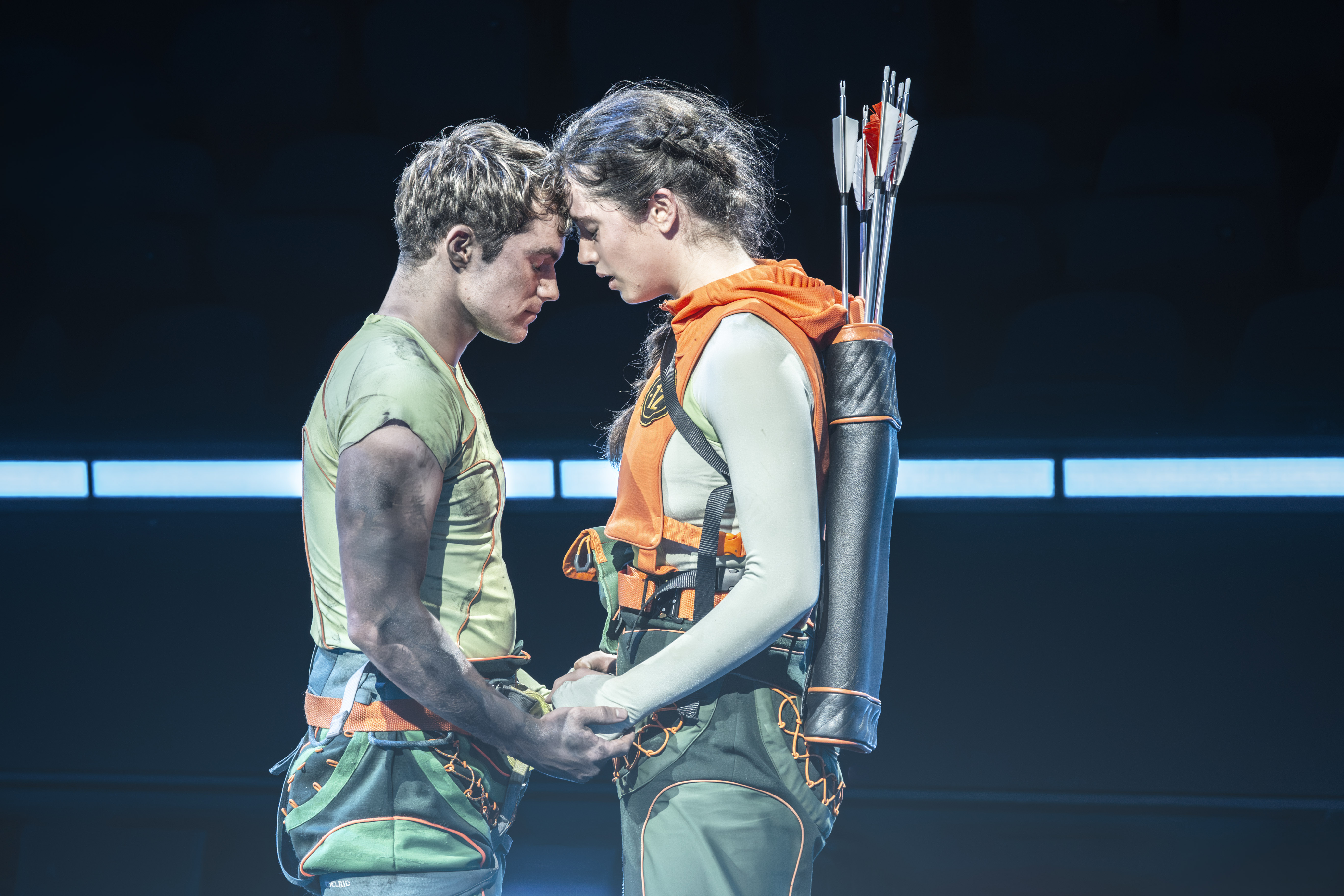
Sadly, Mia Carragher fails to match the same quality as the protagonist, Katniss Everdeen. Although her performance is generally adequate, the lack of layering and nuance results in a shallow and unresponsive take on the role. On the whole, it feels flat and slightly shallow. Perhaps as a consequence, the chemistry she’s supposed to share with her co-star is simply not there. And despite Euan Garrett’s substantial efforts, resourcefully incarnating Peeta Mellark, their rapport rarely falls into place.
Despite significant shortages, it would be unfair to say The Hunger Games on Stage will put viewers through times of famine. Its declining abundance after intermission will not affect the staggering memories Act One will provide in spades, packed with lush scenery, exhilarating numbers, and a cohesive sense of immersiveness that permeates the entire rendition. Many times, it’s a lavish feast for the senses. Yet, not quite enough to feed us until we’re stuffed.
This site is proudly sponsored by

Help us continue our work
We count on your support to keep bringing the greatest quality in theatre-related content, from interviews with the biggest names in the industry to reviews of every show in town and beyond.
We appreciate every donation to maintain our high pace and standards and continue to grow.
Thank you for believing in us!
***************************************************
All pictures credit to Johan Persson.
The Hunger Games on Stage plays at London’s Troubadour Theatre Canary Wharf from Tuesday to Sunday. Tickets are available on the following link.