
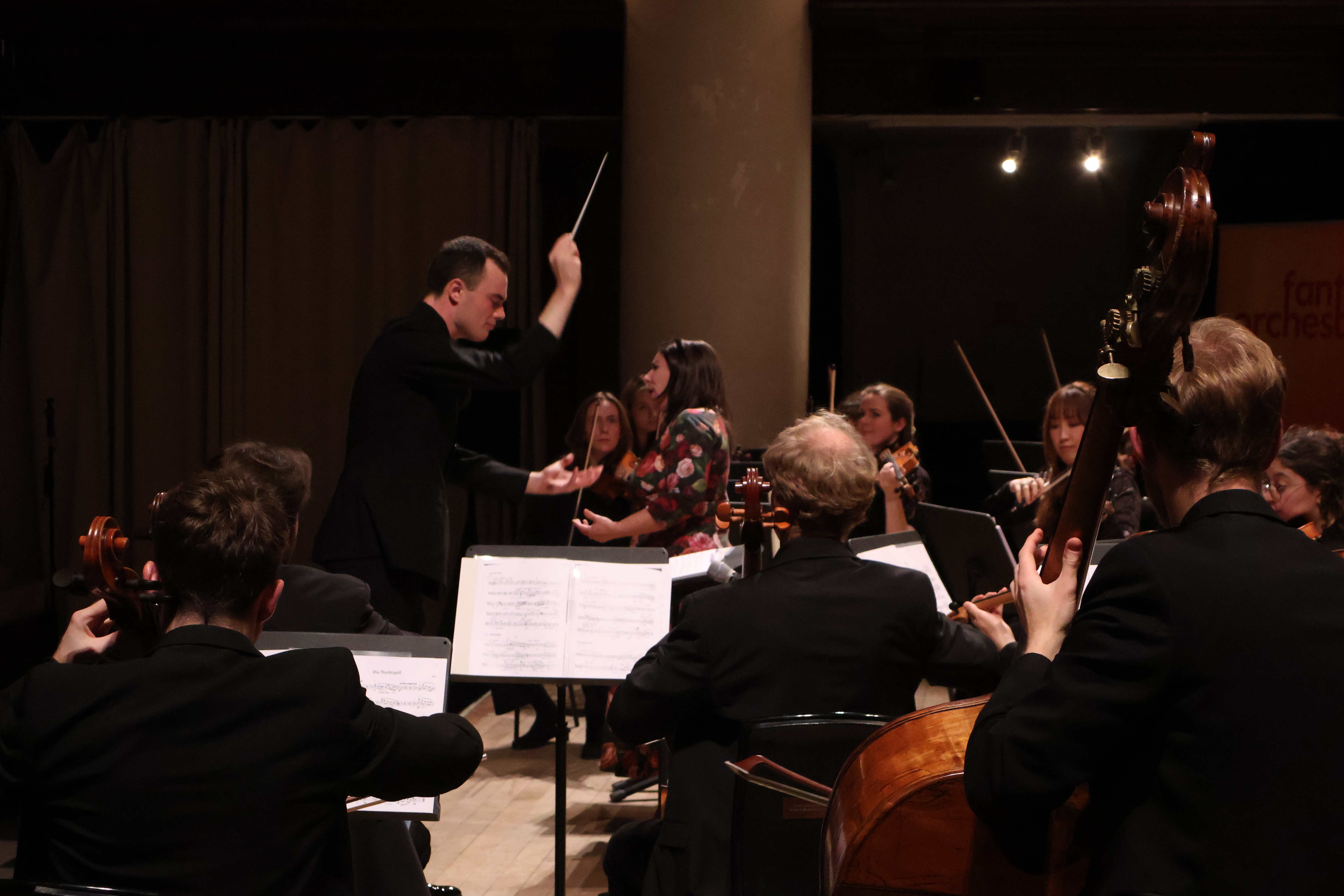
The group celebrated the launch of its Smith Square Hall residency with a diverse classical repertoire, including the London premiere of a new contemporary work. Guillermo Nazara shares his views on the concert to let us know if its assortment of symphonic and operatic pieces hit the high notes.
Sometimes the roughest starts can lead to the most extraordinary finishes. If you want me to prove that idea, I shall present last Sunday’s performance by the Fantasia Orchestra as my first and sole piece of evidence. Playing within the majestic allure of the Smith Square Hall, the group celebrated the launch of its residency with a varied repertoire comprising centuries of classical music, with the concept of a bird as its guiding thread.
Birdsong opened the ensemble’s season with a melange of symphonic works, operatic arias, and even jazz standards, interpreted under the impetuous but confident baton of conductor and artistic director Tom Fetherstonhaugh — also featuring a short-noticed collaboration with soprano Elizabeth Watts following Lucy Crowe OBE’s sudden indisposition.
Last-minute changes in the programming were applied. However, there were very few indicators of a rushed rehearsal process, other than Watts staying on book during her rendition of Handel’s Sweet Bird. All remaining additions were executed flawlessly for the most part, showcasing technical robustness, melodic delicacy, and numerous bravura passages.

Vivaldi’s people-pleasing Spring opened the concert to a conflicting impression. Despite the impeccable quality of its sound, the soulfulness and zest it should have conveyed were noticeably missing. The phrasing was articulate, and the piece flowed adequately despite a slight lack of unity after the first violin’s last solo, where the tempo stumbled for a couple of beats.
Nonetheless, an ongoing sense of mechanicism prevented it from going any further, leashing its fervent spirit — and by doing so, limiting the access to its inner workings. There was correctness but no ownership. And in the end, their approach was similar to that of an actor who can cry on cue, but whose tears will never tear an audience’s heart.
A most pleasant surprise unraveled right after, and its influence permeated throughout the rest of the evening. Florence Prince’s Little Pastorale opened the door to the orchestra’s true potential, as the group delivered an exquisite performance brimming with texture and emotiveness, supported by Harry Baker’s colourful arrangements.
The soft strokes of Price’s petite composition were succeeded by the forceful bars of The Lovebird of the Star — an interesting take on Messiaen’s aria, transformed into a full-part instrumental rendition with the piccolo serving as the lead accompanist.

Haunting and evocative, this new version creates a more intricate picture than its piano-vocal counterpart, despite the missing polish in Jaymee Coonjoobeeharry’s woodwind contributions. His mild struggles with Messiaen’s high-register lines vanish after his virtuosic, nearly immaculate flute performance of Handel’s Sweet Bird, which he carries out with almost unblemished precision and playful flair.
Parallelly, Elizabeth Watts gives an extraordinary soprano rendition, which overflows with technical dexterity, elegance, and sentiment. The praise continues throughout every subsequent enactment — effortlessly capturing the sorrow of the Countess of Almaviva in Dove Sona while bringing out the uplifting charm of Kosma’s Autumn Leaves, which is complemented by Baker’s exuberant Bernstein-esque instrumentation.
The concert also included the London premiere of contemporary composer Blasio Kavuma’s I Am The Sea, an arresting blend of classical and modern elements that emblazoned melodiousness, harmonic boldness, and gripping viscerality. An ongoing dialogue between different sections of the orchestra, the piece’s vigorous essence is a constant battle with its tearful side, marvelously carried out by the string leads in an overall masterful execution.
The greatest florescence never happens in early Spring. Perhaps the nerves of reorganising a gig in less than 24 hours played a crucial and treacherous role. Or maybe being a late bloomer is their introduction card. No matter what caused its not-so-deft start, the Fantasia Orchestra has managed to wipe those initial stains off, and it stands as a widely competent ensemble where talent, knowledge, and intuitiveness stay in the same key. In Beethoven’s own words, “music should strike fire from the heart of man.” And in that sense, the flames were ignited more than once.
This site is proudly sponsored by

Help us continue our work
We count on your support to keep bringing the greatest quality in theatre-related content, from interviews with the biggest names in the industry to reviews of every show in town and beyond.
We appreciate every donation to maintain our high pace and standards and continue to grow.
Thank you for believing in us!
***************************************************
All pictures credit to Alex Rimell.
Upcoming concerts by the Fantasia Orchestra are available on the following link.
One response to “Review of Fantasia Orchestra’s ‘Birdsong’: “Feathery repertoire soars across elated audience””
[…] but fast-growing Fantasia Orchestra, my expectations for high quality were reasonably cemented. My first experience last year might not have been absolutely perfect, but its overall competence wasn’t any less […]