
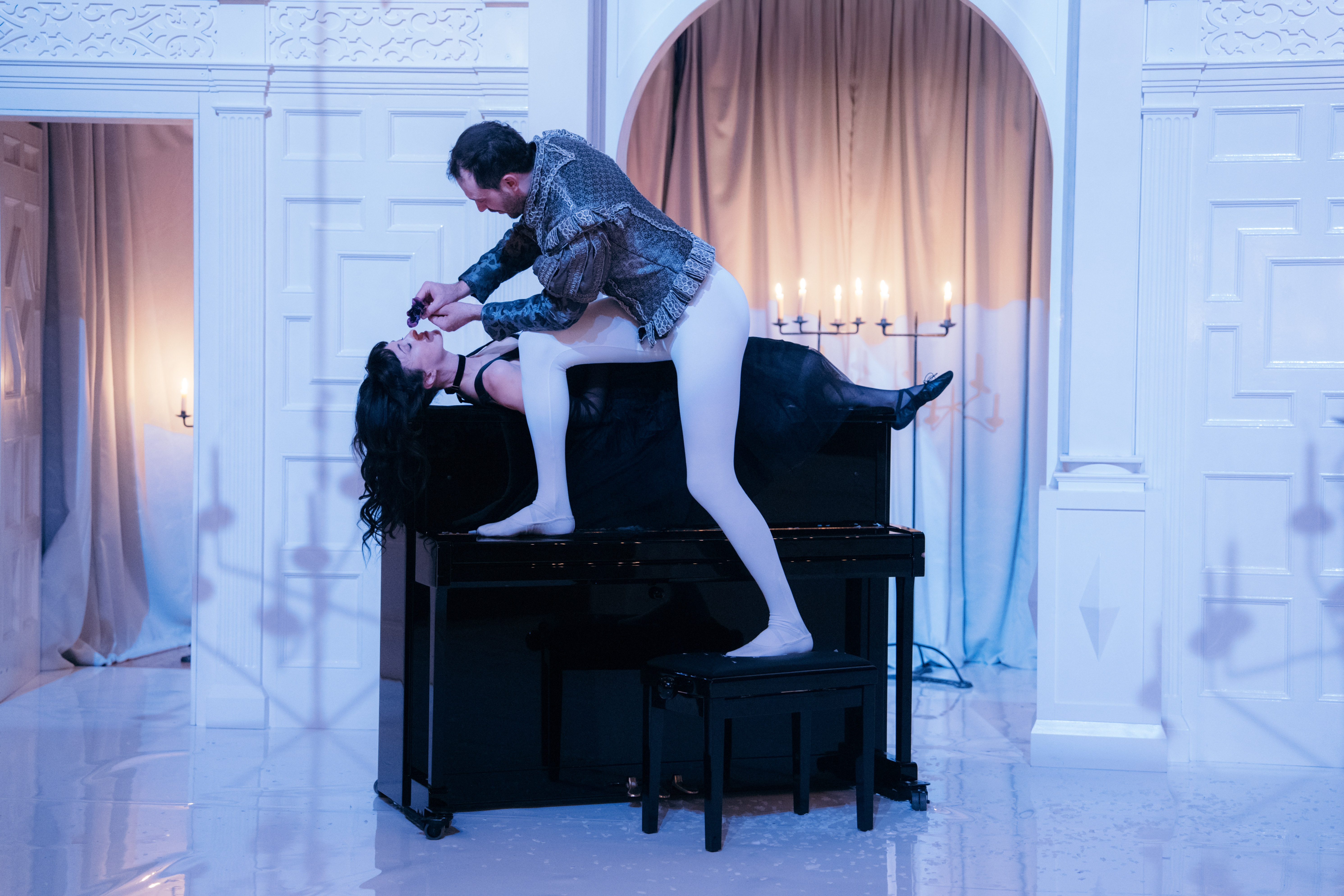
The Sam Wanamaker Playhouse welcomes its first candle-lit production of the Bard’s popular comedy. Guillermo Nazara shares his views on the show to let us know if its bleak, edgier remake has made an ass of itself.
Could we just stop normalizing crushing a man’s groin as a humour device? Seriously, I hate to sound politically correct (not that this is an issue that concerns the current wave much), but this might be one of those things we’d better start phasing out. After all, better uses apply — and don’t tell me you didn’t see it coming. Yeah, exactly.
You might think it’s weird to open a review by questioning the validity of genital-based slapstick. In my defense, the seasonal and all the subsequent productions of Tchaikovsky’s holiday ballet may have something to do with my outrage. And also, there’s nothing normal about Holly Race Roughan’s approach to Shakespeare’s popular comedy, since the term may come off a little restrictive in this nerve-wracking revision.
I wonder how many posters of a feather-coated Natalia Portman are hanging on Roughan’s bedroom wall. The influences from Aronofsky’s psychological thriller are as obvious as they are unsettling — and correspondingly, bleakly delicious.

An androgynous Puck looks upon an anxious audience while patiently eating a banana. His presence exudes an uncanny essence — a thirst for power and blood lingers in his mannerisms. As he turns his back on the viewers, his body contorts to a discordant cadence, while his arms flutter menacingly. He’s summoning. And through that fiendish ritual, unleashing doom.
The white-painted walls of the Sam Wanamaker stage welcome the upcoming nuptials of Theseus and Hippolyta. Contrary to previous incarnations, this is no happy union, and the tension between the two is so fiercely palpable it could be cut with a knife — and a knife does she brandish, only to be confronted with a gun in her mouth.
The frenzy goes on and on for the entire performance. Overall, it’s still a comedy. Yet, the production stays away from most conventional understandings. The title might still include the “midsummer” word in it. Yet, the lovers’ incursion into the magical forest is greeted by a snowfall, as an eerie resemblance to C.S. Lewis’s Narnia begins to unravel. Actors of all genders pirouette around in black tutus as the scenes unfold. And the play’s epilogue takes an unexpected turn when the jest is killed by the death of the jester.

It’s a Jamie Lloyd-level of madness that can’t be separated from its genius. All of Roughan’s additions work remarkably well. The piece preserves its charm and engagement. And in many crucial aspects, its spirit lives on. Yet, this new take conveys a more twisted, interesting reading that blows like a breeze of fresh air. And no matter how putrid the draft might be, the intoxication is hard to resist.
A sense of visceral elegance imbues its subtext and aesthetics. Roughness and delicacy collide and coexist at the same time, balancing each other in a perfect but volatile equilibrium. The performance effectively keeps its audience on edge as a result. We don’t know what the next turn might be. Sometimes, we don’t even expect it. And consequently, their arrivals are as shocking as they are enjoyable — and ultimately, extremely rewarding.
The cast defends every directional decision with extraordinary deftness. Their comedic timing overflows with naturalness and precision, and so does their ability to add new meaning and undertone.
Sergo Vare’s psychopathic Puck, whose white-powdered face evokes a mixture between a deranged Natalie Portman in Black Swan and Jack Nicholson’s Joker, is menacingly droll. The same goes for Michael Marcus’s ill-tempered Theseus, whose tyrannical character contrasts beautifully with his Oberon’s soft-spokenness. Finally, Danny Kirrane delivers an outrageous Nick Bottom that brims with tongue-in-cheekness, while Tara Tijani evenly blends whimsy with poignancy in her endearing rendition of Helena.

As one of the clowns’ bodies lies lifeless onstage, an insidiously gentle Puck extends his hand to a member of the audience. That way, they will be friends — or so he promises. Seconds pass until the suspicious spectator reluctantly agrees. No one can blame her for her refusal. Over two hours later, the play has managed to hit a few nerves. It’s as striking as it’s gripping. And it’s as boisterous as it is horrifying.
There are so many critical points that The Globe’s latest version of A Midsummer Night’s Dream earns, and all of them are of the highest rank. It’s daring, inventive, enduring, and entertaining. Its interpretation stands far away from tradition. And yet, it still captures the heart and soul of the material. There are no revolutionary techniques, but its taste for innovation clings to every part of it. So does its memorability. By the time we leave the theatre, we know we will be haunted forever.
This site is proudly sponsored by

Help us continue our work
We count on your support to keep bringing the greatest quality in theatre-related content, from interviews with the biggest names in the industry to reviews of every show in town and beyond.
We appreciate every donation to maintain our high pace and standards and continue to grow.
Thank you for believing in us!
***************************************************
All pictures credit to Helen Murray.
A Midsummer Night’s Dream plays at London’s Shakespeare’s Globe until 31 January. Tickets are available on the following link.