
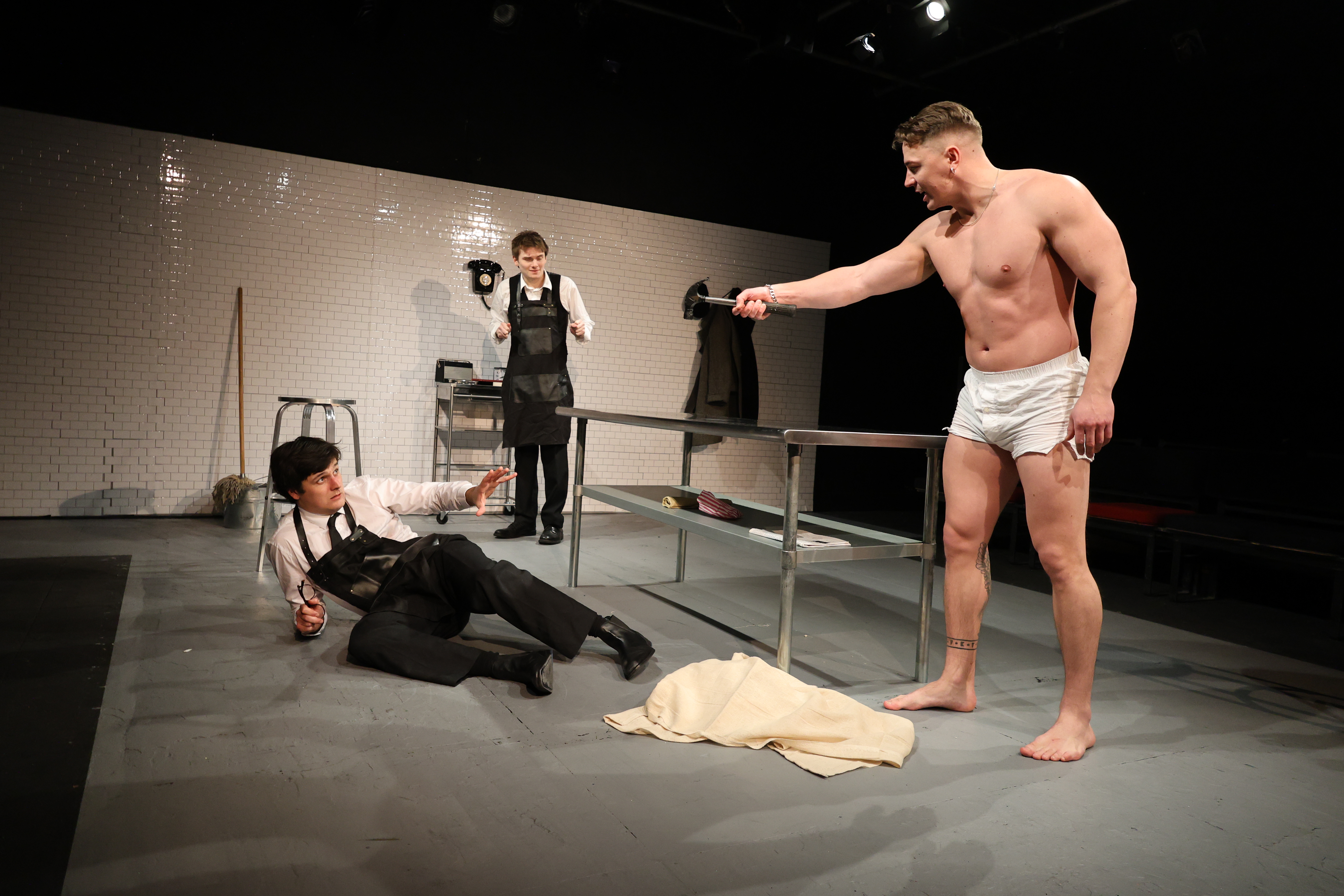
Following its world premiere at the Edinburgh Fringe, the play celebrates its London debut at the Southwark Playhouse for a strictly limited run. Guillermo Nazara disects the show to let us know if its death-hunting narrative left him mortified.
Well, nothing screams Friday fun like seeing a play about undertakers. It’s the holiday season, so the thought of reuniting with the family can trigger interesting yearnings. In all fairness, this is actually an amusing play. Could we categorise it as a comedy? Perhaps, as long as we go down the bleak, bleak road. Yet, there’s a great deal of horror buried underneath (no pun intended), and that’s where its ongoing ambivalence lies. It’s a horror that intentionally makes you chuckle — maybe not to the point of dying of laughter, but enough to resurrect a few dormant reactions.
We step into the peroxide stillness of 1960s East London morgue. Nothing else but a white-tiled wall to break from the dark that falls upon us. In the centre, a naked steel table patiently waits for its next visitor to help them on their last journey. The lights dim, and the hissing sound of an old radio fades in, as a newsflash informs us of the death of a brutal serial murderer. In many aspects, the play walks in the footsteps of an Agatha Christie script. Fortunately, it manages to define its own path clearly.

That doesn’t mean the writing is exempt from criticism. There’s a lot to comment on despite the piece’s exceedingly short length. And that’s one of its major issues. It tries to condense too much in too little time. Inevitably, it doesn’t work — or at least, not sufficiently to exploit its full potential.
It’s hard to analyse its faults without giving away the plot. Christie secures a second mention in that department — she reportedly hated how contemporary reviews spoiled the twist endings in her oeuvre.
Let’s put it this way, then. The first half relies primarily on casual banter. The two young morticians tease each other like they do every other day. Their existences are mundane, but one of them has strong beliefs about fate and the afterworld. It’s then that he explains the idea of the grim — a spectral figure, whose sighting should be interpreted as an imminent bad omen.
The ribbing goes on and on until suddenly an unexpected event occurs inside the room. It’s a striking jump-scare — powerful enough to stop a few hearts. Paradoxically, it brings more life into the action. And at the same time, it’s an excellent device to break into intermission.
The problem is that we’ve only been sitting there for roughly 30 minutes, and the complexities this narrative sets up require a slower-paced and more robust buildup before reaching that moment. If you insist on knowing what was happening, I’ll just say the killer’s body was their latest client. And no sooner had they begun the embalmment than his story was revived.

Conceptually, the play stands on a high rank. It brings a breeze of fresh air to both the genre and, ultimately, the theatre. Stylistically, there’s nothing quite like it. It bounces from boisterous drollery to a spine-tingling thriller — always aware of what it’s doing and executing it adroitly. However, it’s still far from a finished product. There’s a lot to add and a lot to correct.
Although the jokes usually land, the humour occasionally feels slightly predictable and formulaic. So does the dialogue, which, despite its astuteness, doesn’t exhibit all the organicness it should, with several lines sounding clunky, uninspired, and overwritten. Finally, the recount presents a gripping conflict, but it doesn’t take enough advantage of it. There’s a sense of underdevelopment that materialises through its rushed rhythm and abrupt conclusion — noticeably lacking a third act almost in its entirety.
The whole cast delivers an adequate rendition, which brims with rapport and vitality. The level of subtlety and credibility fluctuates among the performers, nonetheless. Louis Davison’s portrayal of Robert is admittedly the most compelling — poised but commanding, and above all, deliciously ironic. Sadly, neither Harry Carter nor Edmund Morris, who also authors the text, meets the same standards — Carter comes off a little wooden while Morris can’t convey the nuance his own words require.
There is a lot of work to do. Yet, the starting point is much higher than other pieces of a similar nature. And in many ways, The Grim has created its own not only through its engaging premise but mainly through its original treatment. Although this post-mortem is not as positive as we would hope for, there is still a steady pulse that could lead the play into something richer and much more memorable. A flawed first draft shouldn’t be regarded as a skeleton in the closet, however. Instead, it’s an opportunity to unearth greater things.
This site is proudly sponsored by

Help us continue our work
We count on your support to keep bringing the greatest quality in theatre-related content, from interviews with the biggest names in the industry to reviews of every show in town and beyond.
We appreciate every donation to maintain our high pace and standards and continue to grow.
Thank you for believing in us!
***************************************************
All pictures credit to Molly Jackson-French.
The Grim plays at London’s Southwark Playhouse Borough until 6 December. Tickets are available on the following link.