
The Marylebone Theatre welcomes the London premiere of Michael McKeever’s harrowing play. Guillermo Nazara shares his views on the show to let us know if this tale of unconditional love ends conditioning itself.
We don’t need Netflix to tell us these are true events. We don’t even need to watch it to believe in it. It hits close to home for many of us — too many of us. Previous works have explored the subject. Toxic families that put their interests before their children’s will, as a coping mechanism to combat the grief they’re overwhelmed by. Barely an excuse. And often a callous act.
This is not a play about homophobia. Its subtext, however, depends heavily on it. The title hints at the core matter of its narrative. Yet, we cannot expect its ominous outcome. Daniel’s Husband is another gay story. One of too many. Not because our stories shouldn’t be told, but because bigotry, injustice, and discrimination imbue our lives with burning anger.

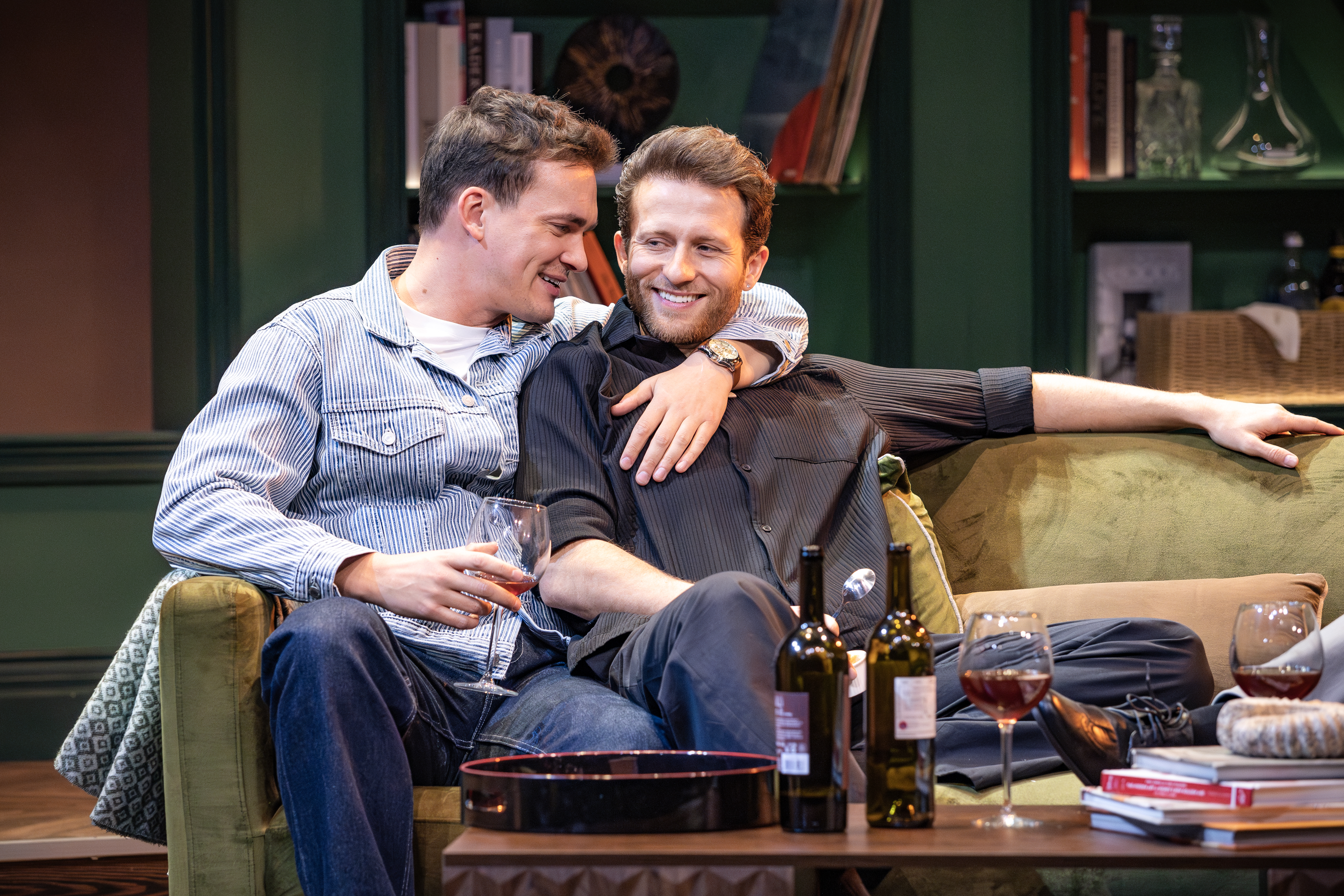
It all starts at a casual house party. There are two couples. On the one hand, a hard-working twink and aging daddy full of sweetness — and probably sugar. On the other hand, a soulful lifelong commitment that’s lasted for seven years and counting. Ever since then, Daniel and Mitchell have meant everything to each other. They share the same house and the same path. Daniel has always wanted to formalise their relationship and get married. Mitchell, however, doesn’t want to comply with the rules of tradition and heteronormativity. He enjoys the difference — until the impossible happens.
Writer Michael McKeever brings back his signature pathos-loaded pen when building this narrative. Or at least, there’s an attempt at it. It’s not as fruitful as it was before, nonetheless. We can appreciate the potential, but the material is in desperate need of reworking. There’s too much fat to trim and too many bones to strengthen with muscle.
Although the script presents us with an unexpected and subsequently engaging conflict, the overall feel is of a disorganised and slightly aimless structure. For half of the performance, this 90-minute recount takes us through Dan and Mitchell’s everyday. One is a successful architect with an accepting but overbearing mother. His relationship with her is, to put it mildly, complicated. Yet, Mitchell has had a tougher upbringing and still appreciates what she’s trying to do. That is, before the problems begin.
It is in the middle of a heated argument that Dan develops a sudden condition that paralyses his entire body for the rest of his life. He can see, hear, and think. Yet, while his mind is still intact, his outside will never be the same. Despite Dan’s contention with his mother, she insists on taking care of him. She’s willing to do anything to make it happen — even if that means taking advantage of the fact that Dan and Mitchell are not formally married.

It all happens in roughly 45 minutes. Suffice to say that it’s not enough. At that point, McKeever has teased such a rousing premise. In many ways, it mirrors Amenabar’s Oscar-winning film The Sea Inside. A paralyzed Javier Bardem fights for his own autonomy —whether that’s to live or to die. This plot has nothing to do with the morals of euthanasia, but its ethos permeates on a similar level.
Just imagine what a compelling journey it could have been. All it takes is for that battle between Mitchel and his mother-in-law to be given the space it deserves. That’s the real core of the show. And consequently, its real heart. Sadly, such a poignant feature is stripped to three scenes, all of which come off vapid and underdeveloped.
The text wastes too much time on unnecessary exposition. All those background elements are relevant, but none of them requires that long. As a result, the important sections are vaguely outlined. The themes are presented, but the script rarely delves into them.
We can’t experience the frustration and discontent Mitchell goes through, simply because that door never opens to us. Lydia (Daniel’s mother) is reduced to a very archetypal role, with nearly no complexity to explain her wrong yet not automatically ill-intended actions. And ultimately, the show fails to make us root for the protagonist. We can relate to Mitchell’s grief and understand his tragedy, but we never feel part of it, since too many crucial moments have been taken away from us.

Alan Souza’s direction generally works well. The scenes transition fluidly in a mix of theatrical and cinematic languages, and the acting remains naturalistic regardless of the emotional cargo. Justin Williams’s figurative design is intricate and visually inviting — and admittedly, the best set the Marylebone Theatre has had in its 2025 season. Furthermore, Jamie Platt’s evocative and elaborate lighting creates a smooth tapestry of textures while effectively accentuating the drama when due.
Overall, the cast delivers beyond adequately. David Bedella flaunts charm and sass as the couple’s friend and agent, Barry, while Joel Harper-Jackson earns the highest praise through a sharp, subtle, and harrowing portrayal of Daniel. Luke Fetherston’s rendition as Mitchell exhibits chemistry with his co-star, but not sufficient depth on his own — his execution usually lacks layering, organicness, and truthfulness. A similar issue affects Liza Sadovy’s interpretation of Lydia, which comes across as shallow and faintly internalised.
Last night, a few sobs could be heard during the closing scene. I wasn’t one of them. Yet, I can’t say I wasn’t touched by the image of two loving men finding a new lasting purpose in each other. It’s a beautiful depiction of a first date that moves you as much as it haunts you.
The rest of the play could have been exactly the same. Nonetheless, its overly linear approach, confused focus, occasional cliched lines, and formulaic attempts to pull at the heartstrings prevent it from going any further. Despite those final steps in the right direction, Daniel’s Husband‘s real potential remains in the shadows for the most part. It’s not a forgettable watch, but its endurance is limited. And much like in its own narrative, it’s a trial that it’s yet to win.
This site is proudly sponsored by

Help us continue our work
We count on your support to keep bringing the greatest quality in theatre-related content, from interviews with the biggest names in the industry to reviews of every show in town and beyond.
We appreciate every donation to maintain our high pace and standards and continue to grow.
Thank you for believing in us!
***************************************************
All pictures credit to Craig Fuller.
Daniel’s Husband plays at London’s Marylebone Theatre until 10 January. Tickets are available on the following link.