
London’s Barbican Theatre welcomes the RSC’s latest production of the Bard’s popular love story, featuring new musical numbers and inventive scenery. Guillermo Nazara shares his views on the show to let us know if this new version has been born great, achieved greatness, or has greatness thrust upon it.
Before we delve into the pros and cons of this not-so-memorable new production of the Bard’s classic, let’s just pause for a minute to mourn the death of etiquette at the theatre. It doesn’t take a genius to figure out that a 3-hour Elizabethan comedy might not be suitable for seven-year-olds. And understandably, they will get bored and start disrupting the rest of the audience, to the point that the actors will incorporate them into the script.
What’s baffling, however, is how the two ladies sitting on my right spent half of the second act exchanging pictures of their dogs on Facebook. The RSC may not have delivered their greatest endeavour, but surely anyone with a speck of grey matter could understand that those actions are not tolerable during a live performance. I’m sure they’ll still brag to their friends about how enlightened they felt upon attending. Yet, for their next stagy incursion, may I suggest something more suitable to their taste and attention span? Perhaps a rendition of Everybody Poops?
Fortunately, the RSC hasn’t sentenced its audience to an evening of similar suffering and subsequent murderous tendencies. For the most part, it passes. And during a scene or two, it shines. That’s about it, though. This latest revival is still far from being granted landmark status, as it pushes too hard for a laugh that barely earns. The reason why is simple. And so is the solution — why don’t we just let Shakespeare be Shakespeare?

We can’t blame this company alone. It’s been a trend, especially with comedies, to incorporate new additions to the Bard’s text for the sake of modernization. We need to catch up with the times. And of course, nobody’s saying that revivals of classics shouldn’t be put through updated filters. That’s precisely what proves their endurance — how a work from another era can still fully resonate with ours. The issue, which has permeated too many productions in recent years, is how current creatives seem to forget one of the most defining qualities in Shakespeare’s oeuvre — immortality.
The track record speaks for itself. During the excerpts where the original text is preserved mostly intact, the script and narrative flow flawlessly — the jokes land, the pacing moves with grip and steadiness, and ultimately, we are presented with a compelling story that’s as entertaining as it is funny and touching. Had they kept that approach for the entire performance, and relegated its modern parallelisms to the visuals -and maybe some very occasional remarks-, the production would have been an utmost success. Unfortunately, their endeavour remains in the pipeline — quite literally.
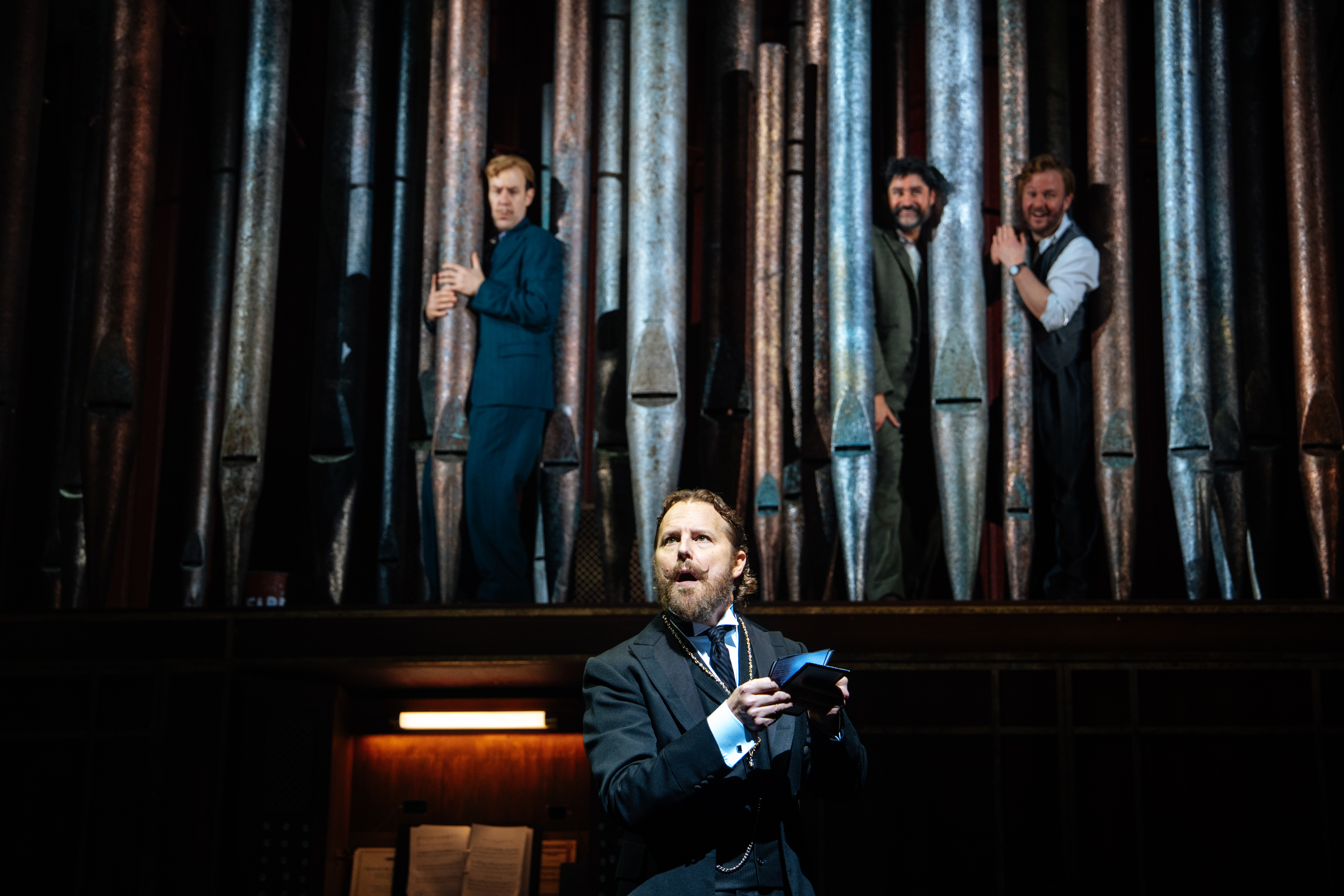
A massive church organ slides downstage, serving as the scenery’s centrepiece. The impending wedding at the end justifies its use. Admittedly, the design exudes theatricality — overall, it’s functional and versatile, as it evenly transforms into the different settings with adequate adaptability. A live organist provides the underscore, which is dramatically effective for the most part, but whose gimmicky musical jest usually comes off forced, strenuous, and unwelcome.
The revival is conceived as a play with songs. And as such, an array of intimate, cabaret-style numbers unfold throughout the recount. None of them is striking enough, however. And neither do they contribute significantly to the tale’s impact. On the whole, Matt Maltese’s melodies are warm and pleasing, but at the same time, they sound too safe, derivative, and eventually, bland — standing as a dispensable component that makes little to no effort to be missed.

The slightly dark, 1950s makeover builds an enticing ambiance. To some extent, it establishes an interesting duality between the piece’s droll facade and this production’s slightly more somber subtext. That might be, in fact, the most satisfying aspect of Prasanna Puwanarajah’s direction, which is embodied principally through Malvolio — he is not just a comedic antagonist, but a character that displays more depth, sympathy, heart, and above all, humanity.
Part of that merit is due to Samuel West’s extraordinary portrayal of the role, which is admittedly the highest praise in the entire cast — and by extension, the entire show. His delivery is impeccable, demonstrating a great command of the text in terms of cadence, meaning, and emotion, inevitably stealing every scene he is in. Daniel Monks and Gwyneth Keyworth also make notable appearances as Orsino and Viola, both playing their parts with naturalness, presence, and soft yet biting strokes of irony.
Wistfully, half of the troupe struggles to match the same quality standards. It might be the result of their little faith in the source material — a problem the direction has a lot to answer for. Or perhaps it’s just a misunderstanding of the piece’s inner workings. Whatever the case, we do encounter many problematic lead and supporting performances. Freeman Agyeman proves her comedy skills as Olivia, but the constant absence of nuance and organicness takes over any redeeming features in her rendition. Comparably, Demetri Goritsas gives the flattest interpretation as Sir Andrew Aguecheek — rarely funny, usually shoehorned, and consequently, extremely annoying.
Although some segments still brim with the brilliance of Shakespeare’s genius, the RSC’s newest production of Twelfth Night doesn’t seem to have been blessed with the arrival of any wise men (or women), who surely would have made of it a more enjoyable and groundbreaking retake on the Bard’s popular rom-com. Those unfamiliar with the piece may regard it as inferior. And those who already loved it might end up calling for an intervention.
This site is proudly sponsored by

Help us continue our work
We count on your support to keep bringing the greatest quality in theatre-related content, from interviews with the biggest names in the industry to reviews of every show in town and beyond.
We appreciate every donation to maintain our high pace and standards and continue to grow.
Thank you for believing in us!
***************************************************
All pictures credit to Helen Murray.
Twelfth Night plays at London’s Barbican Theatre until 17 January. Tickets are available on the following link.