
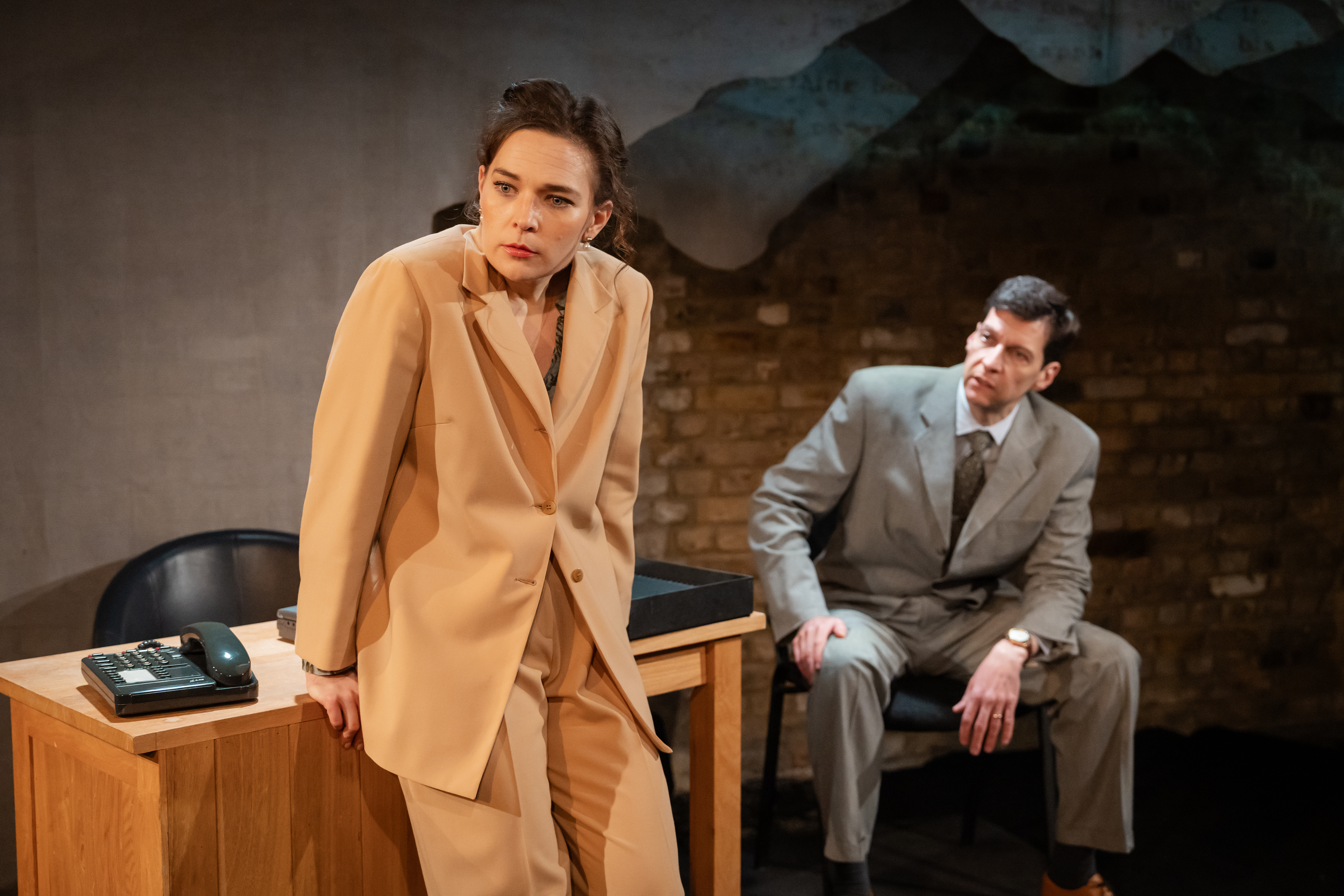
The Arcola Theatre presents this new piece exploring the diplomatic maneuvers amidst one of the most delicate international conflicts in recent history. Guillermo Nazara shares his views on the show to let us know if its attempts to strike as a poignant plot should be followed by a white flag.
“Oh, I write a letter to Gorbachov every day — we’re practically pen pals.” Two separate wars are unfolding within the confines of the Arcola’s Studio 2. One is taking place in the Gulf of Iraq. The other is happening inside my mind, as I battle basic reason to endure the unnerving artificiality of the play’s dialogue.
You don’t need to scroll down to the star rating to guess where my views stand. I believe I said it all already. And yet, I still have a whole lot more to say. But where to start, though? Should it be its one-dimensional characters? Its lack of proper conflict (something ironic given its main topic)? Or maybe the searing feel of disappointment we’re left with after seeing something so promising collapse, following an appallingly heavy-handed approach that just couldn’t hold up?
Few other genres can have as much grip, thrills, and intellectual stir as a compelling political drama. Author Chris Bowers clearly understands that notion, but he just doesn’t know how to put it into his own creation. There’s an attempt, but barely a result — to put it mildly. It’s an extremely shallow, unengaging, and ultimately boring piece of storytelling. And the complete absence of actual tension and structure crosses the line of professional writing.

An usher begins to clap as the first act concludes. That’s how confused audiences were regarding when they should applaud. Or maybe they weren’t just that keen on doing so. In the end, it wasn’t strong enough for a showstopper — and neither was the rest of the play.
Everything about it comes off flawed and overwhelmingly unpolished. During the prologue, a young diplomat sits on a patch of black sand, reflecting upon her journey. She was born in East Africa to British expats. And despite her ancestral background, she’s always felt like an outsider — ever since she and her family moved back to the UK.
Maybe that’s the reason why she works for the Foreign Office, and why the plight of the Kurdish people, hunted by Saddam Hussein’s oppressive tactics, hits so close to home. It’s a problem she just can’t look away from. And she won’t, especially after an unexpected visit from a refugee opens her eyes and starts a call to action.
It baffles me how typing these last few words can still give me goosebumps, yet experiencing it onstage left me in such an apathetic state. It’s a clear example of a great premise ruined by a less-than-adequate execution. You might as well say that they killed the entire thing.
Nothing in it works, apart from the production’s average staging. The dialogue needs more flow and subtext — in fact, it doesn’t have any. Overall, the lines are either dull or melodramatic, and they lack the necessary buildup to come across as both believable and entertaining. There’s no introspection to it, either, which only accentuates the growing sense of phoniness that pervades and, eventually, defines the script.

The plot may revolve around the agitations this conflict brought across the world. Paradoxically, it feels incredibly vanilla — almost like a school show trying to explain complex matters to young students. There’s no gravitas. Everything is superficial, rushed, and struggles to generate the lowest degree of pathos — an effort that never materialises.
The most frustrating part about all of this is that it has been written by someone who was there firsthand. As a former British diplomat in Iraqi Kurdistan, Bowers could have borrowed more rousing elements from the reality he witnessed and, in some way, contributed to. Instead, all that he offers us is a superfluous trail of events that flaunt little uniqueness. And eventually, they come off as the vision of anyone with access to a quick Google Search.
The text’s multiple issues significantly affect the cast’s delivery. It’s a shame, given that so many of them have performed brilliantly in previous shows. This is not the case — for anyone. The renditions are either wooden or histrionic, unable to show any layering or truthfulness. Consequently, none of them is memorable — at least, not in a favourable manner.
We could talk about how the transitions between scenes lack dynamism. We could also mention the need to flesh out so many raw components. Yet, we would still be reaching the same conclusion: this is not ready for the stage. Although it parts from an arresting idea, Safe Heaven’s dramatically naive resolution is unlikely to bring victory to anyone. And it gives no reason to anyone to hold their fire.
This site is proudly sponsored by

Help us continue our work
We count on your support to keep bringing the greatest quality in theatre-related content, from interviews with the biggest names in the industry to reviews of every show in town and beyond.
We appreciate every donation to maintain our high pace and standards and continue to grow.
Thank you for believing in us!
***************************************************
All pictures credit to Ikin Yum.
Safe Haven plays at London’s Arcola Theatre until 7 February. Tickets are available on the following link.