
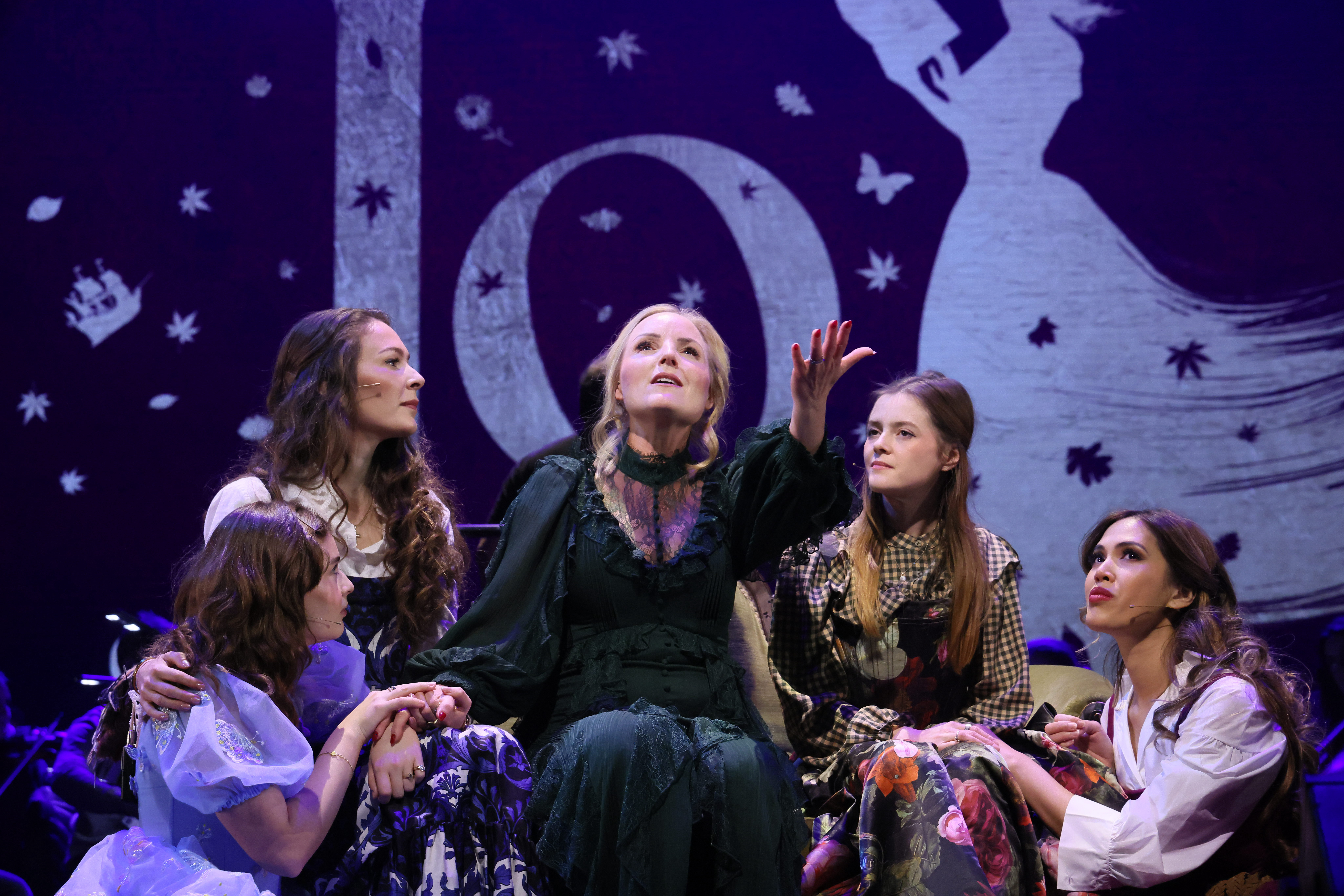
The show celebrated its world premiere through a one-off semi-staged concert starring some of the biggest names in the industry. Guillermo Nazara shares his views on the show to let us know if this newest adaptation of the literary icon outgrows its former incarnations.
It’s been done before. I don’t mean Louisa May Alcott’s classic novel as the subject matter of a stage musical. Well, I do — but that’s not all I mean. Over the course of the evening, I couldn’t help being inundated by that feeling. Was it something I had seen somewhere else? Or perhaps heard? It didn’t take long before my mind began tying the knots. And after that, not that much in this show came out well.
I have no problem with someone writing their own version of a topic that’s already been musicalised. Andrew Lloyd Webber was not the first to turn a deformed artistic prodigy with murderous tendencies into a theatrical extravaganza — but he was the best in that endeavour. And although its sumptuous score managed to entice me more than I’d like to admit, I’ve come to the realisation that this piece stands on the shoulders of more competent endeavours. And it purloins quite unashamedly.

If you’d like me to start with the positive (hardly a reality for my cynical perception of the world), I will acknowledge composer Dan Redfeld’s craftsmanship both as an orchestrator and a conductor. His background as arranger for many prominent film and musical theatre soundtracks confirms his proficiency in that department. They’ve also provided him with a source of inspiration. And perhaps, they’ve contributed to his original work more than he should take credit for.
It’s an extremely derivative creation, almost in direct competition with Frank Wildhorn’s unashamed borrowing. In some instances, it might have even reached a new level.
When Tchaikovsky presented his piano concerto to a cynically unimpressed Rubinstein, he replied that many of his predecessors should be flattered, as that piece reminded him of any composer except Tchaikovsky. Nearly two centuries later, Redfeld seems to have returned the compliment, and he’s done so on a much greater scale. Whether intentionally or not, that’s for him to decide.
A lush ball scene unfolds during Act One. As the French horns play the opening teaser, the Land of Candy instantly pops into my mind. A suspiciously close melody and harmonic progression take place. Coincidence? Maybe. I’m all down for giving them the benefit of the doubt when this happens — because it happens to everyone.

Yet, my distrust increases when the woodwinds deliver the melodic response. Again, with a very kindred tune. And when the climax erupts, and the strings take the lead, all that I can hear and think about is what you’ve probably guessed by now — The Nutcracker‘s Waltz of the Flowers lingers within those bars.
That’s not the only example. We could include so many others, none of which acts like a mere homage. When Jo and Laurence have their meet-cute moment, a sequence of four-note descending arpeggios plays, which later serves as a recurring leitmotif. “I didn’t see you there, forgive me”. Oh, sorry — wrong quote. What could have possibly made me think of Les Misérables?
Well, in case somebody missed Claude-Michel Schönberg reference (unlikely, a grantable wish), there’s another number designed to notice him once and for all — because even the deaf could hear its uncanny resemblance to Martin Guerre‘s The Madness.
The similarities persist, ranging from subtle ostinatos in the style of Alan Menken to melodic resources that scream Andrew Lloyd Webber, and which can be easily traced back to specific titles in his repertoire.
Smartly, they have altered themselves just the right amount not to be considered copycats. However, their status as musical and narrative doppelgangers is undeniable. Consequently, Redfeld can’t be accused of plagiarism, but he also doesn’t earn originality points.
You may argue that every artist needs to find their inspiration somewhere. And that’s correct. Schönberg himself used the beginning of Puccini’s Coro a bocca chiusa as the foundation for Bring Him Home.
That’s not the subject of my criticism, though. If you’re able to take a previous idea and mold it into something greater, that’s where the genius comes forward. It’s a stroke of magic, as it actually involves alchemy. Yet, when that raw idea is the only memorable component, that’s a different concept, and it often goes by the name of mediocrity.

Our next offenders are the show’s vacuous book and lyrics. The issues with the latter can be summarised through a single mention. “Life is exciting, so they say, when you’re young and you’re wealthy.” It’s bad enough as a passing verse. The fact that is repeated throughout the song only makes the writing’s clunkiness louder.
There is no attention to form and external beauty in the words. Its use of language is underwhelmingly prosaic and muddled. On the other hand, there’s no subtext, no depth, or proper exploration of the character’s inner truth. And consequently, their contribution is nonexistent. They could have just said “this is a love song” over and over again, and the effect would have been exactly the same.
The script lacks strength and the dialogue has little flow. The creatives seem undecided whether this is a book or sung-through musical. And so, pivotal moments that should be tackled with through melody are spoken instead — and vice versa.
The structure is also flawed for the most part. All the numbers are too stagnant from a recounting perspective, rarely advancing the plot and investing too much time in telling us things we already know. In addition, the ending suffers from a wrong buildup, giving us the expectation of a conclusion, followed by the not-so-pleasant realisation that there’s more come yet.
Its emotional weight is light, too. Despite the story’s poignancy, the adaptation fails to preserve any of that pathos. The protagonist’s arc is tremendously sketchy. Jo doesn’t want to abide by traditional societal rules, as she tries to fulfill her lifelong dream of becoming a professional writer. Nonetheless, we can never sympathise with her struggle, which is handled with absolute superficiality, tiptoeing across all the crucial stages of her journey.

There is redemption in this show, but that should be attributed exclusively to its cast and orchestra, both of whom regaled audiences with a generally impeccable interpretation. Christina Allado gives a powerhouse performance in the lead role of Jo, brimming with electrifying stamina, presence, and arresting vocals, despite some occasional minor glitches.
At the same time, Tracie Bennett steals the show with her comically grandiose rendition as the bitter, rich old widow, Aunt March, while Tobias Turley is adequately memorable through his fresh-faced portrayal of the goodhearted Laurence. The highest praise, however, goes to Kerry Ellis as Marmee March, once again flaunting extraordinary singing, which is combined with elegance, poise, and magnetism in her acting.
I will appreciate the intricate colourfulness of the instrumentation, and its masterful use of ornaments and countermelody. I can compliment the fortitude of its showstopper and Act Two opening, however proximate it feels to Anastasia’s theatrical adaptation. In terms of its writing, that’s about it.
Jo parallels the creative flaws her main character experiences as a budding novelist. Its overly sugarcoated approach prevents the viewer from witnessing the ugliness of the personages’ universe. And consequently, it blocks its beauty too — at least, the one that speaks directly to the soul. Eventually, it betrays the core principles of its source material. Much like the March sisters, musical theatre songs aren’t supposed to be just a pretty little bunch.
This site is proudly sponsored by

Help us continue our work
We count on your support to keep bringing the greatest quality in theatre-related content, from interviews with the biggest names in the industry to reviews of every show in town and beyond.
We appreciate every donation to maintain our high pace and standards and continue to grow.
Thank you for believing in us!
***************************************************
All pictures credit to Roger Alarcorn.
Jo, The Little Women Musical played at London’s Theatre Royal Drury Lane on 25 January 2026 as a one-night-only event. Further updates on the show are available on the following link.