
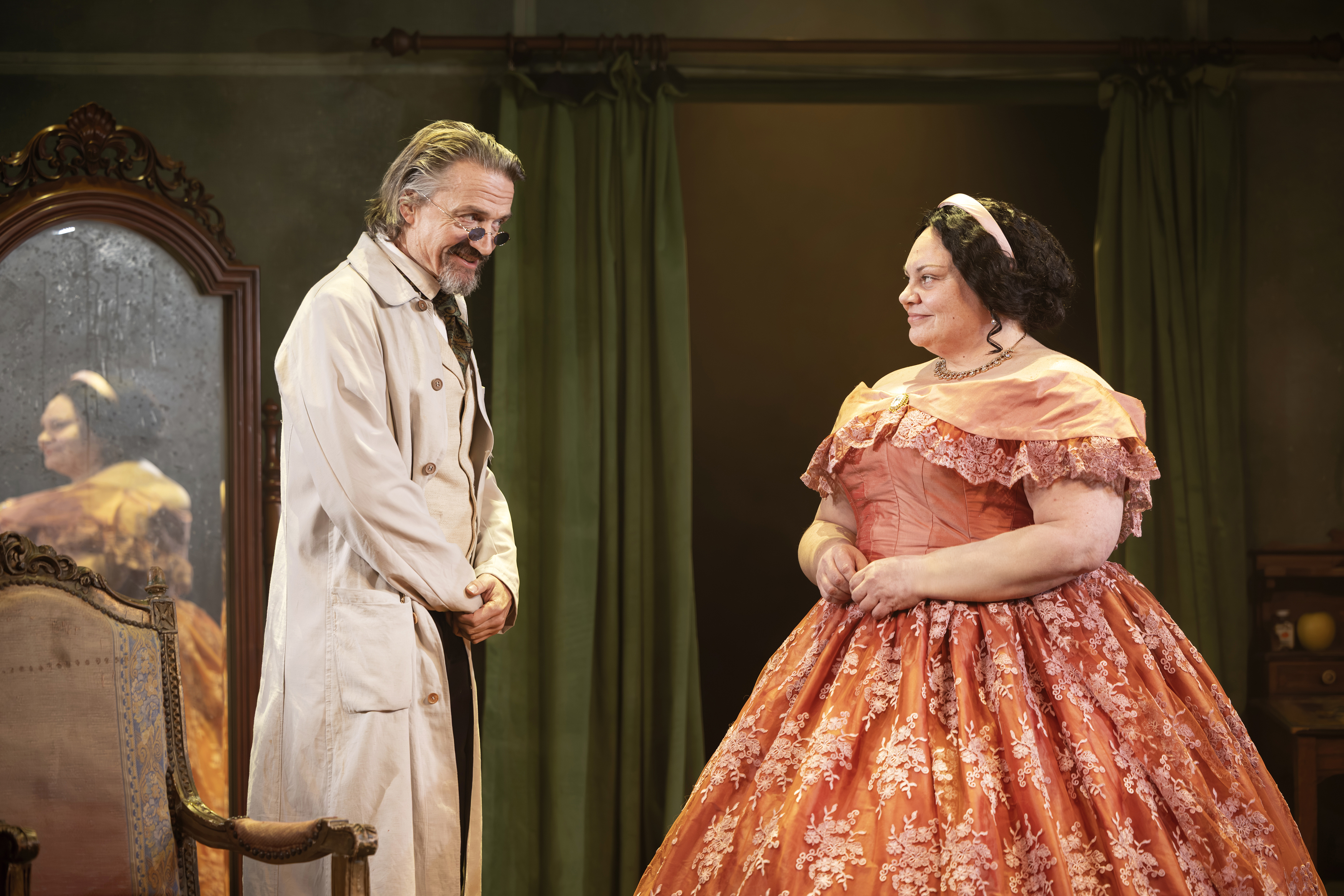
Following its initial run at the Charing Cross Theatre last year, the piece makes a comeback in a reformed version starring Keala Settle as Mary Todd Lincoln. Guillermo Nazara shares his views on the show to let us know if it’s worth electing.
Oh, Mary! If only you knew what theatre has turned you into. You’re a laughing stock at the Trafalgar, and the humour persists across the road, only that audiences at the Charing Cross may not be leaving in their best one.
This already happened. We saw it. We reviewed it. And many of us didn’t like it. There was consensus, from at least a few — this piece wasn’t ready for the stage. There’s still a lot of work to be done, and there are hardly any redeeming features except for a decent premise.
It’s slightly better than last year’s. Then again, the standards weren’t too high. We can at least take solace in the fact that the camera and chair won’t engage in philosophical conversations in between scenes. Yet, its shoddy character exploration persists.

Mrs Lincoln comes to Brady’s studio with the intention of being immortalised. A simple task, but a huge endeavour. And certainly not an easy one. She’s hard to please, although that’s an issue Mr Brady has probably experienced before. In any case, many subsequent visits will follow across the years, as they both endeavour to deliver the right portrait, and she struggles to cope with the hardships of her personal life.
As a concept, it’s a solid narrative structure. So are the themes the author intends to explore. The endurance of loss and grief, coming from the deaths of both her son and husband, is a prominent subject, but so is her struggle to preserve her autonomy in a world that deemed her mad and, according to the script, refused her the chance of being treated like a valid human being.
The goals are there, and the writing makes little effort to mask them. It’s not a subtle text — quite the opposite. Every point it wants to make is presented in a bold, unrefined way, telling the viewer what they should think instead of giving them the tools to reach that conclusion.
That lack of subtlety imbues every aspect of the piece. There’s an inevitable overexposure, and it doesn’t lead to a pretty picture.

Everything is presented in a melodramatic and superficial way. Despite its attempts at profundity, the text fails to delve into Mrs Lincoln’s humanity. All that we are given is the female archetype she vehemently wants to break away from. Every reason for her suffering should feel like a dagger in our hearts. They never do, however. Despite showing us the reasons for her pain, the writing doesn’t provide any channels for viewers to empathise with her.
The outcome is simple — and almost as tragic as her situation. In the end, all that we see is what her contemporaries see: someone histrionic and unstable. The only sorrow we ever experience stems from the fact that we are aware it shouldn’t be like this.
There’s too much talking but very little to say. For at least half of it, the script appears to go nowhere — rambling without really advancing either the plot or the character’s arc, which, despite its expected poignancy, comes off flat, sterile, and vacuous. Some scenes strive to add philosophical weight through metaphorical reveries. Nonetheless, they come across as pretentious moves, which muddle the play’s effectiveness by piling up dirt instead of digging deeper.
The production values play to a higher standard. Featuring the same staging as last season, Anna Kelsey’s figurative approach is inviting, detailed, and moderately flexible. The use of random objects from the studio to evoke different settings is perhaps its strongest feature, adding an element of theatricality that exudes flow and dynamism.

Derek Anderson’s lighting builds a robust atmosphere while vividly capturing the emotional undertone of every scene. At the same time, Matt Powell’s video design contributes to the design’s overall intricacy. And admittedly, it delivers some visually impressive segments, although some transitions feel overly long and unnecessary within the narrative.
Neither Keala Settle nor Hal Fowler offer compelling performances as Mrs Lincoln and her photographer, Matthew Brady. Beyond their noticeable lack of chemistry, both renditions prioritise technique over truthfulness. Unavoidably, their interpretation is shallow, inauthentic, and excruciatingly mechanical — there’s no layering, acuity, or sincerity in their execution; and the audience’s response can only match their effort.
It didn’t work in its first run. And sadly, its return hasn’t improved things significantly. Mrs President may be on a fervent campaign to win the public’s favour, but its poor understanding of storytelling and character development will likely heighten the secession. The show is at a log-cabin state, and it won’t grow into anything grander until it emancipates from its rough beginnings. It’s at war with itself, and there’s nothing civil about it.
This site is proudly sponsored by

Help us continue our work
We count on your support to keep bringing the greatest quality in theatre-related content, from interviews with the biggest names in the industry to reviews of every show in town and beyond.
We appreciate every donation to maintain our high pace and standards and continue to grow.
Thank you for believing in us!
***************************************************
All pictures credit to Pamela Raith.
Mrs. President plays at London’s Charing Cross Theatre until 8 March. Tickets are available on the following link.