
Following an initial tryout in the regional circuit, Anna Jordan’s love story arrives in the London scene, playing for a limited run until the end of the month. Guillermo Nazara shares his views on the show to let us know if this compound of romantic memories passes his acid test.
It’s not that it’s boring, although it is. It’s actually its lack of pathos, insightfulness, and resonance that I have a problem with — many will. Oh, yes, you will laugh. It doesn’t brim with sharpness, but some punchlines are thoroughly enjoyable. That is the extent of it, however. If you’re looking for something meaningful or thought-provoking, Lost Atoms is hardly the element to bring to your equation. It might follow a formula to the letter, but it’s unlikely to cause a reaction — at least, not a positive one.
Another romance has landed onstage. Nothing new, but nothing we should instantly repel. It wouldn’t be the first time that I bring back the old saying: every story has been told. And just like in the past, I’ll refer to my principle and welcome all these rehashes as long as they have something new and exciting to offer. This one does not, in its entirety.

There’s only one thing that we can pardon. Its abstract, visually engaging staging is admittedly its most accomplished asset. It doesn’t come without its flaws, nonetheless. And there’s a strong chance that you will be praying for the cast not to get hurt.
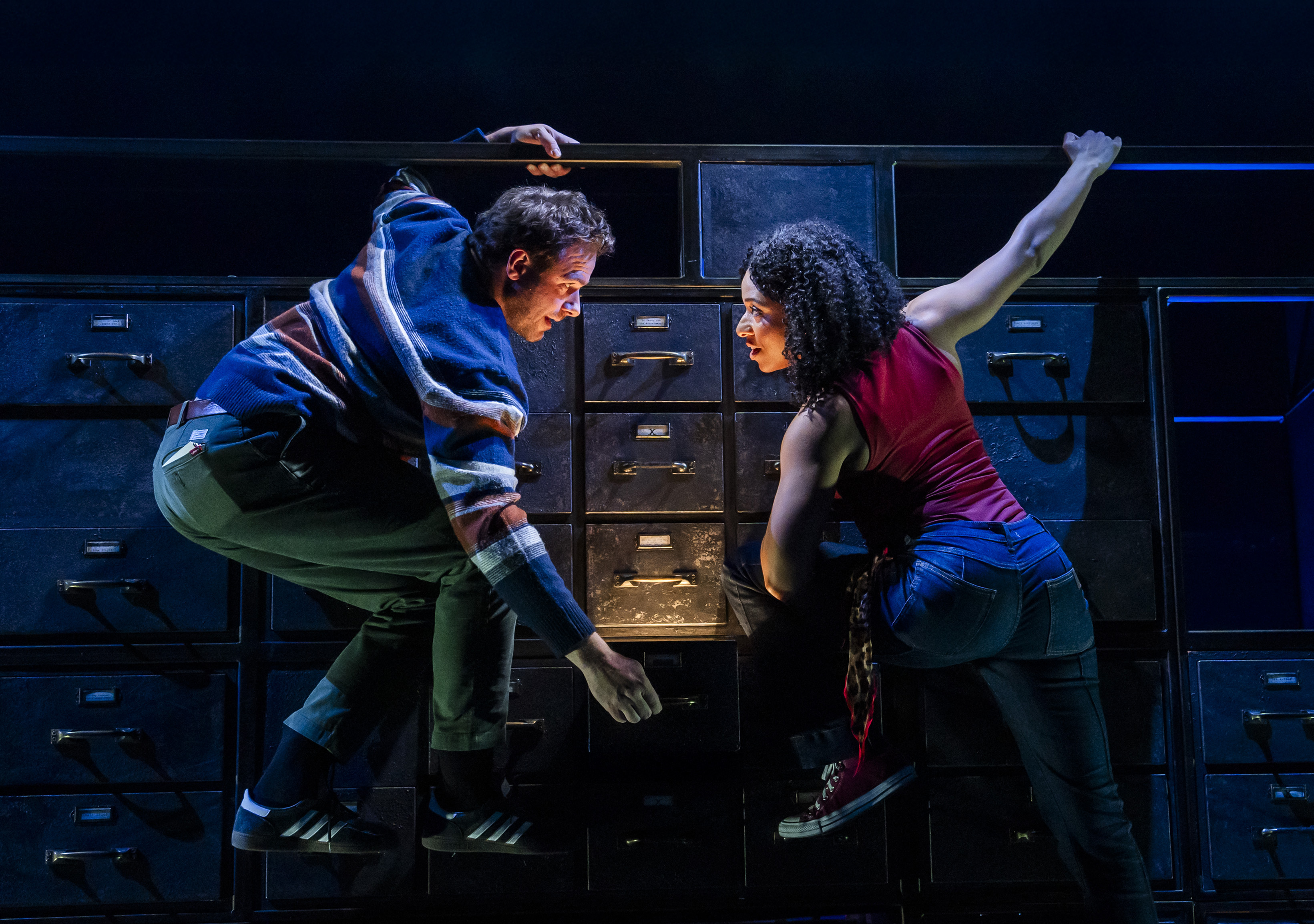
A wall made of metal drawers serves as the recount’s framing setting. Like precious possessions in a highly secured bank vault, the two protagonists revisit the memories of their relationship. Some contain items that transport them to key moments of that journey. Some others are used as steps to climb up to the top of the scenery. And some others create atmosphere through light and physical suggestion. In addition, the large central door rises as it transforms into a platform, where both characters sit, lie, and pirouette as its squeaking shake makes us fear for the worst.
Thankfully, that didn’t happen on press night. There were accidents, but those materialised in the form of cliched writing and flat acting. It’s a real shame when we consider how much potential the premise has, despite its derivative nature. Two souls coming from opposite paths come across each other. One is shy, quiet, and distrustful. The other is outgoing, loud, and messy. They turn each other’s world upside down, and that’s what makes their connection so special and so perfect. That is, of course, until the unthinkable happens.
They could have provided us with a more compelling narrative. Or give us a speck of emotiveness at the very minimum. There’s nothing of the sort. The attempts are numerous, much like the themes lingering throughout the plot. Yet, there’s no actual introspection in the script. And as a result, its promising poignancy slips rapidly through the fingers of its rather heavy and clumsy hands.
All the topics teem with potential: the idealisation of love, the building of trust (especially for people scared to be hurt again), and the acceptance of loss in its many forms. Anna Jordan’s writing is faltered by her prioritisation of action over insight. Consequently, the text never delves into the characters’ growth, which results in sketchy arcs and dramatic oversaturation. It doesn’t allow itself enough time to stop and reflect. And inevitably, it escapes the viewers’ thoughts during and after the performance.

There’s no real rapport between the leads. And separately, their renditions are mechanical, superficial, and slightly plain. We could blame the script for that deficiency, whose shallowness is both cause and effect in such vacuous portrayals. And still, we should thank them for providing some flavour to an overall bland concoction, where humour is employed disproportionately to mask its many limitations.
“It’s you who left me,” cries the show’s heroine as the lights go off, signalling the start of the interval. It’s meant to be the show’s cliffhanger, but ultimately, it doesn’t achieve its goal — and neither do the rest of the play’s components. Irremediably, Lost Atoms doesn’t solidify into anything enduring, as there’s not a molecule of truthfulness, stir, or individuality in its system. Instead, the piece comes across as a chaotic group of particles, whose union increases the number but not the value. It doesn’t take science to discover the reason for its failure. And you won’t find any alchemy in it either.
This site is proudly sponsored by

Help us continue our work
We count on your support to keep bringing the greatest quality in theatre-related content, from interviews with the biggest names in the industry to reviews of every show in town and beyond.
We appreciate every donation to maintain our high pace and standards and continue to grow.
Thank you for believing in us!
***************************************************
All pictures credit to Tristram Kenton.
Lost Atoms plays at London’s Lyric Hammersmith Theatre until 28 February. Tickets are available on the following link.