
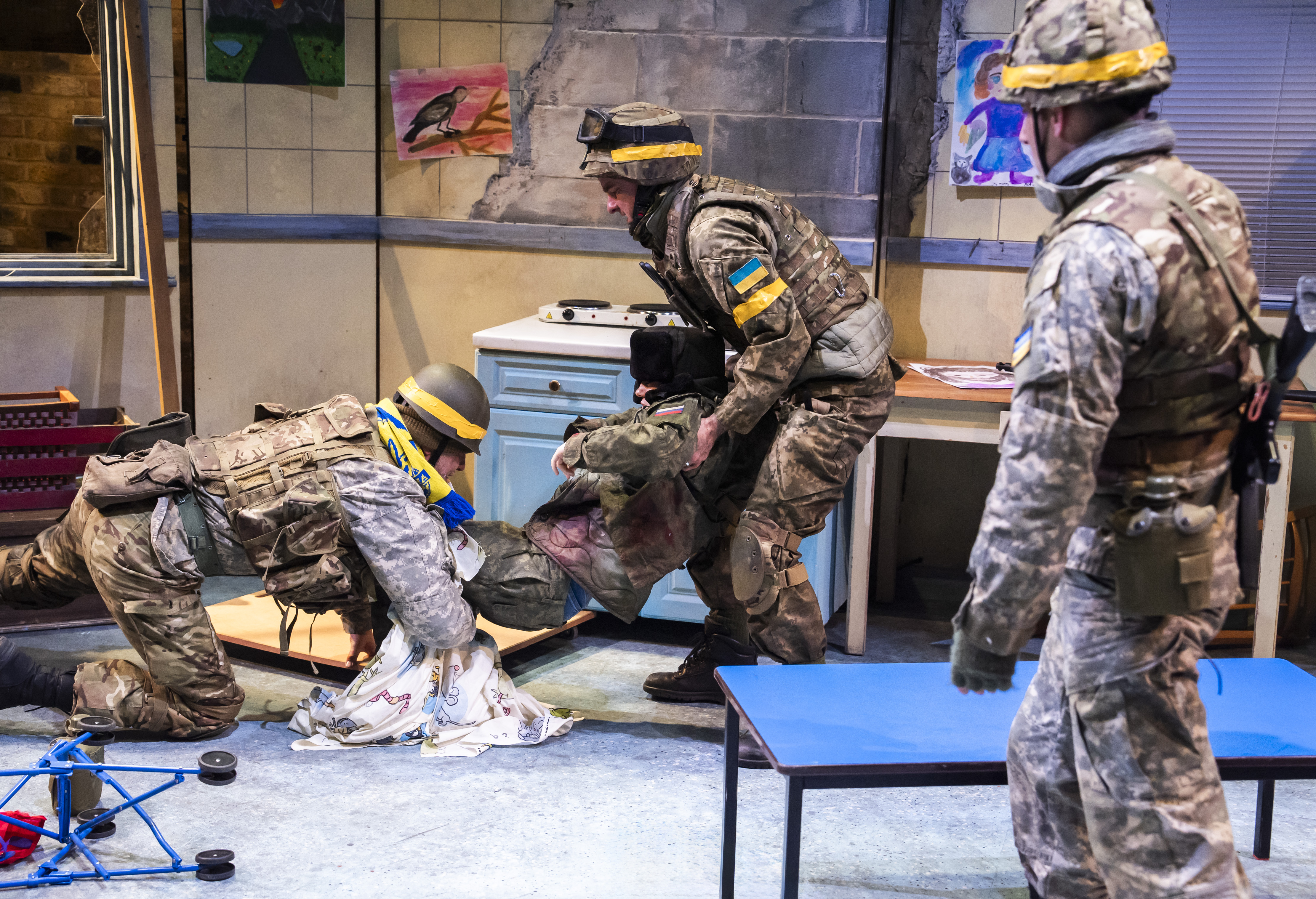
London’s Arcola Theatre presents an array of short narratives involving the Ukrainian-Russian conflict. Guillermo Nazara shares his views on the show to let us know if it passes with flying blue and yellow.
I don’t mean to show no sympathy for Ukraine’s plight. I will, however, show little mercy to this piece. Very little. I can acknowledge the attempt to raise awareness about the country’s situation. Yet, the dramatic ineptitude displayed throughout makes me wonder how far an audience’s patience can be tried even when there’s a good cause behind it.
There’s barely anything to rave about Ukraine Unbroken, which opened this Monday at London’s Arcola Theatre, presenting viewers with five short accounts revolving around the nation’s current conflict. It’s a hot topic that brims with possibilities both on an intellectual and emotional level.
Unfortunately, none of them was fulfilled. We might have been given the facts- a whole lot of them -, but its lack of narrative skills has turned a potentially gripping anthology into a dull, shallow depiction of the struggles and resilience imprinted on the Ukrainian spirit.

Different authors tell different stories. And most of them are met with indifference. It’s not the themes they are handling. It’s the way they are handled. For the most part, the scripts aren’t incapable of delivering a substantial narration.
The issue of timing is no justification. A microplay can be just as stirring, rich, and meaningful if the author knows how to face the challenge. That rarely happens here. And when it does, several crucial elements are still missing.
There is no proper third act in any of them. The characters are sketchy, and they experience no real transformation. They go through extreme ordeals, from seeing death thriving before their eyes every day to being kidnapped and brainwashed by the Russian government. Yet, their arcs are so insignificant that we can’t even notice them.
The same applies to the dialogue, which often comes off plain and unnatural, with some lines sounding slightly unidiomatic. There is not enough flow or subtext in it, and its insubtlety during the expositional segments, which in some pieces make for virtually the entire text, underpins an overall sense of phoniness.
As a result, the material barely engages the viewer, and its resonance is practically nonexistent. The topics are meaningful, but the manner in which they are explored compromises their effectiveness. Even when it deals with more existential matters, such as the guilt stemming from prioritising individual well-being above the so-called greater good- also known as avoiding conscription -, the text comes across as superfluous and underdeveloped.

Consequently, there is no poignancy or any actual sentiment apart from Mariia Petrovska’s heartfelt bandura renditions, all of which flaunt impeccable technique and ample emotiveness. Used as the guiding thread that brings all the pieces together, her personal accounts preluding the musical numbers are the only sign of truthfulness the show exhibits.
Yet, even her interventions look somewhat misplaced. The connection between the plays and her monologues is vague, and its impact would have been much greater had the songs been more thematically proximate to what each play encompasses. The absence of subtitles, an easy addition given that her performance is captured on two live screens, also increases the distance between audience and subject. Her soulful interpretation suggests haunting lyrics. If they really, we shall never know.
The production doesn’t excel either on an acting or design level. Its figurative staging is detailed but clunky when it comes to transitions, and the striving stagehands can corroborate that statement.
On the other hand, the portrayals are flat, with almost no nuance, layering, or authenticity to their credit. Ian Bonar makes one of the few exceptions, whose extensive multi-role appearances demonstrate adequate register. Jade Williams also earns some recognition as Anna in Taken, the show’s final tale, giving a spirited performance that might not be touching but is nonetheless credible.
A lot is going on in the world right now. And most of it is utterly terrifying. Ukraine Unbroken could have been one of those piercing works that reveal its cruelty unfiltered, but also give us a reason to keep going. And although those intentions are palpable, they do not permeate its contents in a way that’s dramatically compelling. They have the right purpose, but they follow the wrong path. And that’s not the best strategy in wartime.
Help us continue our work
We count on your support to keep bringing the greatest quality in theatre-related content, from interviews with the biggest names in the industry to reviews of every show in town and beyond.
We appreciate every donation to maintain our high pace and standards and continue to grow.
Thank you for believing in us!
***************************************************
All pictures credit to Tristram Kenton.
Ukraine Unbroken plays at London’s Arcola Theatre until 28 March. Tickets are available on the following link.