
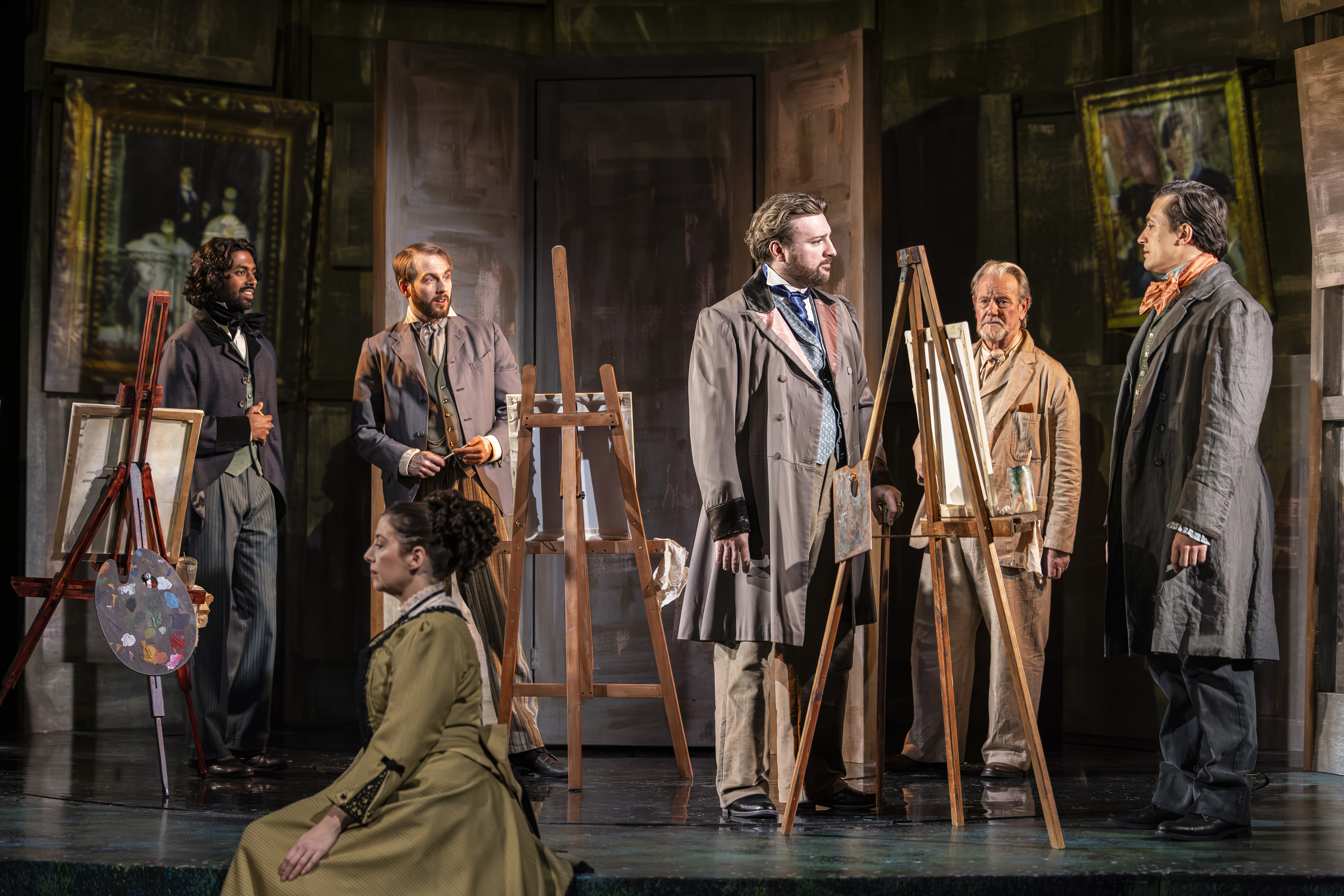
London’s Charing Cross Theatre hosts the world premiere of Carmel Owen’s musical biopic of the influential painter. Guillermo Nazara shares his views on the show to let us know if its portrayal of the artist should be given the brush.
In their defence, they never went as far as talking about a Russian who played on and on, like an endless telethon, while the protagonist wished he were Elton John — but they did feature an agonising wife uttering such precious lyrics as “I’m running out of time, so can I have some water and lime?” There’s also the art dealer who sells work to a gentleman from Cork. And that aforementioned spouse was Monet’s muse, but she was abused. Poetically speaking, it wasn’t a pretty picture.
Sadly, the issues persist in A Mirrored Monet, which celebrated its world premiere last night at London’s Charing Cross Theatre, and which is likely to reflect its characters’ struggles for recognition. The reason behind it is the only difference, however. While Monet pushed boundaries, this piece appears to have taken a step back in terms of quality. And no matter how far or close you look into it, the impression is never good.

An infuriated old Monet laments his inability to finish his next masterpiece. A clear nod to Peter Shaffer’s Amadeus follows. There might not be weeping confessions of jealousy-driven murder. And no demented Italian composer will summon the audience through a campy harpsichord rendition. A similar framing device applies, nonetheless. As Monet looks into the stalls, he notices some unexpected guests have sneaked into his sanctuary. He isn’t disturbed by it. Far from dismissing them, he welcomes them into the story of his life.
It’s not the best tool. At least, not in the way it’s implemented. Contrary to Amadeus, where the antagonist’s overwhelming guilt triggers that urge to tell his truth, there is not sufficient character motivation for Monet to do the same. He is tormented by the memories of his late wife, Camille — but despite his desperation to reconcile with her on a spiritual level, the script doesn’t provide enough intimacy for the viewer to become the protagonist’s confidante.
That’s only one of the many, many, MANY dramaturgical mistakes this piece is plagued by. Structurally flawed from start to finish, the show fails to devise a compelling journey for any of its personages. They all embody powerful themes. However, neither the songs nor the book delves into them in a way that’s remotely stirring, fulfilling, or even engaging.
Monet’s frustration with the cultural clique of the time and his determination to prove himself serve as the main premise. Conceptually, the possibilities for a resonant story of resilience, sacrifice, and self-belief are countless. In reality, they never materialise. Nor do any other subjects solidify. Everything is handled with absolute superficiality, and the result is nothing but a blurred narrative without proper conflict, tension, or evolution. Many ideas are pencilled, but none of them is fully realised. And consequently, it’s impossible to be drawn into its universe.
Owen’s music demonstrates complexity to a certain extent, particularly through its use of somewhat rich harmonies and key changes. Wistfully, her melodic skills are not as competent. While many motifs are enticing, they are not quite as memorable. In addition, the score fails to convey any defined emotions, often stuck in a nondescript mood that very rarely serves the recount. In some cases, it even produces the opposite effect, with Camille’s abortion solo sounding closer to an I Want song.

We can praise the colourfulness of its orchestrations. Some choices are debatable, nevertheless, as the oversaturation of woodwinds contributes to the piece’s generic feel. On the other hand, the band’s rendition doesn’t come without its blemishes — some instrumentalists are constantly off-pitch, which inevitably jeopardises the actors’ vocal performances.
Owen’s writing improves throughout the book, where the dialogue exhibits adequate flow and certain dramatic strength. There are some issues concerning the story’s expositional elements, which are sometimes presented in a clunky, unrealistic manner. Yet, its consistency is far more robust than its musical counterpart.
The company is undoubtedly the greatest asset of the production, whose lazy projection-based scenography comes across as a complete waste of opportunities. Jeff Shankley delivers a powerhouse portrayal of Monet, exuding the magnetic charm of old-school stage acting. At the same time, Dean John-Wilson plays the artist’s younger self with vigour and charisma. The highest praise, however, is earned by Brooke Bazarian through her extraordinary singing and heartfelt interpretation of the grieving Camille.
Despite its legendary inspiration, there are hardly any strokes of genius in A Mirrored Monet, whose clueless approach and mundane development have turned a promising drama into a forgettable, banal, and ultimately boring theatrical experience. It might be an overstatement to say audiences would rather watch paint dry, but it should be clear to everyone involved that they must go back to the drawing board.
Help us continue our work
We count on your support to keep bringing the greatest quality in theatre-related content, from interviews with the biggest names in the industry to reviews of every show in town and beyond.
We appreciate every donation to maintain our high pace and standards and continue to grow.
Thank you for believing in us!
***************************************************
All pictures credit to Pamela Raith.
A Mirrored Monet plays at London’s Charing Cross Theatre until 9 May. Tickets are available on the following link.