
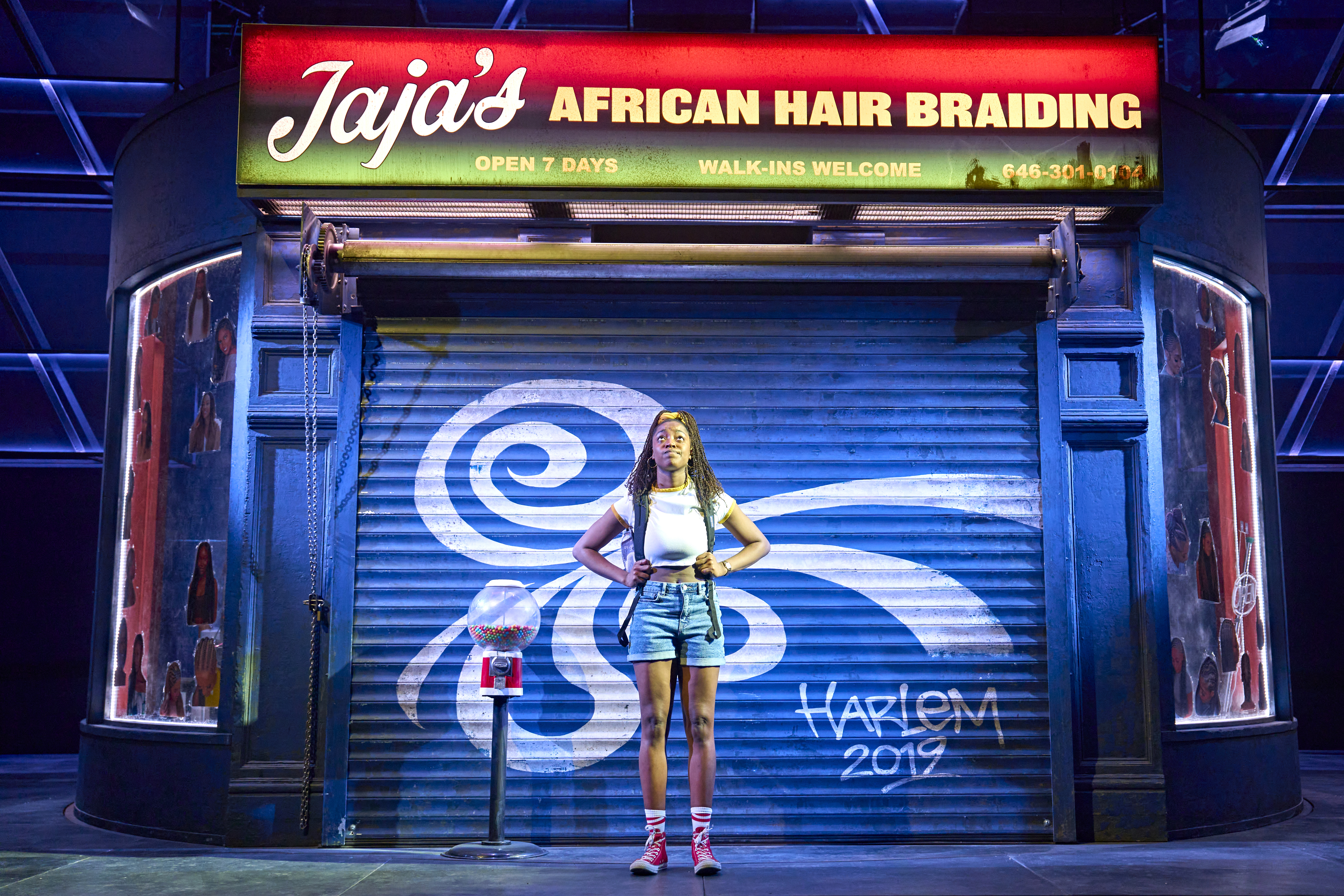
The Lyric Hammersmith hosts the London premiere of Jocelyn Bioh’s comedy play. Guillermo Nazara shares his views on the show to let us know the mane problems of its hairy plot.
They’ve cut it a little too short. And if that’s not the issue, they should definitely let it grow longer. There’s no question about the endearment, bonding, and enjoyability of Jaja’s African Hair Braiding, which celebrated its London opening last Friday at the Lyric Hammersmith. Still, the more I comb its script, the more I realise there’s something missing. It doesn’t require a super tangled plot, but its roots are showing the need for a less frizzy finish.
Set in modern-day Harlem, the play revolves around a young Black woman trying to find her path in the world. While working at her mother’s hairdressing salon, she reflects on the choices she wants to make for herself, which inevitably clash with her mum’s expectations. She wants to become a writer, but that’s too much of a stretch of the American dream that an immigrant parent wishes to see their children fulfil — but it’s still her life, and it’s for her to live.

The premise brims with poignancy and relatability. For the most part, the script maintains that connection. There’s intelligence in its thematic layer. And there’s profundity, too. However, this is not a final product. And no matter how much goofy humour they spray on it, a sense of incompletion permeates its narrative. Obviously, these issues are not serious enough to curl its audience, but its numerous wasted opportunities are a shame, nonetheless.
There’s no defined journey for any of the characters. There is drama, but no evolution or transformation. Marie’s relationship with her mother, who only makes a brief appearance before things take a much darker turn, is vapidly explored. So are the arcs for all the other personages, whose conflicts are introduced, but which the script never delves into in a compelling manner.
The material teems with socially conscious potency, which is conceptually rich. And despite an overall lack of development, it still manages to make a minor impact on the viewer: there’s the dynamics of codependent relationships, such as the one Aminata is trapped in; there’s also the subject of class and privilege, which is adequately depicted when Marie comes across her former classmate, Sheila; domestic abuse and the pursuit of freedom and one’s true happiness are embodied through Miriam’s winsome interventions; and of course, there’s a stimulating portrayal of racism and xenophobic prejudice towards immigrants and their rights.
All of them provide the recount with richness and significance, which pervade both the story and dialogue at several moments. It doesn’t suffice, though, as none of these themes comes into full cycle. Of course, not every problem we are presented with needs solving, but on the whole, many topics are discarded right after being brought in, almost as if being held by the pigtails and flung away, Ms Trunchbull-style.

As a result, a pinch of shallowness lingers throughout. It’s not massive, but it’s consistent. There’s too much emphasis on the humorous side, which is effective despite its formulaic, hyperbolic, and rarely razor-sharp essence. And by focusing on its outer look, the recount can only go as deep and move us just as much.
The performances play a big role in making the piece more engaging than it actually is. The entire cast delivers an exceptional rendition, which swarms with extraordinary comedic instinct, inborn flair, and infectious chemistry.
Zainab Jah earns a first mention through her high-octane interpretation of Jaja, which is followed by Renee Bailey’s exceptional register in her multi-role portrayal of the arrogant, thrown-off-a-cliff-deserving nurse, Vanessa, Marie’s conceited peer, Sheila, and the self-absorbed businesswoman, Radie, all of whom bristle with energy and memorability. The highest praise, however, goes to Babirye Bukilwa as Aminata, whose inviting, droll stamina imbues her character with classic-sitcom iconicity.
Beautifully staged through Paul Wills’s naturalistic design, the production could potentially make the cut as one of the Lyric’s 2026 highlights. Yet, the script seems to have let its hair down a bit too much when devising the plot and its execution. As a result, a few extensions are mandatory to make the whole thing work, as the show’s conclusion comes across as just the start of intermission. I’m not after anyone’s scalp here, but its entertaining qualities can’t disguise the fact that it’s a bald story.
Help us continue our work
We count on your support to keep bringing the greatest quality in theatre-related content, from interviews with the biggest names in the industry to reviews of every show in town and beyond.
We appreciate every donation to maintain our high pace and standards and continue to grow.
Thank you for believing in us!
***************************************************
Jaja’s African Hair Braiding plays at London’s Lyric Hammersmith until 25 April. Tickets are available on the following link.