
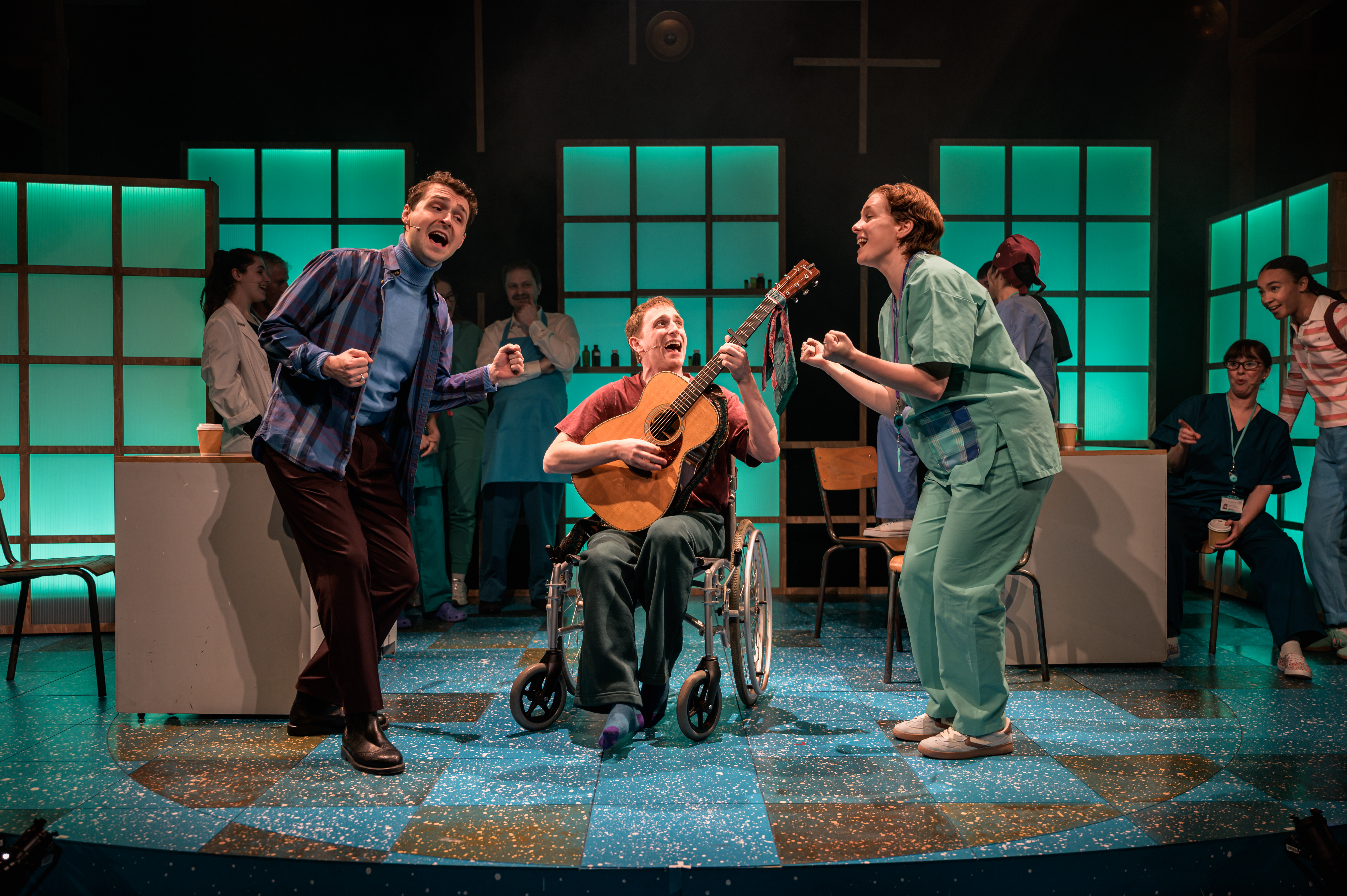
The Southwark Playhouse presents the world premiere of this new Scottish musical about past and modern-day medicine. Guillermo Nazara shares his views on the show to let us know if this love letter to the health services made him sick.
I swear to God that I don’t mean to crucify anyone with this review. Even though it’s Good Friday. Yet, they’re not making my job easy if benevolence is what they’re looking for. This is a strange concept for a musical. Then again, strange can lead to unique if the right formula is found and properly applied. And there is, in fact, a lot of discovery throughout the nearly 3 hours of Lifeline, a show designed to promote the correct use of antibiotics.
It’s a laudable mission, and its premise offers a fair and necessary diagnosis of an ill-minded society, which is plagued with social media-trained scientific experts and conspiracy theorists. Yet, the prognosis for this piece isn’t as positive. I could say that the many flaws this musical is afflicted with put it into cardiac arrest by the middle of Act One, but it would be far-fetched. Not in terms of accuracy, but simply because it doesn’t have a heart.

Two separate stories intertwine throughout an overall boring narrative. In today’s world, a young musician named Aaron is hospitalised following a sudden medical condition. Things seem to be under control. That is, until they realise his body is suffering from an adverse reaction, later found out to be sepsis caused by an antibiotic-resistant bacterium.
Seven decades earlier, a well-known Alexander Fleming cautions about the importance of using the right dose of penicillin, fearing lower amounts could allow microbes to tolerate the medicine and eventually fight it back. More events unfold, such as his romance with a Greek colleague, Amalia, as well as the haunting memories of the friends he lost while serving in the army.
Conceptually, it’s a compelling plot. It’s the execution, however, that is the problem — a massive one. It’s impossible to be enticed by what’s going on, for the mere reason that the show doesn’t make clear what story it wants to tell, which, consequently, is nothing at all. At least, not in full form.
At the beginning, the show hints at a tale of resilience about a patient battling a horrible disease. Later on, we’re presented with a flavourless love subplot with no thrills or surprises whatsoever. Afterwards, we’re given another insipid number criticising the bureaucratic faults when someone attempts to help underfunded health research. And a grieving mother who’s just lost her son experiences the fastest recovery I’ve ever seen, instantly moving on after singing about how broken she feels by the circumstances.
The biggest issue is that all those elements could have worked altogether and resulted in a poignant, thoughtful, and resonant recount. Yet, none of that can happen if the conflict is so vapid it can hardly be identified. Neither can it if the characters’ arcs are as enduring as a Calatrava building. There is no focus, no growth, and no transformation. The message is clear, but the delivery fails miserably — it makes it extremely difficult to engage, and ultimately, the only care it generates in the viewer is of the palliative kind.

There are hardly any redeeming features either in the score or the book. Becky Hope-Palmer’s dialogue lacks flow and subtext, and it’s packed with clichés that only accentuate its artificiality.
Robin Hiley’s music is tuneful and pleasant, but highly derivative and generic, with the show’s opening song being the only memorable one in the entire soundtrack. His compositions often fail to serve the narrative, suggesting a completely different feeling than what the scene depicts. As such, we get to see a man convulsing on his hospital bed while the company sings lively music that screams anything but drama.
The examples go on and on, raging from cringey vocal ostinatos where the words “tonsilitis”, “sinusitis”, and “otitis” are repeated ad nauseam on the bass line, to an ample roster of poorly concocted lyrics in the style of “you’re not like the rest, you treat me with respect” or “we need treatment to live longer, we need medicines to be stronger”. Not a verbatim reproduction- except for those terrible rhymes -, but you get the image. And it doesn’t take X-rays to realise they are problematic.

The cast does their very best to keep the piece alive. Wistfully, there’s not much that they can do when the material is already dead from the start. Therefore, no rendition flaunts sufficient truthfulness. There’s chemistry, and there is competence, but despite some decent singing and adequate acting, none of them shines in the slightest.
To top it all, the uneven balance between the band and the company further jeopardises their interpretation. It’s a real shame, given that the score’s impeccable orchestrations are the production’s sole praiseworthy component. However, the fact that the instrumentals constantly take over the vocal lines compromises the audience’s understanding and the quality of the performances. Noticeably, the actors can’t hear themselves. And inevitably, they go off pitch and occasionally screech.
There’s hardly any cure for Lifeline, which has unfortunately deepened the wound in current new musicals rather than giving them the opportunity to heal. Its clueless dramaturgy and ineffective emotional contagion have led to these disappointing test results, where amputation from the London scene appears to be the only solution. It’s a hard pill to swallow, I’m aware, but sitting through it wasn’t any easier.
Help us continue our work
We count on your support to keep bringing the greatest quality in theatre-related content, from interviews with the biggest names in the industry to reviews of every show in town and beyond.
We appreciate every donation to maintain our high pace and standards and continue to grow.
Thank you for believing in us!
***************************************************
All pictures credit to Charlie Flint.
Lifeline plays at London’s Southwark Playhouse Elephant until 2 May. Tickets are available on the following link.