
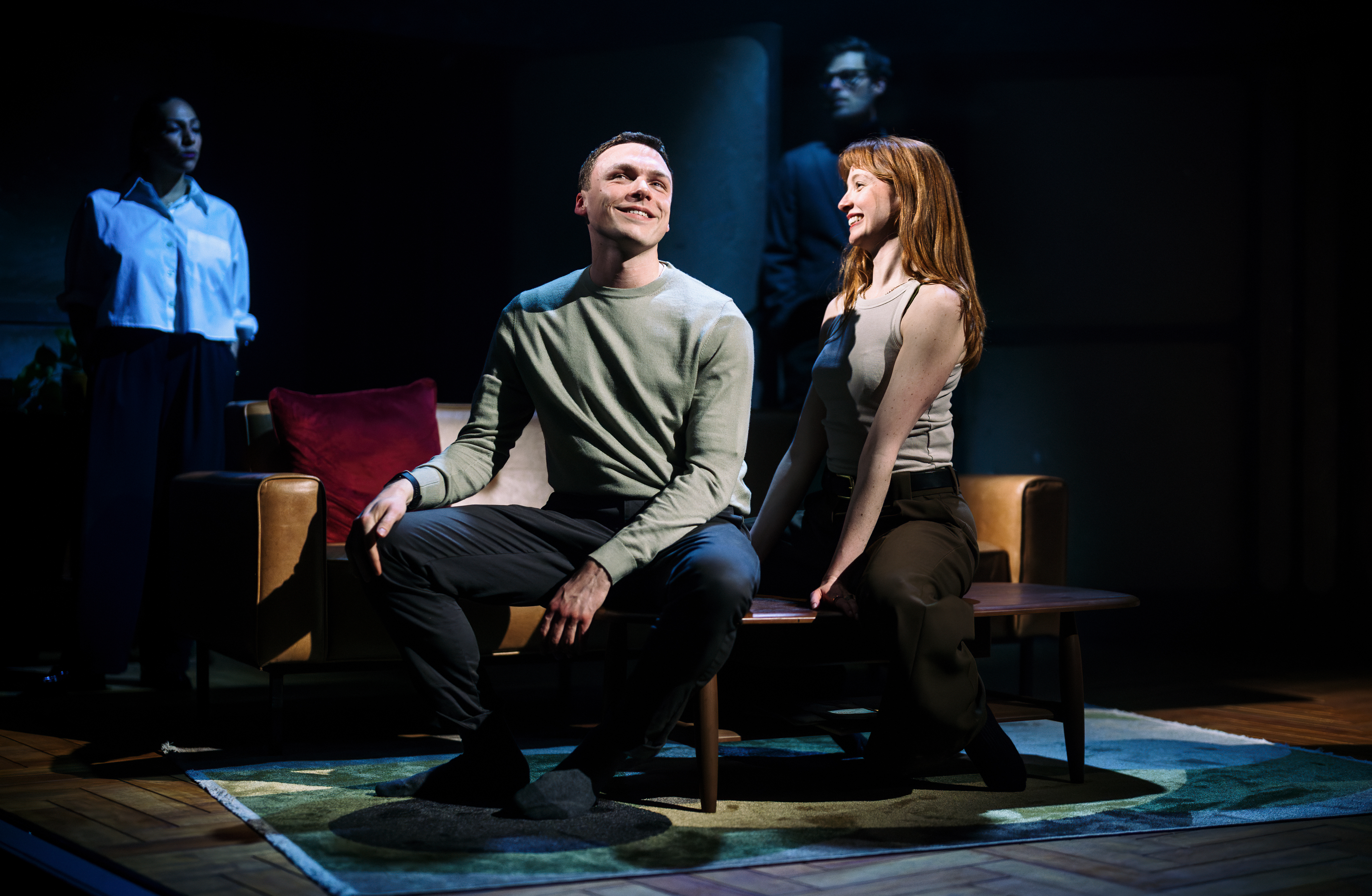
London’s Southwark Playhouse presents the world premiere of Theo Jamieson’s romantic musical, featuring a cast of A-list West End performers. Guillermo Nazara shares his views on the show to let us know if, like its protagonist, this unusual recount has left him lost in space.
Here comes another musical about love. And just like many relationships today, the crash has been inevitable. The subject matter isn’t a crucial problem. Contrary to popular belief, there’s not really an oversaturation of romantic musicals at the moment. Yet, so many have already addressed the issue in the past that it would seem unnecessary to tackle it again if it doesn’t have anything new to say. And shooting its protagonist into another galaxy doesn’t constitute an independent voice.
Nothing interesting happens throughout the 90-minute expedition that Flyby takes audiences on. Despite its galactic framework, it’s just another love story about two straight people who find out they’re not compatible with each other. That doesn’t imply universality. Most sadly, it only stands for dullness. It’s a sketchy plot featuring sketchy characters, whose sole conflict stems from their heated existentialist observations.

None of that results in a profound exploration. Although there’s an enticing philosophical layer to it, the drama is extremely shallow and unresponsive. Beyond their realisations concerning their limited affinity, neither of them experiences a compelling character arc. At one moment, they’re all over each other. A couple of scenes later, they begin to clash. And ultimately, they decide to go their separate ways.
One would argue that this is the basic premise of any romantic tragedy. And that is true, but that’s not the flaw that’s been criticised — it’s the fact that it doesn’t go anywhere further from there. Consequently, the personages have no resonance or engagement qualities. And neither does their story. We cannot root for them, as we’re not provided with enough reasons or elements to care. Nothing really grips us. And eventually, we can’t feel the slightest sorrow or sympathy for their plight.
The use of a Greek chorus commenting on their situations only muddies the narrative’s flow and impact. Rather than underpinning its pathos (which, in general, is noticeably missing), they deliver an overanalytical reading that comes across as sterile, detached, and unnecessarily judgmental. Everything they say could have been articulated by the protagonists. That would have created a much larger sense of intimacy and authenticity with the viewer. And even if it was on a minimum level, it would at least have had some effect on them.
Theo Jamieson’s score is admittedly the piece’s strongest asset. A rich palette of styles weaves this vibrant tapestry of sounds, ranging from simple tonal motifs to more complex segments, with varied influences such as Gershwin, Chopin, and Sondheim. The orchestrations earn a special mention thanks to their swarming colourfulness and intricacy, which the band honours with the utmost command and virtuosism.
Not every aspect of the music is as honed and praiseworthy, however. Although widely enjoyable, many songs can’t serve the drama properly. Albeit there is sentiment, they do not fully capture (let alone accentuate) the key emotion of each scene. Therefore, the score’s overall feel lacks heart — hardly a desired outcome when your genre is romance.

The staging scores significantly higher, primarily due to the visually striking video designs. Libby Todd’s stationary set, composed of sliding panels and living-room furniture, still accomplishes some dynamism, swinging from the abstract to the figurative through the use of projections. It has its deficiencies, nonetheless — sometimes, demonstrating little inventiveness and practicality when trying to depict a different ambience to the protagonists’ houses (whether that be a flat or a spaceship).
Performed by a cast of five, the company is arguably the production’s pièce de résistance. A track record of big West End shows is both the introductory card and evidence of their remarkable competence, which materialises in their impeccable vocals- flaunting excellent technique and pitch -, powerful presence, and vigorous, naturalistic acting. Among them, Poppy Gilbert shines in the lead role of Emily Baker, portrayed with depth and flair.
In an era where the London scene is plagued by lazy adaptation of film blockbusters, the launch of a fully original musical should serve as a reason for celebration. Yet, Flyby‘s undecided tone and underdeveloped plot have propelled the project completely out of orbit. There is a space in our theatrical ecosystem for works like this, as long as they put in the necessary effort. Demanding defined characters and well-structured recounts shouldn’t come across as asking for the moon, but a sine qua non. And until those improvements are made, this show will likely be alienated from its potential audience.
Help us continue our work
We count on your support to keep bringing the greatest quality in theatre-related content, from interviews with the biggest names in the industry to reviews of every show in town and beyond.
We appreciate every donation to maintain our high pace and standards and continue to grow.
Thank you for believing in us!
***************************************************
All pictures credit to Alex Brenner.
Flyby plays at London’s Southwark Playhouse Borough until 16 May. Tickets are available on the following link.