
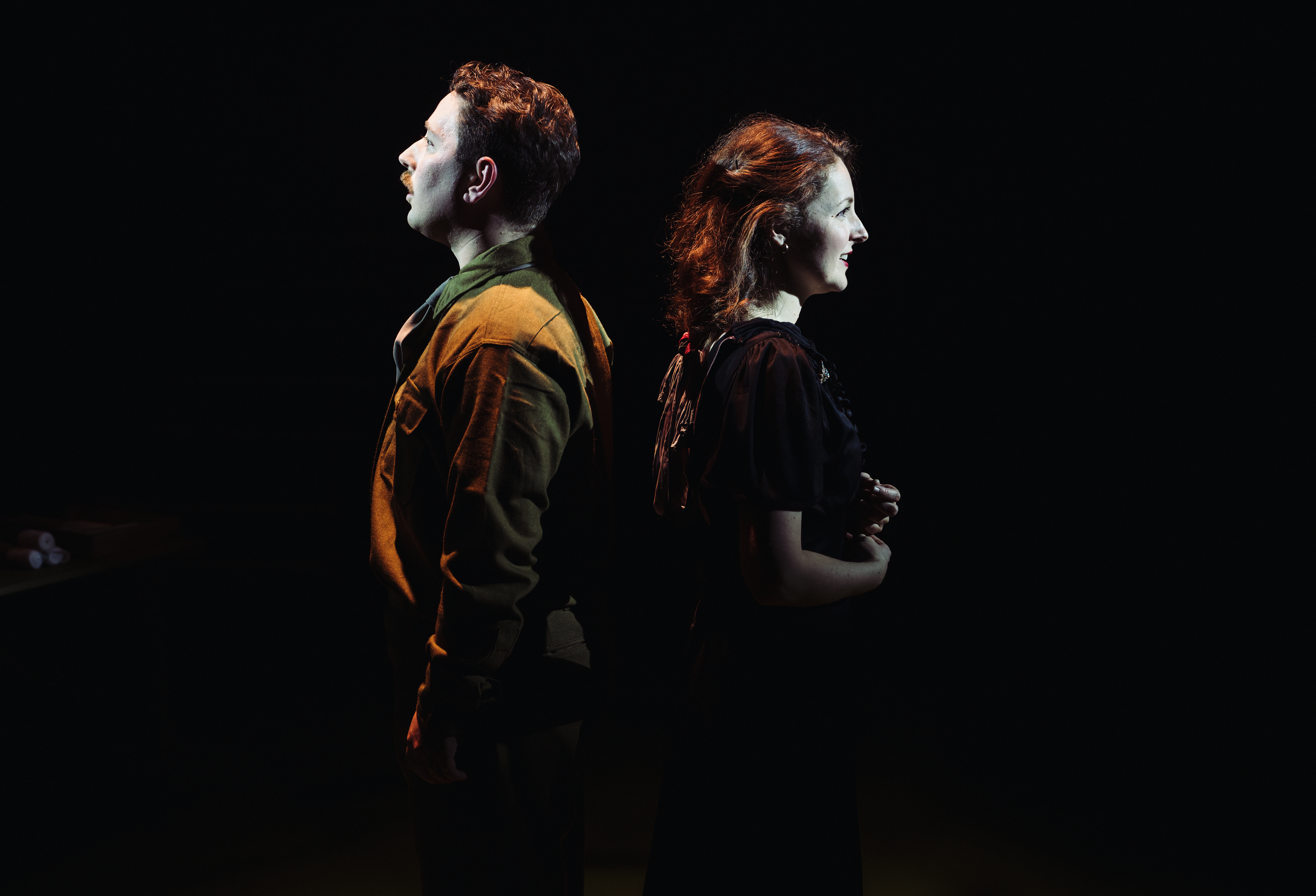
London’s Arcola Theatre presents the revival of Ken Ludwig’s epistolary two-hander. Guillermo Nazara shares his views on the show to let us know if this post-depression love story suffers from any delivery fails.
Love. Love changes everything. Don’t worry. It’s not that show. Thank goodness it isn’t. There will be romance, though. Actually, that’s the only thing there will be. Nothing wrong with it. Or new. Yet, a tale of two pen lovers who long to meet each other for the first time amidst the turmoil of World War II is a premise that exudes old-Hollywood charm. In some way, Ken Ludwig’s script has managed to capture it too — but only in sample-sized doses.
There is an ongoing feeling that this idea’s potential could have been further and better exploited. Conceptually, an epistolary play creates an excellent opportunity for insightful character exploration (much like the songs in a musical, the letters offer the personages the chance to express themselves more deeply and openly) as well as making their longing more proximate to the viewer.

Ludwig’s writing meets those goals to some extent, but ultimately, a sense of unfulfillment persists. Overall, the structure is flawed and unbalanced. There’s too much exposition and not sufficient drama. And when the conflicts emerge, they aren’t expanded compellingly enough to generate the stir a story like this requires — and should be expected to.
Evidently, its framing device leads to an excess of character information that isn’t necessarily undesirable. The problem is Ludwig’s inability to move much further from that initial stage. While Jack continues to save lives- first in America and later overseas -Louise goes through many disappointing auditions until she finally lands a job in a touring production. Not much else happens apart from their first date being constantly delayed due to unexpected events, an initial get-together with Jack’s family, and some casual displays of jealousy.
All those plot elements could have sufficed if the approach had been more thorough and poignant. In the end, the material demonstrates little emotional instinct, ticking all the checkpoints of the romantic formula rather than allowing intuition and creativity to take over. Consequently, many of those turns- if not all of them -are extremely predictable and lack impact. And as much as the protagonists pour their hearts out, they rarely touch the audience’s.

Both Preston Nyman and Eva Feiler deliver a fine performance in the roles of Jack and Louise. Feiler’s take on the character efficiently conveys the histrionic mannerisms of the era, often presented with ease and flair, despite a few over-the-top, slightly superficial segments. Nyman’s portrayal swarms with naturalness and down-to-earth magnetism, effectively contributing to his personage’s immediate likability. And for the most part, their renditions teem with wholesome chemistry, which adequately encapsulate the essence of the recount.
No one should bank on a love tale to push the envelope. Still, we should demand that authors think more out of the box when addressing any subject. Although the germ of Dear Jack, Dear Louise exhibits aptitude, the script limits itself to an overly conventional execution, where a basic recipe is followed to the letter without any additional spices. When it comes to its most pivotal dramatic components, it hauls the mail. And by doing so, it seals its fate.
Help us continue our work
We count on your support to keep bringing the greatest quality in theatre-related content, from interviews with the biggest names in the industry to reviews of every show in town and beyond.
We appreciate every donation to maintain our high pace and standards and continue to grow.
Thank you for believing in us!
***************************************************
All pictures credit to Alex Brenner.
Dear Jack, Dear Louise plays at London’s Arcola Theatre until 2 May. Tickets are available on the following link.