
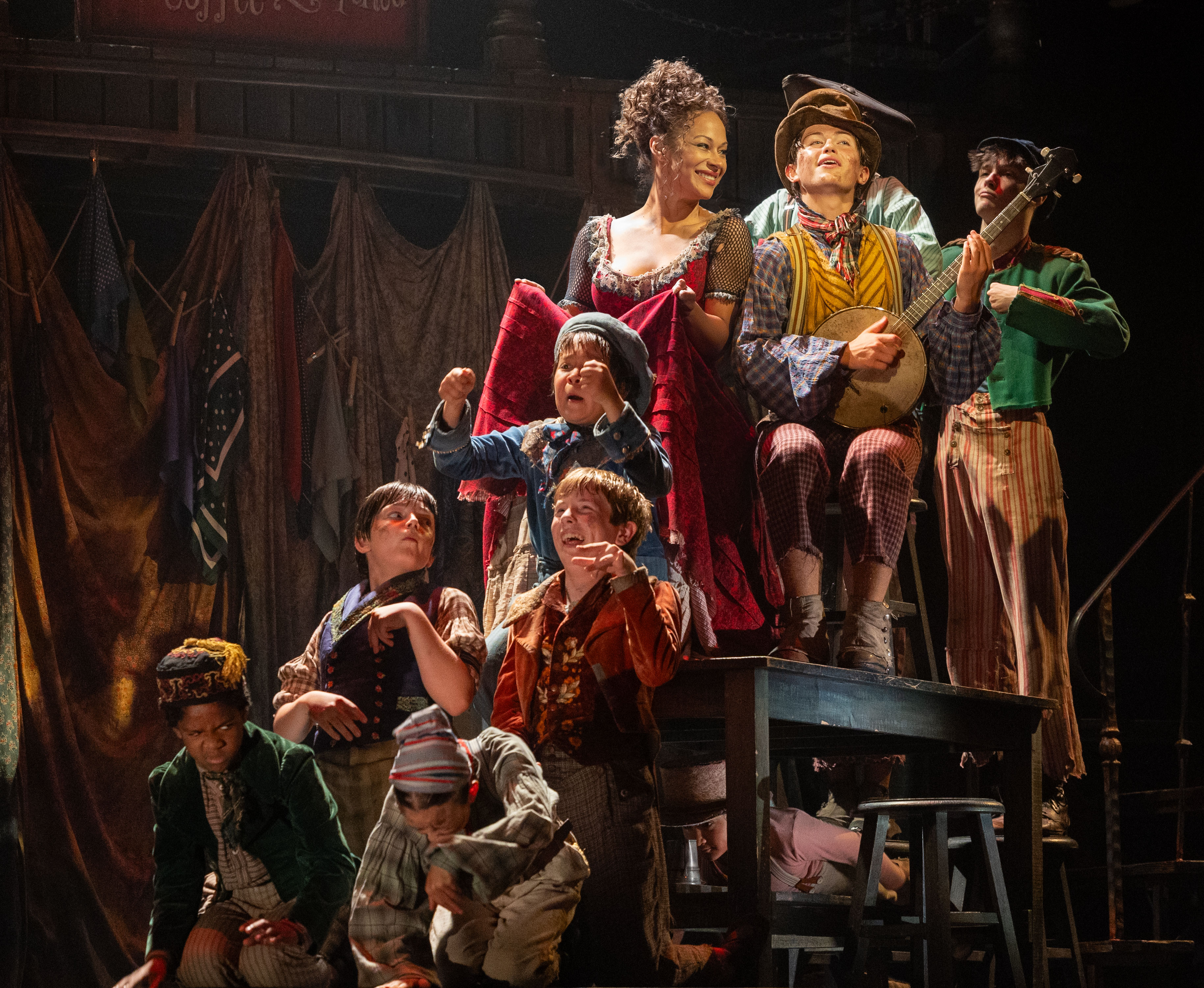
Following its inaugural run at the Chichester Festival, Lionel Bart’s musical-theatre classic celebrates its first anniversary since its latest return to the London scene. Guillermo Nazara reviews the situation to let us know if its newest West End version should consider itself at home.
Some of you might leave the theatre begging for more. Some would wonder if they could actually give you more. Those who first came across Lionel Bart’s magnum opus during its golden stay at the Theatre Royal Drury Lane should at least be cautioned — there are no grand sets or mindblogging stunts in the latest rebirth of one of Cameron Mackintosh’s cash cows.
That doesn’t mean that the production is likely to disappoint. On the contrary, the staging, whose influences from Sean Kenney’s 1960s design are evident, is a robust asset. And those who are still lamenting the death of its neighbour show’s original incarnation will be pleased to know that John Napier’s spirit pervades the foggy air of this faux Dickensian London. And it goes around. And around. And around.

The partial lack of spectacularity hasn’t compromised the allure of Oliver!. One year after the Chichester revival found its home in Shaftesbury Avenue, it doesn’t seem like its tenants will be cancelling the lease any time soon. And they really shouldn’t. Beyond a few and not too relevant flaws across its execution, this orphan has done quite well after seeking its fortune in London once again.
Storytelling takes the lead throughout this simplified yet resourceful take on the material. As such, the performances are stripped of any visual support other than a multi-purpose bridge and some additional props. Consequently, the whole weight of the show lies on the cast’s shoulders. But that’s hardly their funeral. And for the most part, they deliver triumphantly.
Matthew Bourne’s approach concentrates all its splendour in the actors’ interpretation. And it absolutely succeeds with its intent. His high-octane choreographies and dynamic blocking set the path for an almost endless parade of world-class talent, where each section is meticulously curated. More than speaking for themselves, the results sing.

The same level of care has been given to the score. In a time when pre-recorded tracks and reduced orchestrations have become the norm, it’s incredibly refreshing to hear Lionel Bart’s music being properly honoured. Live brass, woodwinds, and strings concoct the piece’s signature sound, where old Broadway meets 19th-century operetta to convey a lush, deeply emotional flavour.
I’d do anything- and I mean anything -if the current trend of keeping the lighting grid visible came to an end. Some may see it as an attempt to create a metatheatrical duality. The question, however, is what is the point of pursuing that effect? It feels completely unnecessary. And if it weren’t for it, as well as the hideously tacky greens and violets used during the undertakers’ numbers, its Victorian atmospheric tone could be considered a solid accomplishment.
Although Lez Brotherson’s scenic design is generally adroit, it doesn’t come without its blemishes. The proscenium is admittedly its weakest element, whose unevocative, bland wooden boards and oxidised spiral staircases struggle to capture the essence of 1830s London. And instead, they come across as a lazy solution to fill the space.

The company outshines every other aspect of the production. Their overflowing rapport and precision, as well as their impeccable vocals, put the entire team at the very top of West End’s offer at the moment.
Some of the acting isn’t as honed, nonetheless. Simon Lipkin’s portrayal of Fagin teems with magnetism and organic comicality, but there’s not enough detachment from himself and the character. As a result, while still captivating, his performance eventually feels like a version of himself, which is also affected by a slight sense of one-dimensionality.
Ava Brennan flaunts remarkable singing skills as Nancy, earning a fair ovation for heir powerhouse musical renditions. Yet, the motherly side can’t be found anywhere. There’s too much emphasis on trying to impress with what her voice can do that, inevitably, it deprives the personage of their own.
Some other roles are played with utmost prowess. The highest praise goes to Aaron MacGregor as Dodger, whose exceptional presence is matched by his impressive dance moves and perfect understanding of the character, making him one of the most promising new talents British musical theatre has been blessed with.
The boy is for sale again. And no matter who will buy, this latest revival of Oliver! is certain to keep charming crowds, perhaps for a few more seasons to come. There are some issues, but none of them is too concerning. And ultimately, that should be enough to secure a fine life at the Gielgud Theatre. The snobs will cry oh-la-la. The rest will scream oom-pah-pah. And everyone will wish to be back soon.
Help us continue our work
We count on your support to keep bringing the greatest quality in theatre-related content, from interviews with the biggest names in the industry to reviews of every show in town and beyond.
We appreciate every donation to maintain our high pace and standards and continue to grow.
Thank you for believing in us!
***************************************************
All pictures credit to Johan Persson.
Oliver! plays at London’s Gielgud Theatre from Tuesday to Sunday. Tickets are available on the following link.