
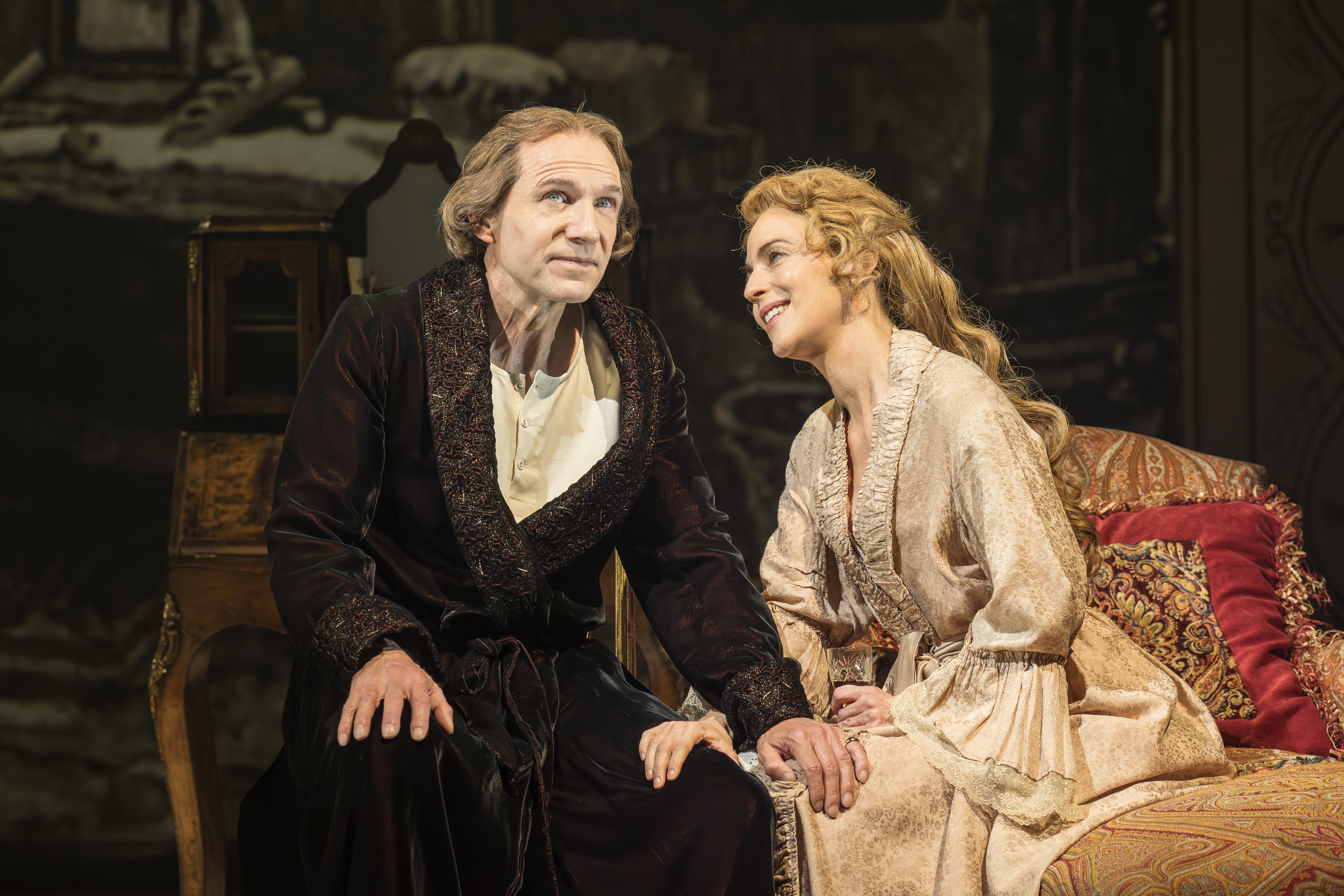
It’s funny, if not ironic, that the story of a frustrated, perfectionist actor trying to deliver the finest theatre has been told by somebody who doesn’t seem to know the basics of proper storytelling. There is only one reason to come see this show, and after a glimpse of it, you don’t need to stay for the rest.
If you’ve bought your ticket for Ralph Fiennes and Ralph Fiennes alone, you shan’t be disappointed — that is, if you can ignore how stagnant the narrative is, how banal the dialogue comes across, how predictable and unfunny its humour is, and how the character arcs are as shallow and underdeveloped as the sequel to Devil Wears Prada. If you’re genuinely able to disconnect from all of that, you might find yourself having a decent evening. You might also need to turn your attention elsewhere during Miranda Raison’s performance, though.

The most infuriating part of it is that the premise of David Hare’s flavourless script is actually good. Summoning one of the most iconic figures the London scene has birthed in probably its entire history, his longstanding relationship with colleague and lover Ellen Terry is a melting pot of dramatic possibilities. Bring all the necessary elements in the right doses, and you’ll get a tenacious alloy. Do it as vacuously and cluelessly as this piece, and it can hardly be considered a play. Not in a way that feels compelling and profound as a plot of this kind requires.
Hare’s non-linear structure tries to boost the rhythm with very little success. Jumping through decades, every segment functions as a piece of an incomplete puzzle, where no proper storyline assembles, and no interesting picture ever materialises. The problem lies in its overall lack of depth and character development. Although the concept revolves around Terry’s influence on Irving at a professional and personal level, the conflict is extremely vague and usually leads to nothing. It’s often solved right after being introduced, and there’s barely any exploration of it.
Eventually, the play loses all its grip, which wasn’t much in the first place. Although events happen, none of them builds enough dramatic tension. As a result, our response as viewers is apathetic at best and disapproving at worst.
The script tries to add depth through a few poignant themes, such as an artist’s life priorities- primarily focused on the balance between work and family -, as well as subplots concerning Terry’s son and daughter, both of whom try to pursue their own paths in the theatre — the latter by honouring her mother’s legacy; the former by being a self-appointed genius. Once again, the approach is vague and superficial, rarely delving into the personages beyond their archetypal features. And much like the rest of the piece, it comes off rather cliché.

The production doesn’t impress either. Perhaps inspired by the National Theatre’s original production of Amadeus, Bob Crowley’s design consists mainly of an ornate frame standing upstage. Inside it, a scrim displays projections of sketched backgrounds. Unmasked wings filled with dust-clothed props convey a sense of metatheatricality. It’s a nice touch, but unfortunately, it doesn’t make up for the overall cheap, unresourceful, and occasionally clunky impression that the scenery ultimately leaves us with.
The cast gives a legitimate performance without any real standouts — except for the ones acting in their detriment. Opting for a slightly classical style, the renditions are adequate from a technical perspective. However, there’s not enough rapport or authenticity for the most part, leading to a generally one-dimensional execution.
Ralph Fiennes delivers an excellent portrayal as the self-centred, socially inept Irving, who’s still captivating thanks to Fiennes’s masterful accentuation of the character’s awkward charm. The same can’t be said about Miranda Raison, whose interpretation of Edith Craig is excruciatingly flat and unlayered. There’s no nuance to her role, just like there is no truthful emotion. And for all that matters, no sentiment whatsoever.
Celebrating the life of one of the most prominent thespians of his generation, Grace Pervades is nonetheless a clumsy tribute to the memory of everyone depicted in it. Albeit it can generate interest in the lives of its protagonists, such merit belongs to those who lived them rather than those recounting them. One can only wonder why they’re doing this play. And everyone familiar with Irving’s quotes would know where he stood when that happened.
Help us continue our work
We count on your support to keep bringing the greatest quality in theatre-related content, from interviews with the biggest names in the industry to reviews of every show in town and beyond.
We appreciate every donation to maintain our high pace and standards and continue to grow.
Thank you for believing in us!
***************************************************
Grace Pervades plays at London’s Theatre Royal Haymarket until 11 July. Tickets are available on the following link.