
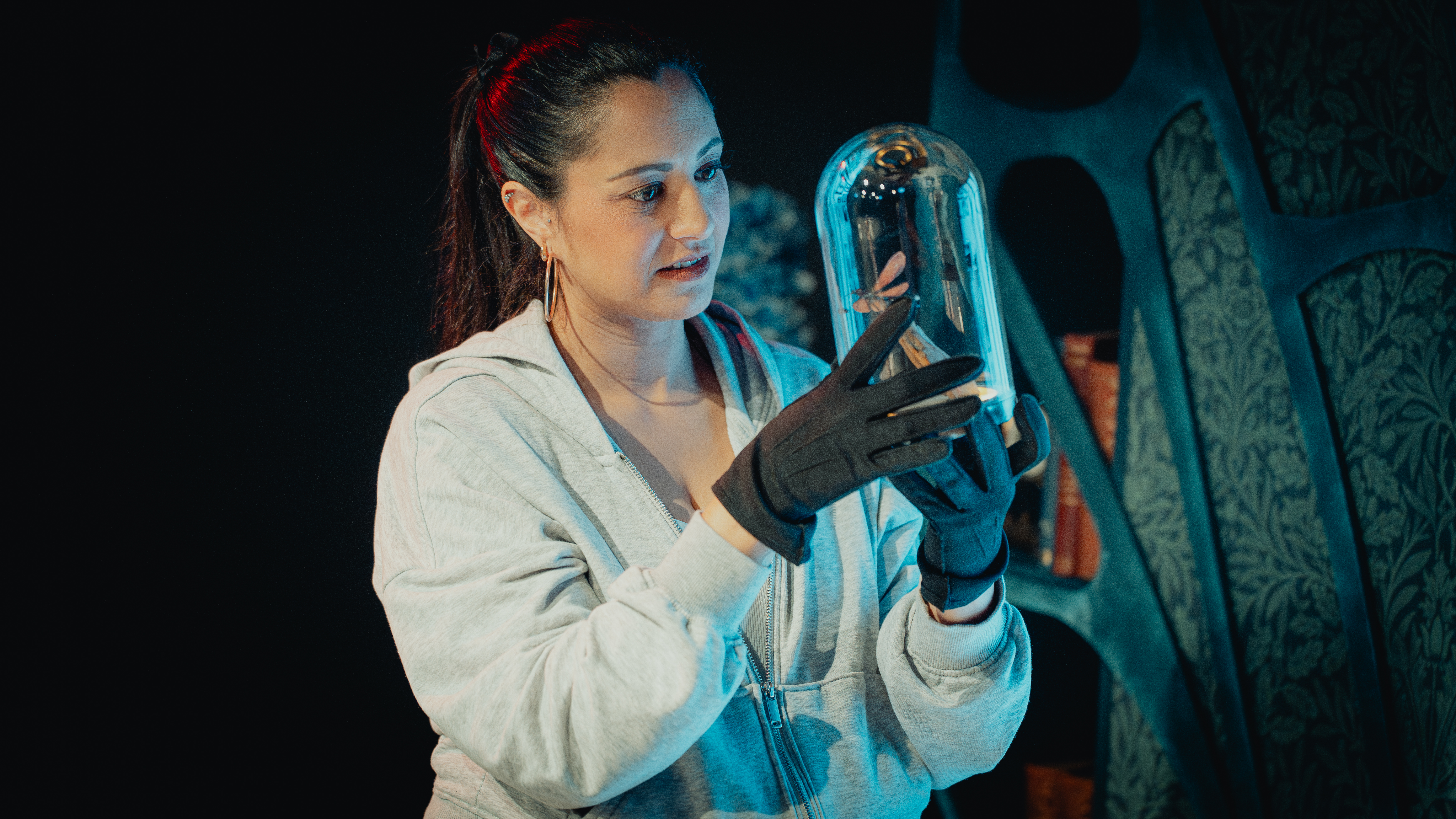
I was on board the moment I saw there was murder involved. And perhaps, that was the only part of it that got me engaged. It wasn’t too big an investment anyway. There’s some brilliance shimmering through the basic pieces of The Wasp, which is returning to the London scene in a new production presented by Greenwich Theatre. Yet, its overall execution doesn’t really come together. And sometimes, it’s like it’s poisoned itself with its own venom.
Originally staged at the Hampstead Theatre and followed by a West End transfer at the Trafalgar Studios, the play has even leapt onto the screen through a 2024 film adaptation starring Naomi Harris and Natalie Dormer. There is a reason why. It’s a gripping storyline founded on deeply resonant themes. And if that were all a play required to function, it would have been a triumph.
Two former classmates reconnect after decades of estrangement. Each of them has gone on very different paths. Carla is trapped in a loveless marriage with a man twenty years her senior, currently expecting her fourth child. It’s far from an idyllic lifestyle. However, things haven’t been any easier for Heather, who, despite her higher economic position, is haunted by the fact that she can’t have children of her own. A scar that goes way deeper than Carla imagines. And also, way back.

A random reunion takes a darker turn when Heather makes Carla an unexpected offer. Contrary to Carla’s predictions, it’s not her baby that she wants. It’s not a new life that she’s after, but death. She’s found out her husband has been cheating on her for a while now. And she wants him to pay for it. She’s willing to give Carla a large sum of money to do the dirty job. Carla is hesitant at first, but she’s soon reminded of what she did back in high school — and of what she’s capable of. The reward is just too good to let go. Even if that entails committing a heinous crime.
Morgan Lloyd Malcolm’s plot ticks all the boxes for a cliff-hanging thriller imbued with highly poignant, thought-provoking topics ranging from childhood trauma to cold-hearted revenge. As a result, there’s an element of enticement to it — but it isn’t permanent or consistent. It takes too long for the viewer to be seduced by its narrative. And even when that happens, it’s hardly a perfect match. Either the approach feels too blunt, or it lacks the emotional weight to stir the viewer.
The problem stems from the form rather than the content. All the aspects of the story are correct and necessary. It’s how they are introduced and, to some extent, developed that leads to this heavy-handed outcome. Although the dialogue flows, a slight sense of artificiality pervades. At the same time, the repetition of some sequences, which are reenacted with either different blocking or character attitudes, fails to build or underpin the tension. And instead, it acts like an obstacle that comes across as comical at best and exasperating at worst.
Consequently, what could have been an intelligent, profound piece of psychological suspense is reduced to a somewhat melodramatic jaunt. Albeit there is substance, it never goes beyond the raw material. The personages are compelling on an archetypal level, but the script refuses to dig any deeper. There is no nuance to them. Their traits are sketchy. And in the end, the whole thing comes off as an undercooked concoction, and some bits are especially difficult to swallow.

The performances might be responsible for some of the writing’s ineffectiveness. Neither Cassandra Hercules (Heather) nor Serin Ibrahim (Carla) shares enough chemistry to make the text work. It’s not an easy task, but we would expect a more elaborate delivery. Sadly, both renditions come out slightly forced and clunky. Both personages are disingenuous, and such a nature must permeate their interpretation. However, there’s a difference between playing an untruthful character and depriving the role of authenticity. Regrettably, it’s the latter that we’re given for the most part.
Performed in a thrust stage, the set design manages to build an atmosphere despite its simplicity. It’s not dynamic enough, nonetheless. Fortunately, the story only features a couple of scenes. Yet, the transition between the two feels clumsy. It doesn’t demonstrate sufficient visual strength. And, on the whole, it takes too long to come to fruition — something that could have been prevented by avoiding a few superfluous props.
Although the concept swarms with possibilities, The Wasp struggles to evolve beyond its larva state. Parting from a sound germinal idea, it’s the absence of subtlety and deft narrative tools that make it more of a bugging than a biting experience. It might not kick the hornet’s nest, but it’s unlikely to trigger any positive reactions.
Help us continue our work
We count on your support to keep bringing the greatest quality in theatre-related content, from interviews with the biggest names in the industry to reviews of every show in town and beyond.
We appreciate every donation to maintain our high pace and standards and continue to grow.
Thank you for believing in us!
***************************************************
All pictures credit to Ross Kernahan.
The Wasp plays at London’s Southwark Playhouse Borough until 30 May. Tickets are available on the following link.