
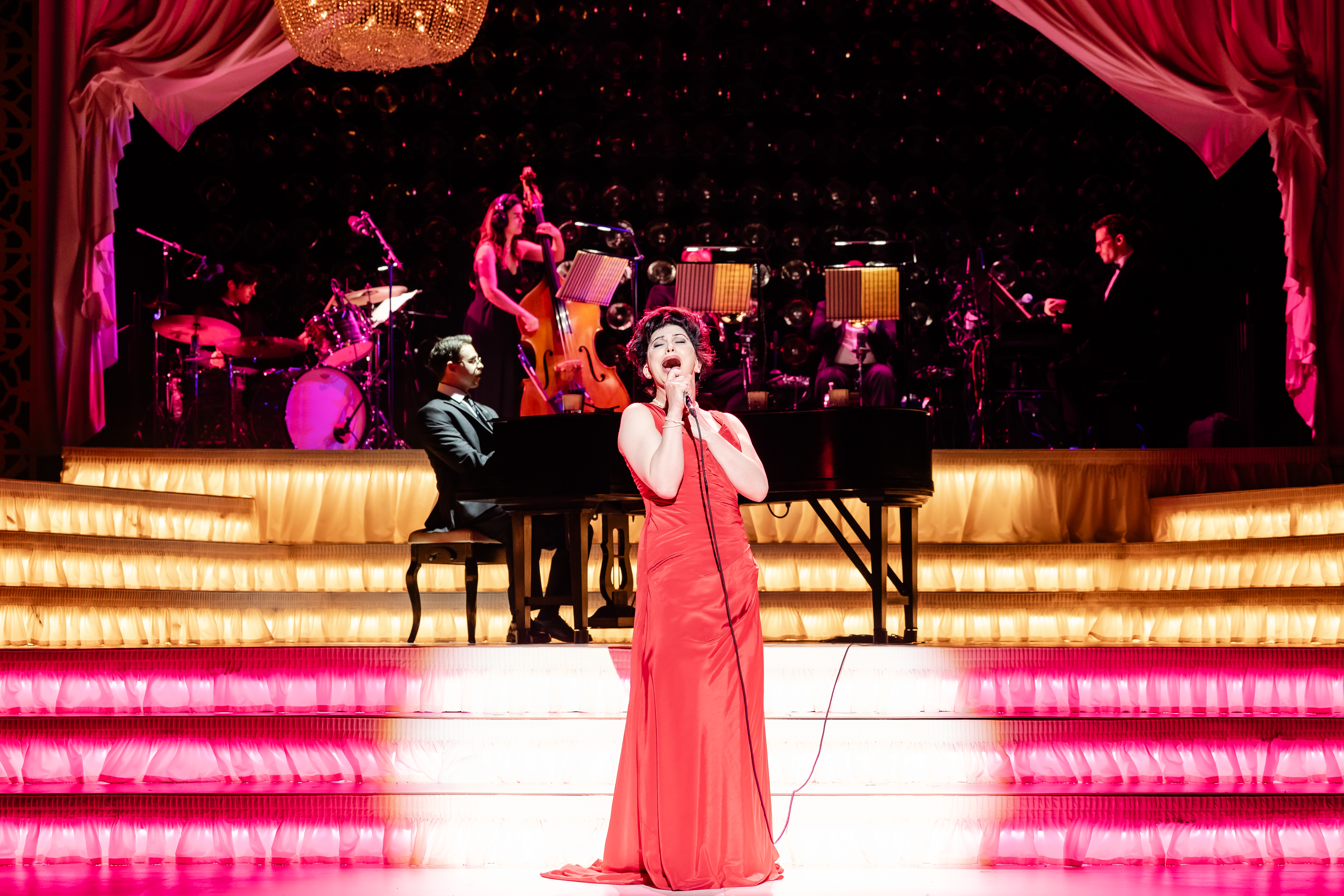
Judy Garland is back. In the flesh. In the spirit. And in the drag. Before anyone jumps to conclusions, let me be clear: this is no drag show. And for the most part, it doesn’t come across as one. But the fact that the winner of American RuPaul’s fifth edition stars in it cannot be ignored. And its essence slips through every now and then. For better and for worse.
This is not only a comeback for one of the greatest film icons of all time. Peter Quilter’s play with songs (whoever tells you it’s a musical is either lying or blatantly ignorant) made its first incursion into the London scene back in 2011, when a probably sensational Tracie Bennett portrayed the artist’s professional and psychological decline, only a few months before her premature departure at age 47.
Now the torch has been passed. And it’s Jinkx Monsoon who’s stepping into the worn-down ruby shoes of once a child prodigy and always a Hollywood victim. And she does justice to the role. Not to utter perfection, but with enough competence, decency, and dedication to let her performance resonate. And it does.

We can easily feel the pain of this broken woman, who tried to survive a world that wanted her but never cared for her. She got fame and idolization in return. But none of that mattered. All that she ever wanted was to be loved. To be treated the right way. And to be understood. The consequences of Tinseltown’s ugliest sides slowly materialise throughout this two-and-a-half-hour journey into despair. Where there’s suffering, but there’s also laughter. Perhaps, a little too much.
Quilter’s writing brims with wit and amusing qualities. On the whole, the script is highly entertaining, and it connects with the viewer almost instantly. But its grip loses momentum several times. Although the structure is generally adept, the first act suffers from inconsistent pacing. And it doesn’t take flying monkeys or a crystal ball to spot the issue, which is the same affecting the piece’s overall emotional tone.
There’s no question about Quilter’s wit. All his jokes land and contribute to the show’s engagement. But there are other ways of getting an audience invested. And when your story involves drug abuse, mental deterioration, and isolation, keeping the humour alive for too long might be counterproductive if not inappropriate. It’s both in this case.
There’s nothing wrong with a lively approach during the initial scenes. But the shift into a more serious mood needs to happen at some point. The right one. And it shouldn’t be interrupted. In the end, Quilter leaves us with the impression that he either fears or doesn’t believe in his own creation. As if assuming the plot’s intrinsic gravitas was something to avoid at all costs. As a result, the drollery persists during segments that should be infused with poignancy, but which are abruptly broken by irrelevant tongue-in-cheek remarks that inevitably wipe it out.

It is not until the second half that the real drama takes over. And that’s when its brilliance shines in all its glory. It’s not faultless, as the lack of a more elaborate third act prevents the pathos from solidifying. But it’s powerful, nonetheless. And its predecessor should follow its example by trimming the unnecessary fat and underpinning what’s important for both the character arc and the viewer’s experience. We should have been feeling sorry for her much earlier on. But the comedy keeps us distracted. And much like the people around her, it prevents us from focusing on what’s important.
The production is sumptuous and majestic. Jasmine Swan’s design exhibits elegance and theatrical versatility through its simplicity. A pyramidal stage covered with white cloths serves as the set’s basis, adorned with golden frames that create a seamless transition into the venue’s Art Deco architecture. On top, a grand piano stands as the centre piece, while a full band suddenly emerges upstage, as amber lights sweep blindingly behind, occasionally spelling the name ‘Judy’.
Prema Mehta’s lighting is adequate but somewhat incomplete. And sometimes, inefficient. Once again, the problems are most noticeable in Act One, where Judy’s Ritz Hotel suite is usually depicted under a heartless, generic light that conveys no sentiment, texture, or atmosphere. And somehow, it kills the emotional tension that the script, despite its errors, is trying to build.

Jinkx Monsoon is a fine Judy. And sometimes, a great one. At some moments, her performance is truly transfixing. There is a clear effort put into her delivery. And the outcome is fairly positive. Her mannerisms are masterfully captured. Her voice bears a satisfactory resemblance. Her singing teems with passion and sturdiness while adroitly depicting her progressive decline. And the character’s grief pulsates throughout the rendition, despite the sporadic camp lapses that briefly turn her interpretation into a drag-act impersonation.
The highest praise, however, goes to Jacob Dudman as Judy’s fifth and last husband, Mickey, flawlessly encapsulating the personage’s complex nature — dominant but gentle, attentive but oblivious, toxic but soothing. Adam Filipe offers an acceptable portrayal of Judy’s devoted gay pianist, Anthony. Yet, his execution comes off slightly flat. There’s not enough layering. Nor is there presence. And ultimately, the spiritual chemistry he’s supposed to share with Judy just isn’t there.
Solid but not fully in place, End of the Rainbow will still entice viewers with a compelling plot brought together by a strong team of creatives and performers. Nonetheless, the emotional tornado that audiences should have been caught in evaporates before it forms, precisely because of the author’s resistance to leaving Kansas at the right time. There might be no place like home, but a deeper exploration of the protagonist’s downfall would have been more enriching. It has the power to make it happen. It’s always had the power. But it needs to learn it for itself.
Help us continue our work
We count on your support to keep bringing the greatest quality in theatre-related content, from interviews with the biggest names in the industry to reviews of every show in town and beyond.
We appreciate every donation to maintain our high pace and standards and continue to grow.
Thank you for believing in us!
***************************************************
All pictures credit to Danny Kaan.
End of the Rainbow plays at London’s Soho Theatre Walthamstow until 21 June. Tickets are available on the following link.