
These are the words of someone who had his whole childhood and adolescence ruined by overwhelming homophobia. And yet, I’m grateful. For the fact that, despite the progress that still needs to be made, I can live truthfully and away from the pain others inflicted on me. It’s not been easy. It never is. And it certainly wasn’t for those who came before me — whether it was decades or centuries ago.
The 2026 Pride season is officially open. And as I spice up my drink with the tears of moaning retrogrades, I reflect on the bravery of those who fought against the system. A system that condemned love. And ultimately, the right to exist. As the show’s epilogue states, this is just one of those stories. Of those many stories. All of them, true.
1700s Bristol. A young footman named William returns home for the holidays. His elated mother welcomes him with open arms, hoping their next reunion will come with a new addition to the family. At 24, it’s time for her son to settle down with the right woman. Only that for Will, there is no such thing as the right woman. And there never will be.

It won’t take long until the feelings he’s so vehemently tried to repress finally take over. A first encounter with Richard, a fresh-faced bachelor from London, will lead to a heated romance. And eventually, it will be the cause of their demise. There’s no place for homosexuality in 18th-century England, whose law regarded it as a crime punishable by death. Still, that brief affair is worth more than a long life filled with lies and frustration. And if they must face the consequences, at least they will do it the same way everything they’ve done before — together.
If you can ignore the fact that this is a gay recount featuring two guys called Willie and Dick, then you can focus on the poignancy the premise teems with. It isn’t honoured, however. Not to its full potential. And probably, not even half of it.
It doesn’t need to make you cry, although it would be appreciated given the plot’s tragic nature. But it does need to make you feel. This isn’t by any means an inert piece of theatre, but it doesn’t pulsate as strongly as it should. And despite its numerous attempts at pulling at the heartstrings, it needs to grow one of its own. A much bigger one, that is.
Featuring book, lyrics and music by West End darling Jordan Luke Gage, who also stars in the role of Will, there are nonetheless few major pros to this somewhat unpolished work. The path is solid. And more importantly, it is the right one. But there still is a lot to cement along the road. So much so that, at some moments, its narrative compass seems to lose track of where they’re going. And at others, it appears to be completely lost.

It’s not a matter of what they’re telling, but how they’re telling it. And above all, how much they are telling. In the end, it’s not enough. Not enough love. Not enough introspection. Not enough conflict. And not enough substance to make us care as much as we should for the happiness and suffering of these two tortured souls, who find redemption in each other.
Gage has taken a few liberties when depicting the case. Although both characters are portrayed as of similar age, the real Richard was actually in his sixties. Their encounter was steamier than what the musical suggests. And far riskier. It wasn’t in the caves, but in a private room they hired at a local pub, when they were discovered having sexual relations.
There’s nothing wrong with changing facts for dramatic effect. The problem is that such an effect never materialises due to its flawed dramaturgy. The issues are all around, and they concern structure, pacing, and resolution. On the whole, their relationship is vapidly explored, as they are not given the necessary space to let their emotions flourish in a manner that’s compelling to the audience.
Consequently, many key themes are given a very vacuous treatment. The subject of Christian guilt, which should have served as the opening number, doesn’t feel as crushing as the recount requires. The same goes for the protagonists’ struggles with their sexuality and society’s attitudes to them. They are presented. And they play a pivotal role. But the script only scratches the surface of what ultimately is a life-defining (and life-ending) topic.

Some other scenes come off as rushed and highly implausible. Will’s sister’s ability to find a loophole to save him from the gallows, a feat she performs in less than 2 minutes (patter singing included), is anything but credible. And the fact that Richard would dare write explicit letters to Will, particularly after admitting what happened to his former partner, just goes beyond anyone’s mind.
I haven’t found evidence of that ever occurring, but one would expect they would at least code them, which would have been another great element in its storytelling. And if that did ever occur, Gage has already taken enough licenses to justify another one.
In any case, we can praise some of Gage’s skills in the art of musical-theatre writing. Overall, his music is tuneful, varied, and memorable. His influences, ranging from Dear Evan Hansen to ABBA, are evident, but he still manages to create a few earworms he can confidently take credit for.
His real craftsmanship, however, shines through his lyrics. For the most part, his verses excel in both form and content. There’s a rich, consistent, and occasionally masterful use of rhyming. And some interesting wordplay sporadically makes its way into a generally well-made libretto. Some strokes of profundity and authenticity can be spotted throughout, pervading several crucial numbers like Will’s “I Want Song”, which teems with understanding and sincerity at revealing the conflicts of a closeted gay man longing for freedom.

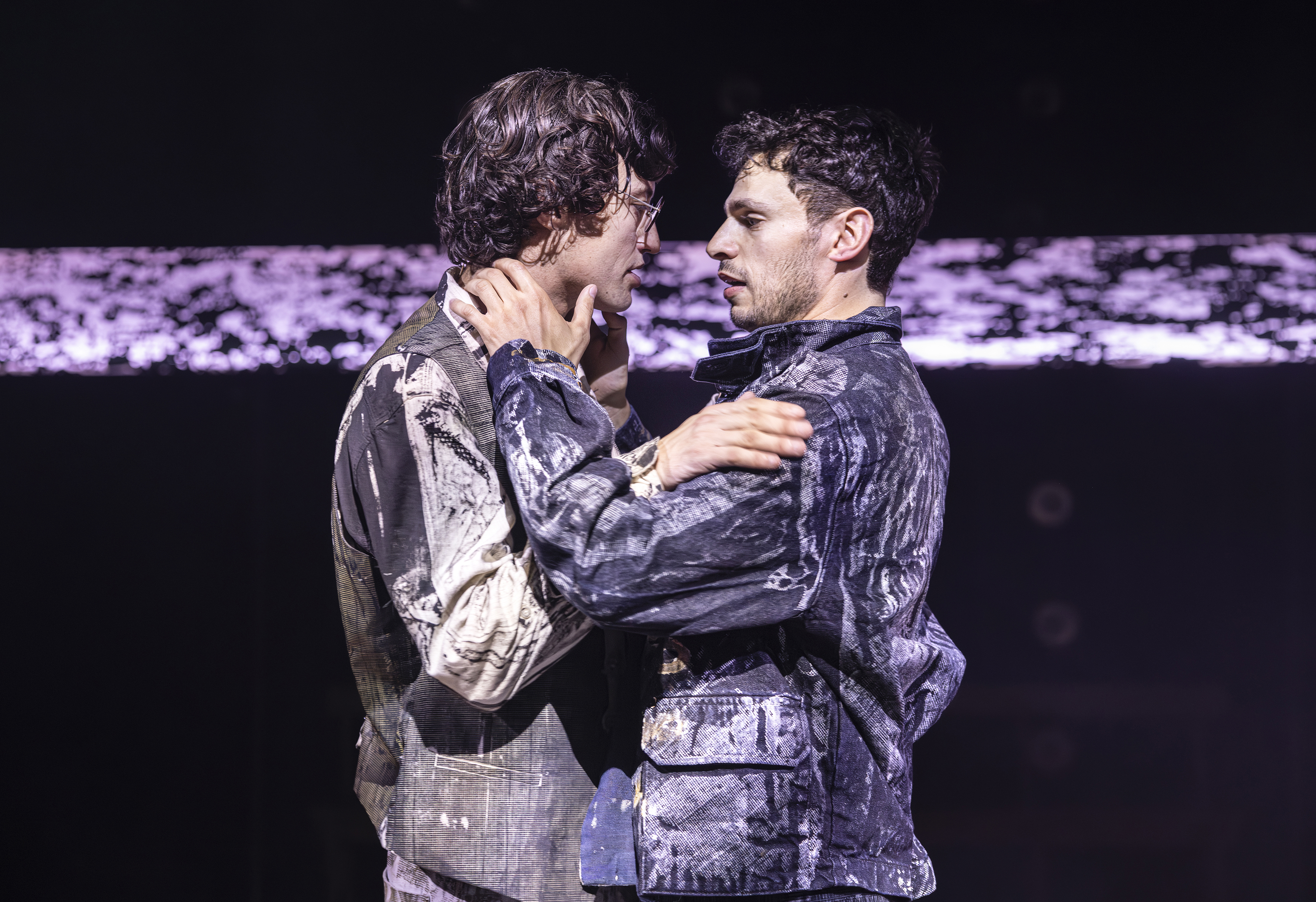
The entire cast delivers an exceptional performance. Both Jordan Luke Gage and Daniel Krikler swarm with chemistry and presence in their portrayals of Will and Richard. Simultaneously, Rebecca Lock steals the show with her infectious humourosness and outstanding singing, the latter also prominent in Adrian Hansel’s rendition as Barber.
The production is equally satisfactory. Andrew Exeter’s thrust staging, consisting of a rectangular wooden platform and a mottled band hovering above, perfectly encapsulates the setting through a dynamic, suggestive approach that sometimes carries poetic symbolism.
I’m willing to omit the age-gap aspects of the original account in favour of a more touching story. Or I would have been willing to if that’s what I had been offered. Despite its robust positives, there is much to improve in Recliffe, which is a commendable first effort, but hardly a finished product. A deeper exploration of their relationship and what it means (both to them and society) is imperative for this romance to work and resonate. And ultimately, live on much like their love for each other.
Help us continue our work
We count on your support to keep bringing the greatest quality in theatre-related content, from interviews with the biggest names in the industry to reviews of every show in town and beyond.
We appreciate every donation to maintain our high pace and standards and continue to grow.
Thank you for believing in us!
***************************************************
All pictures credit to Pamela Raith.
Redcliffe plays at London’s Southwark Playhouse Borough until 4 July. Tickets are available on the following link.