
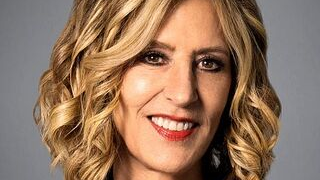
Following its original New York run, the Academy Award-, Emmy-, and Golden Globe winner debuts on the London stage with this intimate biographical show that reflects on her personal journey and her family through the lens of social justice. Guillermo Nazara chats with the actress to learn more about the piece’s development and what makes her life story resonant and universal.
How does it feel to make your debut on the London stage with such a personal play?
It is incredibly exciting, scary, and vulnerable-making — but I think that’s the point of it. So, I really am trying to tell some truths about my life and kind of lift the veil of secrecy to examine the ways in which the patriarchy did not serve me and my family, how I navigated through that, and how the members of my family and I did or not did not survive that. In order to shine a light on the more universal story, which is that the patriarchy is not serving anyone anymore. It never did, but it doesn’t serve men or women. This hierarchy of human worth is all made up and destructive, but there’s a lot of comedy in it. And so, how it feels to do it is also really fun. And I’m so honored and filled with gratitude to be able to hopefully inspire people to to work towards a more equitable system that is not the patriarchy, and that is more fair.
How did the idea for the show come about?
I wrote a book- a collection of personal essays called True Stories from an Unreliable Eyewitness -a feminist coming of age story, collection of personal essays, and the idea for the play came from those. I was performing the essays as monologues in various cabarets and small theatres across New York, and I actually thought about writing a one-woman show first. But then, I got the publisher interested in the book, so that happened first, and the play happened second.

One of the piece’s main themes is the repression of our own feelings, particularly those involving pain and suffering. Why do you think society has traditionally imposed those standards?
I think that, for patriarchy, there’s no room for vulnerability — especially, as power and control are really what it asks for. So, being in denial of pain or sadness is part of that, and that’s certainly something I grew up with. But I believe that sadness is an equally important part of human life as joy is. They go hand in hand, and the more we can talk about it, the less shame we feel around things that are painful or even traumatic, and we don’t need to hold them in or repress them.
Has society evolved towards discussing those subjects in a more open, healthier manner?
I think so. Things that were formerly taboo are now being talked about more. I hope this show inspires others to not feel so alone and to tell their own stories, so they can find healing in sharing instead of keeping it a secret.
Is there still room for improvement? If so, how?
Of course, of course. Women in particular don’t speak about things that society thinks are shameful. But yeah, I think it’s really important that we, as survivors, speak our truth.

What has the piece’s development process been like?
The development process has been amazing. I did this play in the Berkshires, I think three summers ago, and it was very different play, with a very different structure. I’ve been working with Melissa Annis on this iteration. Robert Egan was my former collaborator and director and dramaturg, but Melissa has been amazing as well. She’s so smart and such a fierce feminist, and I just really love this part of the process.
Have you made any changes for the London version?
Yes, this version has an actual 12-year-old girl in it. In the Berkshires, we had a 22-year-old young, wonderful actress playing eight, nine, and ten years old. It was very different. Having a real child onstage portraying me when I was little, and also representing my inner child, has been such a huge change for the play,. And it’s been for the better. These young actresses really capture the innocence of this part in a beautiful way.
Are there any highlights in the show that you’d like to flag?
There’s a lot of comedy in it, so it’s not really just all sad. The ways in which I navigate the not only the externalized patriarchy, but its internalized version, can sometimes be very funny. I think it’s also a lifelong struggle to try to exorcise us from all the internalized misogyny that we grew up with. But looking at it with some sense of humour can be helpful.

How would you summarise the show’s message?
I think the show’s message is that it’s time for the patriarchy to go. This hierarchy of human worth has not served men and women at all, and all this gender made-up stuff is is it’s not working. And certainly in the 50s, it was patriarchy and steroids. I really try to examine specifically how it didn’t, and how that hierarchy affected my family.
Why come see ‘The Smile of Her’?
I hope people come and feel seen and heard. Maybe they can identify with it. I hope I’ve written a very universal story, for anyone who lives under the patriarchy, which I think is everybody on the planet. I’m hoping people take a lot of inspiration for a more equitable future. We can have more equal future for our sons and daughters.
Read our review of The Smile of Her here!
Help us continue our work
We count on your support to keep bringing the greatest quality in theatre-related content, from interviews with the biggest names in the industry to reviews of every show in town and beyond.
We appreciate every donation to maintain our high pace and standards and continue to grow.
Thank you for believing in us!
***************************************************
The Smile of Her plays at London’s Marylebone Theatre until 29 August. Tickets are available on the following link.