
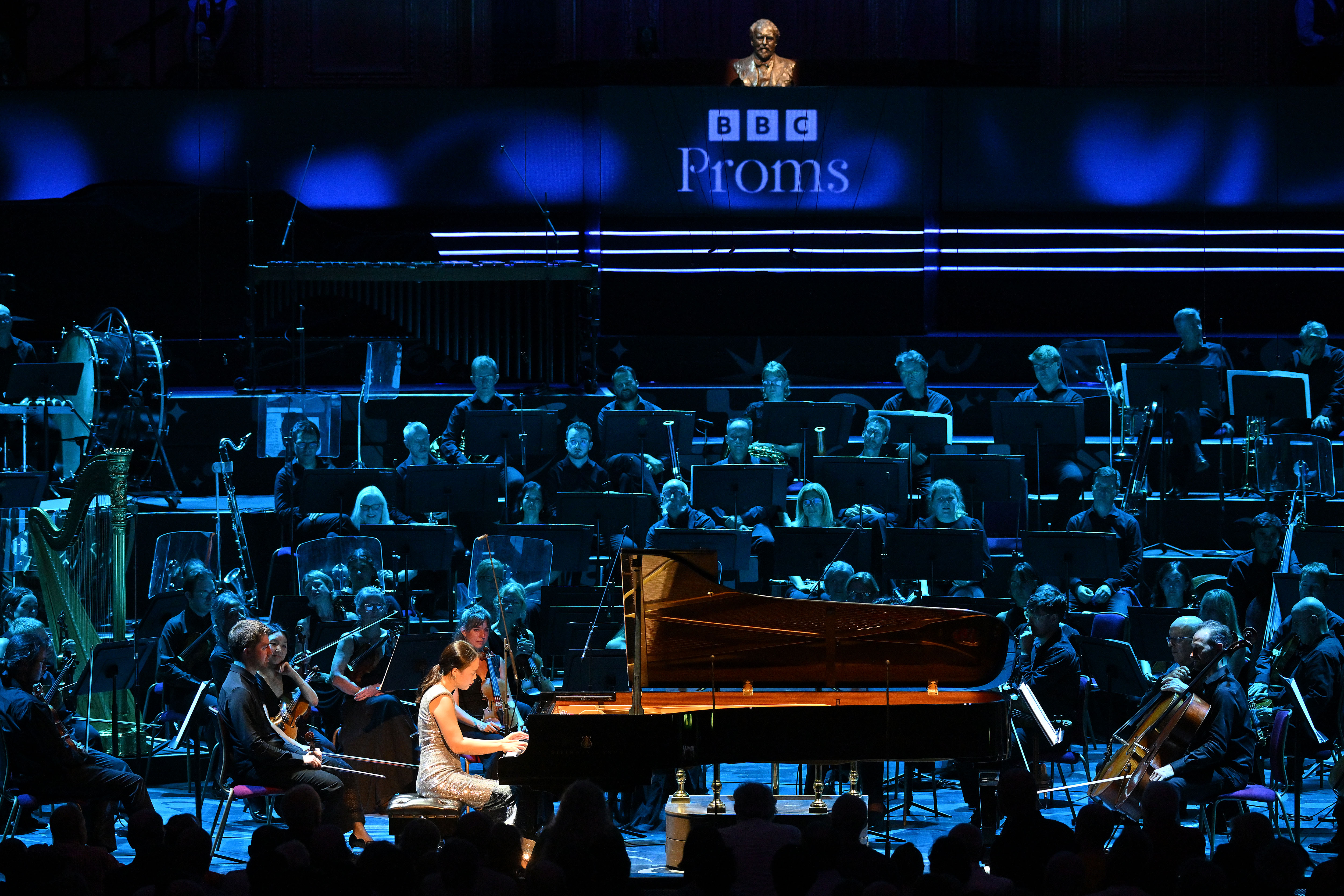
There’s no question that art can show the best and the worst in humans. May this concert serve as a fair example of that. I’m not talking about its message or emotional reading. What I’m referring to is how greatness and banality stood on the same stage, hand in hand.
Fortunately enough, the latter was promptly banished, but its ineptitude still haunts me to this day — nearly a week after attending the concert. It’s a most interesting case; curious, if you prefer. A sensational orchestra, an exquisite pianist, and an astounding repertoire — that is, except for its maladroit first half.
I’ve been very close to lowering the rating just because of this work. But it would be unfair to let its mediocrity tar the reputation of far more accomplished artists. Yes, Wynton Marsalis — it is you that I’m alluding to. His so-called Concerto for Orchestra, which had its UK premiere at his Prom, appropriately titles its final movement “Say What?”. That’s a very accurate description of my reaction all across it. Because I can’t believe I was listening to something so trite.

It’s not a good composition. Not only does it lack the slightest distinctiveness in its sound, but it’s also extremely second-rate as a pastiche creation. With a sound that borrows too much from Leonard Bernstein, the piece is empty on every level. There are no proper motifs, no melodiousness, no sense of journey, no sentimentality of any sort, and no compelling structure.
At best, it is a cheap knockoff of Britten’s Young Person’s Guide to the Orchestra, as it capriciously focuses on different sections and refuses to go anywhere from there. And in the end, it comes across as a bog-standard experiment by somebody with next to no originality or artistic instinct.
I will take a deep breath now, and my joy shall be restored by remembering the wonders Act Two mesmerised viewers with. George Gershwin’s kaleidoscopic Piano Concerto came to life to rapturous applause — a feat both conductor James Gaffigan and soloist Yeol Eum Son can take solid credit for.
Son’s execution brimmed with delicacy and precision. For the most part, Gershwin’s classical patterns and jazz-infused textures were intricately interlaced in an almost uninterrupted display of technical refinement and occasional bravura. Although some segments could benefit from clearer phrasing, her overall prowess is undeniable — ultimately honouring the composer’s legacy in a way that can only be described as rhapsodic (pun intended).

To a greater extent, Gaffigan demonstrates exceptional command and understanding of every piece he picks up the baton for, to the point that even Marsalis’s insipid concoction came out far more soulful than what’s written on the page. As such, his interpretation exhibits a degree of expressiveness that’s nearly cathartic, underpinning the spiritedness of Gershwin’s opus as well as Samuel Barber’s yearning Symphony No. 1.
I can forgive, but I can’t forget. Although maybe I should this time. Their interpretation should be reason enough. In the end, beauty overtook plainness, and greatness overcame commonplaceness. There was excellence to be enticed by. And sometimes, it was enthralling. Perhaps, starting with an inferior work is nothing but a cunning strategy to make the next more appetising. If so, they’ve hit all the right keys in more than one way.
Help us continue our work
We count on your support to keep bringing the greatest quality in theatre-related content, from interviews with the biggest names in the industry to reviews of every show in town and beyond.
We appreciate every donation to maintain our high pace and standards and continue to grow.
Thank you for believing in us!
***************************************************
All pictures credit to Mark Allan.
The 2026 BBC Proms play at London’s Royal Albert Hall until 12 September. Tickets are available on the following link.