
I’m all down for a good old English farce. And probably no other stock-character duo embodies that quintessence better than an idle gentleman and his dry, quick-witted valet. With that in mind, P. G. Wodehouse’s revered creation would have got me in stitches. Or more appropriately, a subtle smirk and an ironic laugh as tradition requires. It’s been the case, but not to the extent I would have imagined or hoped for. And although there is a lot to praise, I’m curious if my mild disillusionment is because its humour wasn’t really my cup of tea or because it could actually be funnier.
Satire comes in many forms. But as with many, Jeeves is the kind of comedy that requires the same level of physical and intellectual punch. Sharp remarks, eccentric personages, and a fair amount of horseplay are the key elements that forge the piece and keep it going. And that’s precisely, sir, what the script does. Yet, as much as its execution is flawless for what it is, I find its ambitious approach compromises several comedic possibilities.

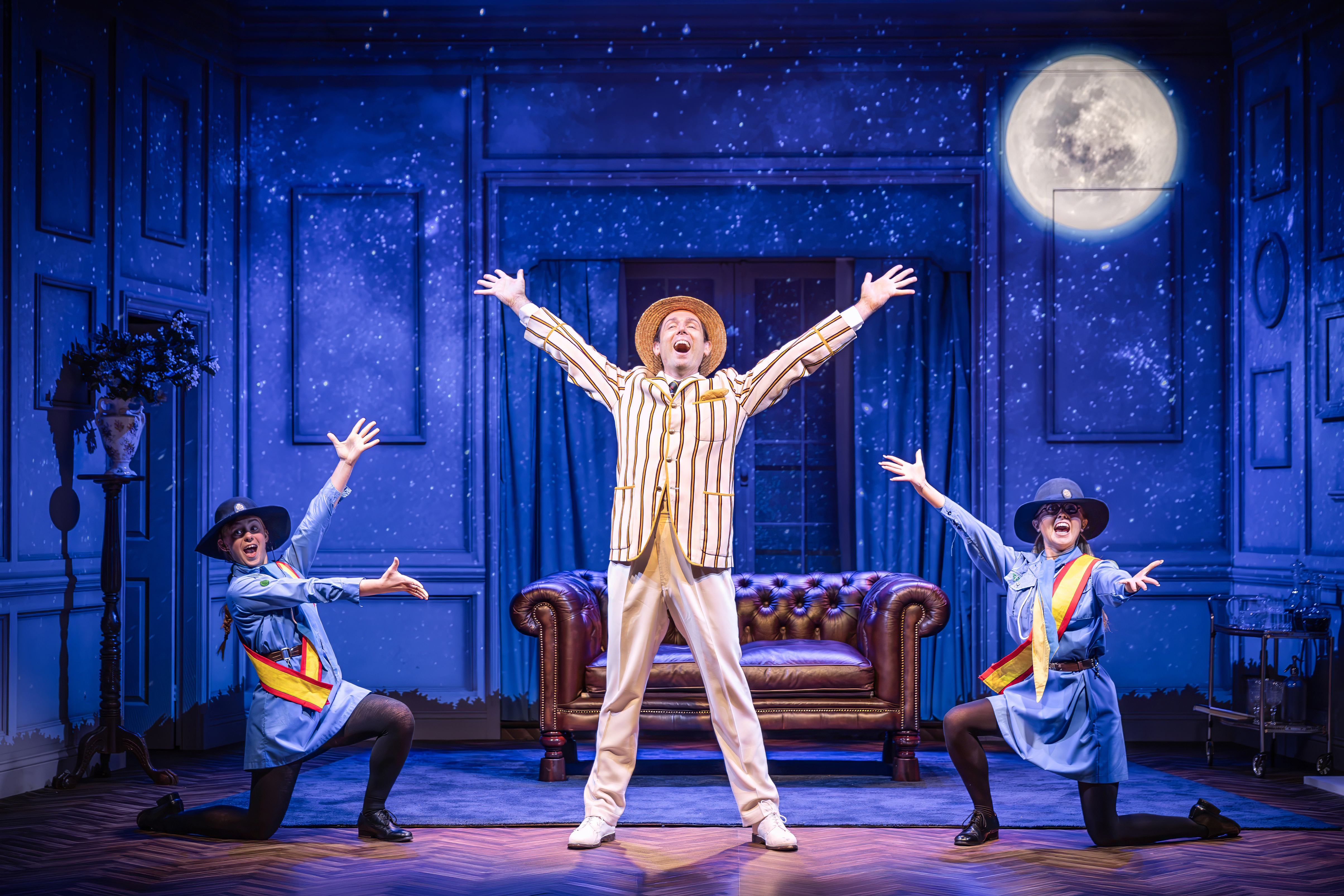
There is no question that actor Sam Harrison delivers an impeccable performance in every single role. He can be both Jeeves and Bertie — and an endless roster of characters comprising neurotic fiancées, lispy boarding school students, and every imaginable unbearable aunt in the book. Every portrayal brims with unparalleled stamina and flaunts exceptional timing. But it’s not enough to make the drollery effective. And perhaps the show’s one-man nature is the problem.
Harrison demonstrates an uncanny ability to instantly switch from one role to another, despite some occasional mixups, but some moments come across as corseted and slightly squandered. The issue stems from an absence of interaction during segments where the drollery relies entirely on it. Whether it’s a look, a gasp, or simply an awkward silence, the fact that nobody else is around makes the joke difficult to land. And although Harrison’s strenuous efforts are compelling, we can’t help but feel that something is missing.
The narrative is entertaining for the most part, but not every plot is as gripping. There is chaos all around, but a story involving the goofy theft of an elderly relative’s salacious memoirs comes out more amusing than a clueless, improvised speech at some random boarding school. Each to their own. In any case, director Hugh Wooldridge does a wonderful job of keeping the energy high through visually evocative blocking and brisk pacing.

The staging is immaculately put together. Caite Hevner’s design is clever and dynamic. An Edwardian mansion seamlessly transforms into different settings through elaborate projection mapping, resulting in a simple yet fluid, varied, and transporting scenography, which is deftly underpinned by Tim Mitchell’s intricate, colourful, and exceedingly atmospheric lighting.
There is an audience for it. And even those who don’t fit that profile will likely appreciate its craftsmanship. As such, Jeeves Takes Charge might need some extra help to win the house over and eventually exploit its full potential. It’s enjoyable but not a bally gem, I say. Fortunately, it’s just a few corrections away from being considered very good, sir.
Help us continue our work
We count on your support to keep bringing the greatest quality in theatre-related content, from interviews with the biggest names in the industry to reviews of every show in town and beyond.
We appreciate every donation to maintain our high pace and standards and continue to grow.
Thank you for believing in us!
***************************************************
All pictures credit to Craig Fuller.
Jeeves Takes Charge plays at London’s Charing Cross Theatre until 6 September. Tickets are available on the following link.