
It flopped on Broadway. No wonder why. The reason has nothing to do with Americans not understanding the struggles of working-class Britons. The show is just bad. Terribly bad. From a sluggish plot devoid of grip and poignancy to a clueless, nondescript score, there are no redeeming features (or even a speck of adequacy) in Sting’s failed theatrical endeavour.
Set in the songwriter’s hometown and inspired by his own childhood memories, the story depicts the revolts of 1980s North England shipbuilders, whose jobs were put at stake following Thatcher’s deindustrialisation campaign. It’s a promising premise for a drama. It’s not groundbreaking (Billy Elliot portrayed a similar situation with the miners), but with enough potential to become a soul-stirring piece. It isn’t. And the disappointment is twice as big as the subject of its title.

Sting would have benefited from some musical theatre writing lessons before getting on with it. His compositions are as oblivious as they are clunky. There’s a basic notion everyone should understand about book musicals: the personages don’t need to sing about every single thing they talk about.
If the topic isn’t powerful enough to make plain words unfulfilling, it’s not worth the effort of turning into a number. Simple as that. Sadly, we are presented with the exact opposite: pointless, interminable songs that focus on the wrong themes and do next to nothing to move the plot along or provide character depth.
They could still have a pass if the melodies were at least tuneful, but even that feels like a luxury in this show. For the most part, the songs are pedestrian and insipid. They rarely enhance or even capture the emotion of the moment. And Sting’s compositional methods are often childish, predictable, and misguided, overusing compound signatures and carrying a nostalgic, suave undertone in sections that require the contrary effect.

The lyrics are even poorer. When they’re not prosaic and frivolous, they are painfully idiotic. The ship-related puns are excruciatingly clumsy, and the examples never run dry: capitalism flows like water; the Ship of State; the ship has sailed. For nearly three hours, we are drowned in a sea of stilted, superficial verses bereft of any poetic craftsmanship.
The coup de grâce is found in their lazy, heavy-handed rhymes: “I will prolong my life / if I succumb to the surgical knife”. Or a personal fave: “appointed/disappointed”, which vividly summarises how much thought and expertise is put into the whole thing.
The script misses the mark in making audiences care about the characters or what is happening. The story involves parental reunion, high romance, political fighting, and even the death of one of its protagonists. Yet, it generates an impassive reaction. There is no pathos. Every plot turn is formulaic and artificially melodramatic. And even by those standards, nothing rocks the viewer’s boat.

Sting’s performance is underwhelming. So is Shaggy’s, whose ethereal role as the Wallsend Ferryman is awfully underwritten and feels rather unnecessary. Sting’s pitch shortcomings are too frequent and noticeable, just like his inability to act convincingly. In that regard, Frances McNamee delivers a more competent portrayal, but her vocals are far from flawless — too much sweeping and not the best placement in several segments.
Both Jackie Morrison and Hannah Richardson stand out as the strongest lead cast members, especially on a musical level. The same praise applies to the ensemble, except for Adam Strong, whose unbelievable, high-pitched acting verges on an amateurish caricature.
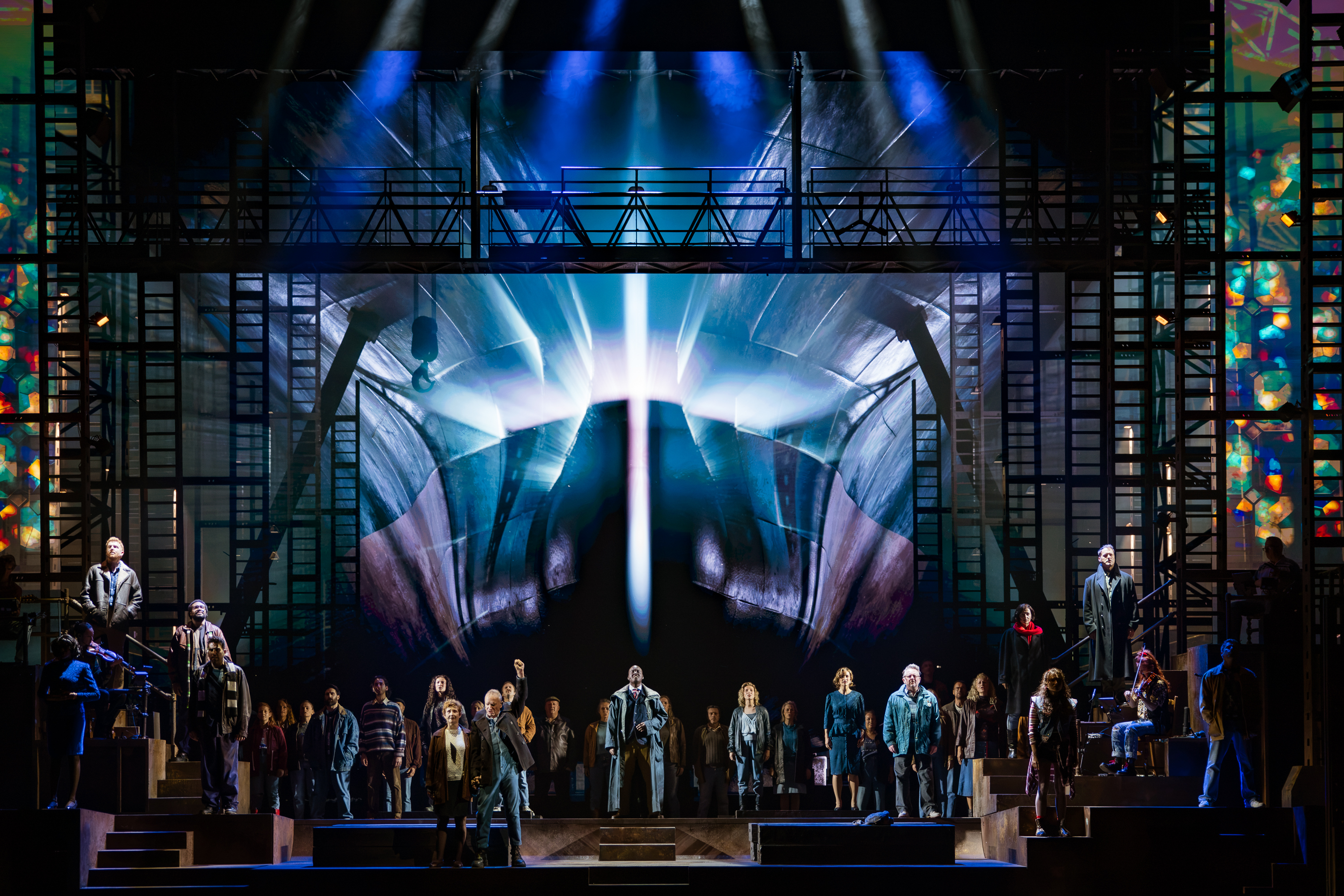
Some acknowledgement should be given to the staging, which is fairly opulent and striking. A massive screen displays a hyperrealistic animation of an under-construction ship — so intricate and well-lit that it sometimes fools the eye into thinking it’s a practical set. Side scaffolds, an overhanging platform, and a few additional props complete the scenery, resulting in a dynamic, versatile, and somewhat spectacular array of visuals.
The ship has sailed, and there’s nothing we can do about it — other than, perhaps, avoid getting onboard. There’s no point in taking a voyage when its itinerary is doomed, especially if the wreck is so blatantly imminent. The Last Ship can’t stay afloat, let alone make port. Suffice it to say, it’s hardly a pier-fect musical.
Help us continue our work
We count on your support to keep bringing the greatest quality in theatre-related content, from interviews with the biggest names in the industry to reviews of every show in town and beyond.
We appreciate every donation to maintain our high pace and standards and continue to grow.
Thank you for believing in us!
***************************************************
All pictures credit to Nienke de Groot.
The Last Ship plays at London’s Theatre Royal Drury Lane until 3 October. Tickets are available on the following link.